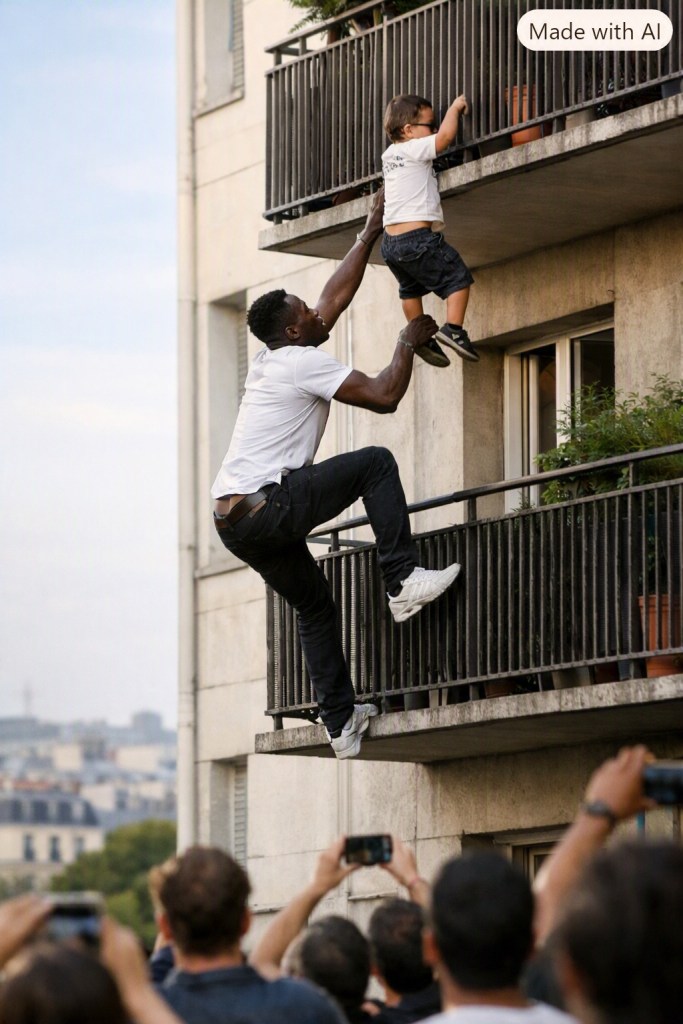
Mamoudou Gassama — a 22‑year‑old undocumented Malian migrant — scaled four storeys of a Paris building in roughly 30 seconds to save a dangling four‑year‑old child, an act that turned him overnight from an invisible migrant into a national hero.
On 26 May 2018, crowds in the 18th arrondissement watched a child hanging from a fourth‑floor balcony. The boy had been left alone while his father went out; investigators later found he’d delayed returning because he stopped to play Pokémon Go.
Gassama, passing by, didn’t hesitate. He grabbed the first balcony, hauled himself up with explosive pull‑ups, and repeated the movement floor by floor. Witnesses shouted “Allez, vas‑y, vite!” as he climbed. In about half a minute, he reached the child and lifted him to safety.
Gassama had been in France for about eight months without legal papers, living quietly in Montreuil and working construction jobs.
The rescue went viral globally within hours. Paris’s mayor called him “Spider-Man of the 18th.” President Emmanuel Macron invited him to the Élysée Palace, awarded him the Médaille d’honneur pour acte de courage et de dévouement, and announced he would be granted French citizenship.
He was offered a place with the Paris fire brigade — a poetic twist, given he’d just performed a firefighter‑level rescue as an undocumented migrant.
Gassama’s act landed in the middle of heated debates about migration in France. His courage forced the public to confront the humanity behind the label “undocumented.” He became a symbol of both migrant resilience and the contradictions of immigration policy.
The father faced criminal consequences for leaving his four‑year‑old son alone, and the courts treated the incident as a serious case of parental negligence.
He received a three‑month suspended prison sentence and was ordered to complete a parenting course.
One man climbed four storeys in 30 seconds. Our lot in the UK need a breather halfway up the kerb.
Gassama’s act wasn’t about fitness or nationality — it was about instinct, courage, and zero hesitation. Most people, regardless of shape or swagger, freeze. He didn’t.
Mamoudou Gassama’s courage shows he was brave, fast‑thinking, and selfless. It doesn’t prove migrants as a group are “good,” just like one criminal doesn’t prove migrants as a group are “bad.”
That’s the trap people fall into — judging millions by the behaviour of one.
Of course it felt like a counter‑punch to the stereotype. A young undocumented man, no papers, no safety net, no status — and he’s the one who climbs a building like a firefighter to save a child while everyone else freezes.
It’s a reminder that human beings are complicated, and you can’t sort them into neat boxes of “good” and “bad” based on where they were born.
I wasn’t trying to make a political statement. I was reacting to a human moment: a man everyone would normally overlook did something extraordinary, and it naturally challenges the lazy stereotypes people throw around.
That’s not “political hijacking.” That’s just basic humanity.
One man saved a child. That tells you something about him, not about his immigration status.

