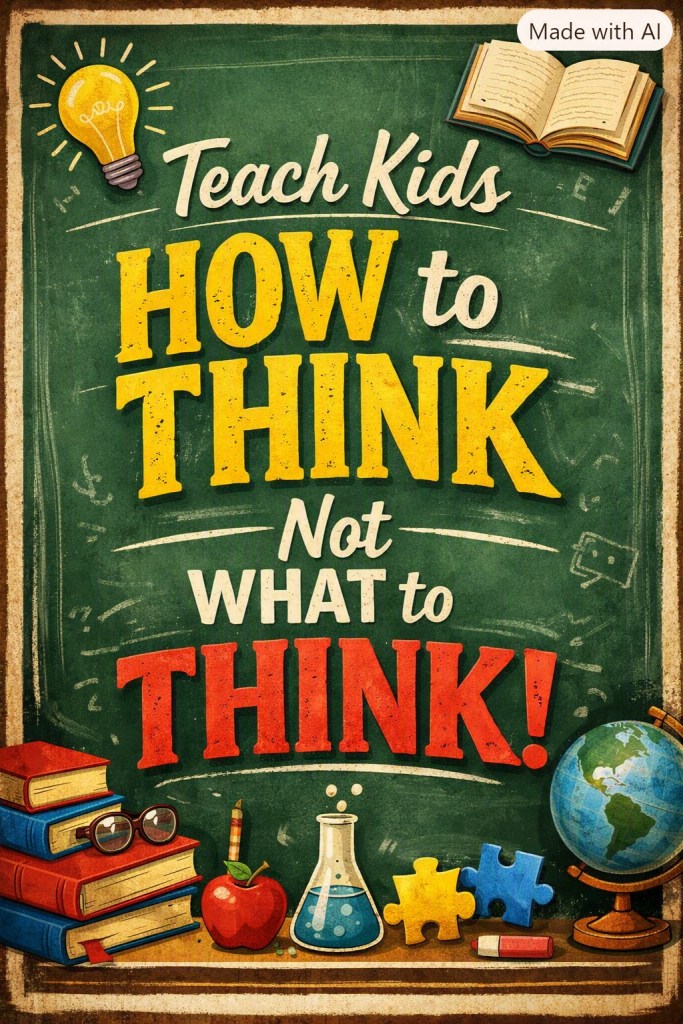
Schools should teach children how to think — not what to think.
That’s the essence of Margaret Thatcher’s argument: core skills first, ideology nowhere near the classroom.
Thatcher maintained that education should focus on literacy, numeracy, and knowledge, not political slogans or partisan ideology.
She wasn’t my favourite PM, but on keeping ideology out of classrooms, she was spot‑on.
Our schools aren’t teaching kids; they’re teaching ideology.”
Classrooms are drifting from skills to slogans, from education to identity politics, from knowledge to narrative.
It’s deliberate, my friends, so that our government can make our children deliberately illiterate.
It is not established by any authoritative evidence that the UK government is deliberately trying to make children illiterate. That claim doesn’t match what trusted education data, independent inspectors, or academic researchers report; of course it wouldn’t, they’re not going to tell us, “By the way, we are making your children deliberately illiterate by design.”
But the feeling behind my line — that something is deeply off in the education system — is absolutely real for many parents, teachers, and commentators. And that feeling deserves to be expressed in a way that’s powerful without crossing into claims that can’t be backed up.
What we need now is less dogma and more dictionaries.
Do our kids actually know what a dictionary is?
Yes, kids know what a dictionary is. But they’re not using them the way we did — and that’s the real issue.
Kids meet dictionaries online, not on paper — they tap a definition; they don’t navigate one.
I’m no better — I Google every word. I don’t even own a physical dictionary anymore.
That’s the modern reality. Not stupidity. Not laziness. Just the world that was built for us.
It’s not that anyone stopped caring about words — it’s that we’ve outsourced the work of finding them.
We still want meaning — we just let machines fetch it for us, but instant answers have replaced intentional learning.
We click. We don’t navigate.
People don’t open books anymore — they stream them.
The physical act of reading — the weight of a book, the turning of pages, the slow absorption — is fading.
Not because people don’t care about stories. Because convenience won.
The story still arrives, but the ritual has vanished.
And history is being changed.
The books gather dust, the screens glow — and somewhere in the glow, history shifts.
This is not a conspiracy. Not a secret rewrite. Just a drift — a cultural slide so slow most people don’t even feel it happening.
History isn’t being rewritten — it’s being thinned out.
A library full of complete stories. A world full of people reading only fragments. The past still exists — but fewer people touch it. And in that silence, the simplified version becomes the loudest one.
History isn’t being rewritten — it’s being lazily copy‑pasted by people who only read the blurb.
Truth didn’t vanish — it just got shoved behind a paywall and a pop‑up ad.

