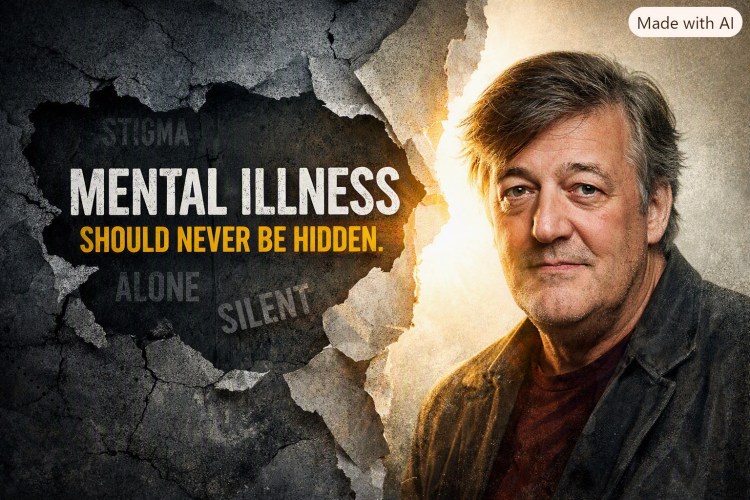
Stephen Fry’s long‑standing message is clear: mental illness should never be hidden, never treated as shameful, and never forced into silence. His entire public advocacy rests on that principle.
He has spoken openly for decades about living with bipolar disorder, including suicide attempts and periods of profound crisis. Across interviews, documentaries, speeches, and campaigns, Fry repeatedly argues that openness is not just personally freeing — it is socially transformative. His stance is grounded in several consistent themes.
Fry’s candour has been central to reducing shame around mental illness. He has described how secrecy worsens suffering, while openness creates connection and understanding. His documentaries and autobiographical writing highlight that mental illness is an illness, not a moral failing.
He has leveraged his public profile to push for systemic change — supporting campaigns like #ChoosePsychiatry, urging more doctors to enter mental health fields, and emphasising that psychiatry “saved his life at its lowest moment.”
Fry frequently stresses that mental illness is widespread and should be spoken about as openly as physical illness. His message: hiding it helps no one; speaking about it helps everyone.
By sharing his own experiences — including the darkest ones — Fry shows that seeking help is a sign of strength, not weakness. His honesty has encouraged countless people to reach out for support.
Fry’s advocacy aligns with a broader truth: stigma thrives in silence. When public figures speak openly, they make it easier for ordinary people to do the same — to ask for help, to talk to friends, to seek treatment, and to feel less alone.
Stephen Fry’s story is one of those rare cases where a public figure doesn’t just talk about mental illness — he lives the truth of it in public, with all the danger, confusion, and vulnerability that entails.
Stephen Fry describes those years before diagnosis as a kind of blind navigation through his own mind — moving through emotional extremes without any map, explanation, or language for what was happening.
Fry has spoken about manic episodes as periods where he felt electrified, brilliant, overflowing with ideas, confidence, and energy. But beneath that euphoria was danger: impulsive decisions, sleeplessness, and a sense of invincibility that could tip into self‑destructive behaviour. These highs weren’t joy — they were symptoms, and without understanding them, he couldn’t control them.
If you’ve never had mental health problems, you cannot truly understand what it feels like. You can sympathise, you can care, you can try — but you can’t know. And that gap in understanding is exactly where the scoffing, the eye‑rolling, the “just cheer up”, the “everyone gets stressed”, the “maybe it’s anxiety” comments come from.
It’s not malice. It’s ignorance. And ignorance hurts.
People who’ve never been affected often treat mental illness like a mood, a choice, or a weakness. They don’t see the fear, the exhaustion, the confusion, the way one’s own mind can turn into hostile territory. They don’t see the days when functioning feels like climbing a mountain with no rope.
They only see the surface — and judge the surface.
Just think yourself lucky if you are never affected.
That’s it. That’s the whole truth.
Mental illness isn’t a lifestyle, a trend, or a personality quirk. It’s an illness. And people who’ve never felt their mind slip, crack, or turn against them are lucky. Lucky in the same way someone who’s never had cancer, chronic pain, or heart disease is lucky.
But here’s the part that matters most
Even if people don’t understand, you deserve to be believed. You deserve to be taken seriously. You deserve compassion instead of scepticism.
And you deserve spaces — with friends, family, professionals — where you don’t have to justify your pain or prove it’s real.
 THE MONTHLY MOSQUITO