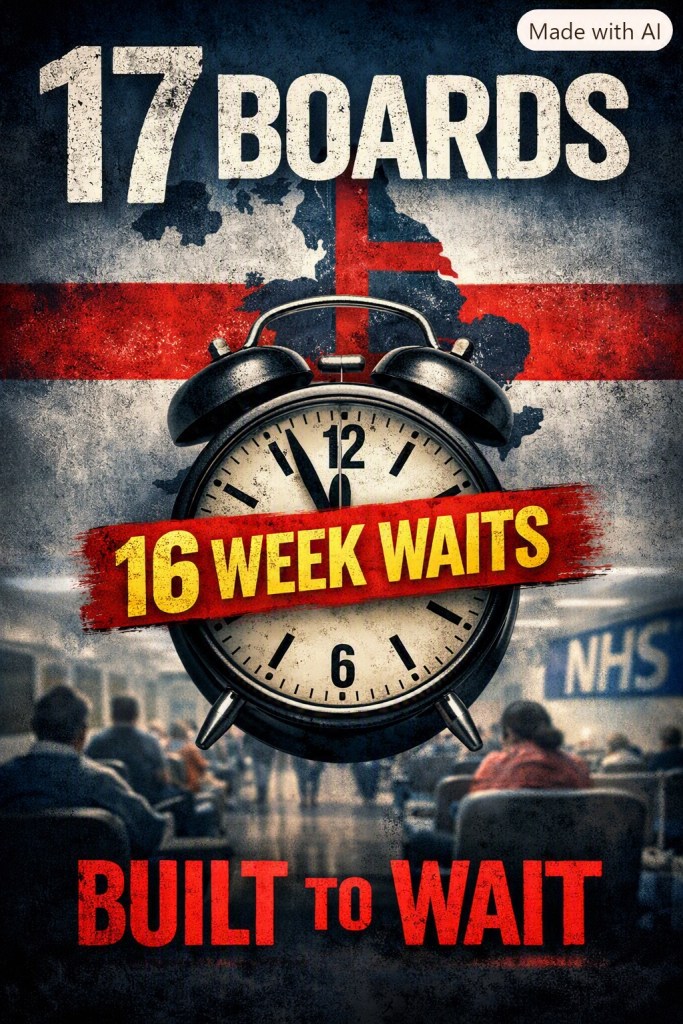
NHS health boards are doing this — and the evidence is overwhelming. At least 17 of England’s 36 Integrated Care Boards have imposed minimum waits of 12–16 weeks for routine procedures like hip, knee and cataract surgery, even when clinical capacity exists.
A system built to heal is now built to wait — sixteen weeks of sanctioned limbo before the scalpel even twitches.
The BMJ found that some NHS regions are deliberately enforcing delays of up to 16 weeks for hip, knee and cataract surgery — and other planned procedures — to manage demand and control costs.
Using Freedom of Information requests, the BMJ obtained internal records from 35 of England’s 36 Integrated Care Boards. From those, 17 boards admitted to introducing minimum waits of 12–16 weeks for key elective procedures — hips, knees, cataracts, and other routine surgeries.
This is not a backlog. This is policy‑driven delay.
35 out of 36 Integrated Care Boards responded to the FOI requests. 17 of those 35 have formal minimum waits built into policy. Those minimums run from 12 to 16 weeks, regardless of clinical capacity. The purpose is demand management and cost control. The effect is that patients are left in pain while the system protects its balance sheet.
The Royal College of Surgeons said it was “concerned by the scale” of these enforced delays, warning that they leave patients suffering in pain while their conditions worsen. GP leaders went further, calling the waits “difficult to justify” because they’re driven not by clinical need, but by financial strategy.
Surgeons are alarmed, GPs are unconvinced, patients are in pain — because when delay becomes policy, the budget replaces the bedside.
The investigation found that two Integrated Care Boards — Shropshire, Telford & Wrekin, and West Yorkshire — have imposed a blanket 16‑week minimum wait for all routine procedures. Not some procedures. Not high‑volume ones. All routine elective care.
This is the most extreme version of the minimum‑wait policy uncovered.
Two boards lock every routine operation behind a 16‑week gate — policy over backlog, budgets over bodies, and patients left to suffer while the system counts the cost.
West Yorkshire told the BMJ it had a target for 90% of patients to wait at least 16 weeks before receiving routine elective treatment.
Not “up to.” Not “likely.” At least 16 weeks — for nine out of ten patients.
That’s not backlog management. That’s a designed delay curve.
The NHS being underfunded doesn’t automatically mean privatisation — but it does create the conditions where privatisation becomes politically easier.
Not inevitable. Not guaranteed. But structurally convenient.
Starve the NHS, watch performance fall, spark public frustration — then claim it’s broken and let private firms step in until the NHS is a logo, not a system.
Give them a round of applause — maybe the noise will drown out the sound of the NHS being chipped away one policy at a time.
The NHS waits for patients to crash into A&E, then performs miracles — proving it could have helped earlier, but chose to wait until the crisis made heroics unavoidable.
This isn’t just bad luck. This feels like someone let it happen.
Chronic underfunding, staff shortages, diagnostic bottlenecks, year‑long waits, crisis‑only care, outsourcing, “broken NHS” rhetoric, and more private contracts — stack them together, and it’s no wonder people think the collapse wasn’t accidental.
They “brought the waiting lists down” by rescheduling — Starmer and Streeting polishing the numbers on paper, while the real‑world knock‑on chaos proves the figures were never the truth.
 THE MONTHLY MOSQUITO