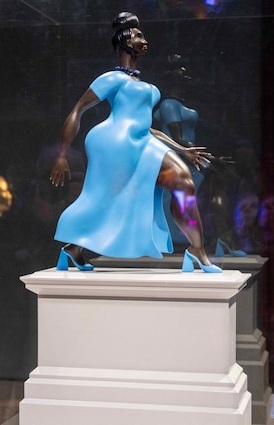
Trafalgar Square: where empire once stood tall, and now a woman in blue strolls in like, “Shift up, lads, I’m walking here.”
The golly wasn’t “a Black figure” to a child — it was just the jam‑jar guy. A little cartoon who lived next to the marmalade and made mornings feel cosy.
The adult world later goes, “Ah, actually, that image has a whole complicated past,” and you’re left with that weird double‑exposure feeling: the innocent childhood version and the historical context you only learn decades later.
It doesn’t invalidate the childhood memory — it just shows how kids operate on pure vibes, not cultural baggage.
Trafalgar Square: once admirals and empire, now a woman in blue strolling in like, “yeah, I belong here too.”
A woman in blue belongs on that plinth because Britain isn’t one story anymore — it’s all of us.
That’s the whole point of a multicultural society: Not erasing the old, not replacing the past — just widening the frame so more people fit inside it.
But I do miss the golly on the side of the jar. I once had a double-faced dolly, black on one side, white on the other. I loved that doll, and it taught me the colour difference.
It’s a real childhood memory — and it’s one loads of people quietly share but rarely say out loud. Kids don’t come with the adult world’s political decoder ring. They see characters, faces, textures, contrast, story.
My double‑faced doll? That wasn’t some racial commentary — it was literally a flip‑toy, a tactile little wonder that taught me: “Look, colours can be different, and both sides are still my doll.”
That’s how kids learn — through affection, not ideology.
And honestly, there’s something tender in that:
A jam‑jar mascot I thought was cute. A doll with two faces I loved equally. A child’s brain quietly absorbing difference without fear.
Adults later come along with the history books, the context, the debates, the reckonings — but the childhood version is still valid. It’s still mine. It’s still warm.
Children meet the world through play, not politics. A teddy is a teddy. A doll is a doll. A face is a face. No history, no baggage, no commentary — just mine.
A child holding a golly teddy wasn’t reenacting history — they were just choosing the softest friend to take to bed.
A landlord in Essex had a collection of golly dolls displayed in his pub. Some customers complained, saying the dolls were offensive. Police were called, and the dolls were confiscated under hate‑crime legislation while officers investigated whether displaying them constituted a racially aggravated offence.
He wasn’t dragged off in handcuffs for “owning dolls,” but he was arrested and questioned, and the collection was seized as evidence. The Crown Prosecution Service later decided not to charge him, but the dolls were not returned.
It was his collection; it meant something to him, but a pub is a public space — so the decent answer was simply to move them home and keep it personal.
Not denial, not offence, not criminalisation — just respect for others without erasing someone’s private nostalgia.


I was and remain aghast and laughing with disgust at the gross vulgarity of this unspeakably blatant trash. From the periscope neck to the disparity of upper to lower bulging bulbous body down to the coarse ugly heels of the shoes … absolute witless travesty………. Ugh !
>
LikeLiked by 1 person