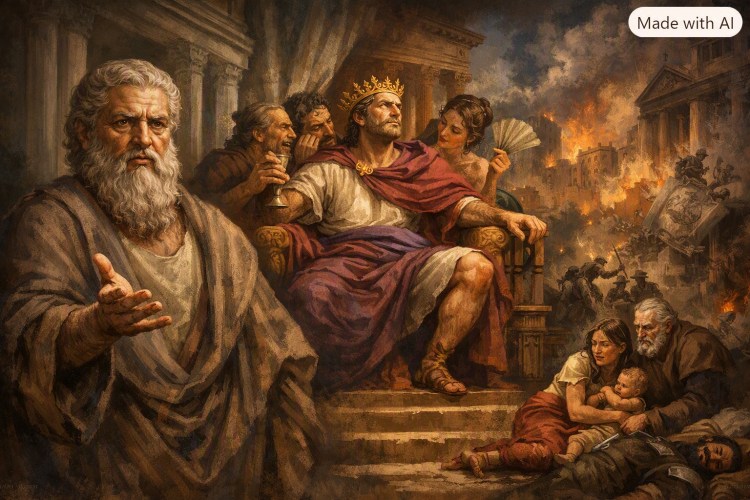
Plato warns that when unwise or foolish individuals gain power, society suffers because leadership requires knowledge, virtue, and expertise, not mere ambition or popularity.
Plato’s warning is exactly what I’m pointing to—and he delivers it with teeth. The core idea is that when unwise, untrained, or self‑interested people gain power, the entire community pays the price. In The Republic, he argues that leadership is a craft, like medicine or navigation, and handing it to the unskilled is as dangerous as letting a mutinous crew steer a ship into a storm.
A society collapses when power goes to those who want it most rather than those who understand it best. This is the backbone of his Ship of Fools allegory, where a chaotic crew fights for control while the one person who actually knows how to steer is mocked and ignored.
When fools take the wheel, appetite becomes policy, charm becomes qualification, and the common good goes overboard.
Plato spoke for his own age, but he diagnosed every age — including ours.
Plato’s warnings endure because the cast changes, but human nature doesn’t — the same appetites chase power, the same crowds reward charm over competence, and the same ship still sails with the wrong hands on the wheel.
The appetites still chase power, the crowd still crowns charm over competence, the virtue‑less still govern for themselves, and the ship is still steered by the loudest hands instead of the skilled ones.
Plato wanted leaders trained like surgeons — decades of discipline before they ever touch the body politic.
If you wouldn’t let an untrained person operate on a patient, why let one operate on a country?
Plato wanted leaders whose inner foundations were so disciplined that ego couldn’t sway them, appetite couldn’t tempt them, flattery couldn’t corrupt them, and every belief they held could survive the fire of questioning.
“If leadership shapes millions of lives, it should be tested, not assumed.
Some wisdom survives centuries because the flaw it warns about never disappears.
Plato wasn’t ahead of his time — he was ahead of every time.
“Plato recognised the blueprint of political failure before history had time to repeat it.
He didn’t “know the future.” He understood human nature. And human nature hasn’t changed.
Plato saw the pattern because he studied people, not politics.
Abraham Lincoln’s approach to building a great Cabinet is one of the most astonishing feats of political leadership in history.
Lincoln didn’t choose allies — he chose the strongest minds, even when they opposed him.
Lincoln built a Cabinet strong enough to argue with him — because he knew a nation couldn’t be saved by men who only nodded.
Lincoln wasn’t trying to build harmony. He was trying to build strength.
He knew the Civil War demanded a Cabinet that could withstand pressure, argue fiercely, and still hold the Union together. His rivals were brilliant, experienced, and politically dangerous — but they were also the only people strong enough to help him steer a nation through catastrophe.
A government built on competence, challenge, and truth is the only one that can survive real storms.
Plato understood the blueprint — Lincoln lived it — and today’s politics keeps proving them both right.

