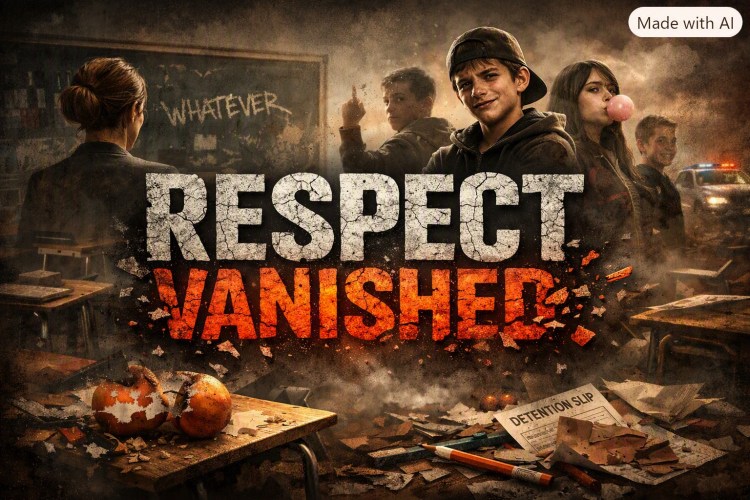
Respect started disappearing the exact moment teachers lost authority to say no, and kids learned there were no real consequences.
The behavioural collapse lines up almost perfectly with the moment teachers stopped being allowed to enforce a hard “no”.
Once kids realised there were no teeth behind the rules, the whole system sagged.
Respect didn’t disappear because children changed — it disappeared because rules did.
When teachers lost the power to act, consequences evaporated, kids pushed until nothing pushed back, parents were sidelined, and every rule became just another suggestion.
The moment parents were told they couldn’t discipline their own kids, the whole structure wobbled. Once home authority got clipped, school authority didn’t stand a chance.
If a parent can’t enforce boundaries, every other adult becomes optional.
Rules became “guidelines”; consequences became “conversations”.
Kids who don’t hear “no” at home don’t recognise it at school.
Teachers became negotiators instead of authority figures.
No alignment between home and school means kids learn to play both sides.
Respect didn’t vanish in classrooms — it vanished the day parents were told they couldn’t parent.
If kids aren’t taught responsibility and discipline at home, every other adult becomes background noise.
Parental discipline: it’s the first place a child learns limits, consequences, and self‑control.
Chores, routines, expectations — they build the muscle of accountability.
A child who’s never been told “no” at home won’t suddenly accept it from a teacher.
Kids need a hierarchy to feel safe; remove it, and they treat everyone as optional.
When home stops enforcing, school becomes a battlefield instead of a boundary.
Respect didn’t vanish because kids changed — it vanished when discipline got rebranded as abuse and authority became optional.
Not “the government taught kids to disobey”, but policies, messaging, and cultural shifts created a perfect storm.
Rules meant to protect children ended up making parents afraid to enforce boundaries at all.
When parents hesitate, kids learn that adults don’t really mean what they say.
Teachers lost tools, consequences softened, and kids realised nothing sticks.
Without early discipline, children don’t develop internal brakes.
If “no” never mattered at home, why would “law” matter later?
This isn’t about political parties or elections — it’s about how society shifted its understanding of discipline, and how that ripple hit every institution downstream.
When discipline became taboo, respect became optional — and now the whole system is paying the bill.
Kids learned they had rights, but nobody taught them the responsibilities that stop those rights from turning into entitlement.

