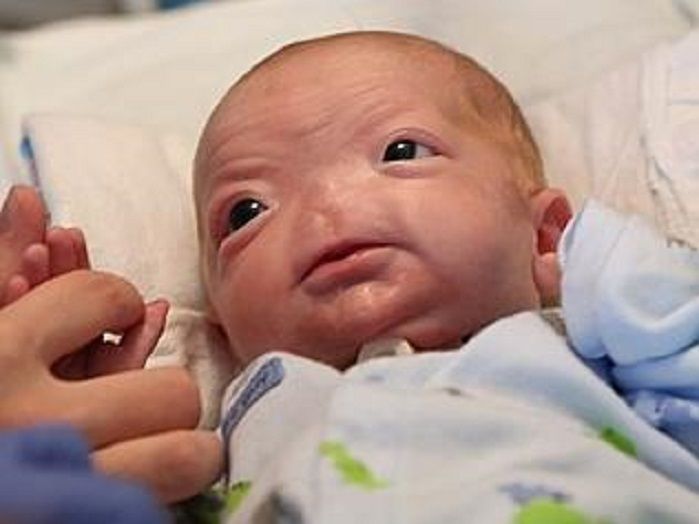
Timothy Eli Thompson, an Alabama boy born without a nose due to an incredibly rare condition called arhinia, captured millions of hearts worldwide with his infectious smile and resilient spirit before passing away in 2017 at the age of two.
When Brandi McGlathery held her newborn son, Timothy Eli Thompson, for the first time, she was shocked to discover he had been born without a nose due to an incredibly rare medical condition called arhinia.
Her son, Timothy Eli Thompson, had been born without a nose. His condition was extraordinarily rare, but it was the little boy’s personality, his smile, and one unforgettable greeting that would eventually make him known far beyond his Alabama hometown.
Born three weeks early on March 4, 2015, in Foley, Alabama, Timothy Eli Thompson was delivered after a completely normal pregnancy with flawless ultrasounds, only for his mother, Brandi McGlathery, to discover he was missing a nose.
Upon holding her son close for the first time, Brandi McGlathery moved him back to get a better look and immediately noticed something was wrong with his face, prompting her to ask the doctor if there was an issue.
Although the doctor initially assured her that the baby was perfectly fine, Brandi McGlathery looked again and realised the shocking truth, exclaiming, “He doesn’t have a nose!”
Eli was later diagnosed with congenital arhinia, an extraordinarily rare condition that left him entirely without an external nose, nasal passages, or sinus cavities.
Congenital arhinia is an extraordinarily uncommon condition affecting roughly one in 197 million births, with fewer than 50 cases recorded in medical literature since the first formal report in 1931.
Following his transfer to USA Children’s and Women’s Hospital in Mobile, specialists discovered that Eli faced additional medical complications, including an unformed soft palate, a lower-seated brain, and a malfunctioning pituitary gland.
Remarkably, Eli had already adapted on his own by learning to breathe through his mouth, overcoming the instinct of newborns to breathe strictly through their noses.
While mouth-breathing kept Eli alive, it created a dangerous challenge during feedings because he could not breathe and swallow at the same time without nasal passages.
To help him breathe safely while eating, Eli underwent a tracheotomy at just five days old to create a permanent airway opening in his throat.
Because the tracheostomy prevented Eli from making normal crying sounds, his mother had to learn to recognise his subtle facial expressions to know when he needed something.
McGlathery later noted that the procedure helped him considerably, describing him as “a much happier baby.”
Upon leaving the hospital with his tracheostomy in place, Eli returned home with parents who now faced the daunting task of learning how to manage complex medical needs unlike anything they had ever encountered.
Although doctors could have built a nose for Eli through reconstructive surgeries, his parents chose to wait so that he could make that decision for himself when he was older.
Emphasising that Eli was beautiful just as he was, McGlathery told reporters, “Until the day he wants to have a nose, we don’t want to touch him; he’s perfect the way he is.”
She also explained that her husband, Troy, loved the baby’s unique look, sharing that he “says all the time, ‘I think it gives him character.'”
Eli was not the only child whose family faced that difficult decision, as Tessa Evans from Maghera in Northern Ireland was also born with complete congenital arhinia.
Tessa became the first child with arhinia to receive a cosmetic nasal implant in 2015 after doctors at Great Ormond Street Hospital in London utilised cutting-edge 3-D printing and tissue expansion for the historic procedure.
Emphasising that her daughter remained gorgeous, Grainne Evans celebrated the successful surgery by stating, “She’s equally as beautiful as before—there’s just a little extra Tessa now.”
By a remarkable stroke of coincidence, the two families crossed paths for a long dinner in Atlanta, Georgia, when Tessa’s father unexpectedly won a trip to the exact city Eli’s grandparents were already visiting, resulting in a rare and beautiful meeting between two of the world’s most unique children.
Because Eli could not speak normally, his family taught him to communicate using baby sign language, leading him to frequently use the sign for “cookie” to ask for his favourite treat every single morning.
By his second year, Eli was receiving speech therapy at home and working with a specialised speaking valve, reflecting his family’s deep hope that he would eventually develop a voice.
Communication became about much more than speech for Eli, who developed a simple fist-bump greeting that people quickly came to associate with him.
His father, Jeremy Finch, fondly described Eli as incredibly bright and happy, noting that the toddler was always smiling and enthusiastically giving everybody fist bumps.
Those fist bumps became part of the little boy’s identity. People who encountered him could not simply see the medical condition that had attracted so much attention. They met a child who wanted to connect with them.
Eli’s extraordinary birth captured widespread international attention, while his parents’ decision to let him choose his own future surgery added a deeply moving layer to the narrative.
The public responded with overwhelming generosity to “the miracle baby,” shattering a modest $5,000 fundraiser goal by pulling in more than $19,500 within days as media coverage expanded globally.
Yet the endearing details his family shared about him were remarkably ordinary, showing a sweet toddler who loved cookies, practised baby sign language, worked on his speech, and greeted everyone with enthusiastic fist bumps.
Those small, everyday details helped people see Eli as a vibrant child rather than simply as a rare medical case, proving that while his condition explained why strangers were curious about him, it was his personality that gave them a reason to remember him.
Tragically, on June 3, 2017, Eli passed away at Springhill Medical Centre in Mobile at just two years and three months old.
While his obituary referred only to a sudden medical emergency, his family chose to keep the specific cause of death private.
His father announced the profound loss the following day, heartbrokenly describing Eli as his “little buddy” and writing about how incredibly difficult it was to comprehend what had happened.
Finch wrote that he felt deeply blessed to have had Eli in his life and imagined seeing his son again one day, while McGlathery expressed her own profound grief in a separate message, sharing that Eli had been loved by countless individuals and had truly touched people all around the world.
She also acknowledged something only a mother could fully describe: the unique, profound pain of losing the child she had carried and brought into the world.
While Eli’s rare medical condition was the reason his story initially reached the public, it was his joyful spirit and vibrant personality that his family chose to emphasise when they spoke about him.
This distinction truly matters because while Eli’s face drew initial attention, it was his personality that created lasting memories, proving that though people could talk about what he lacked anatomically, those who knew him had plenty to say about what he gave to the people around him.
Tragically, Eli never reached the age when he could decide whether he wanted reconstructive surgery, as his parents had firmly intended to leave that choice entirely to him rather than allowing society’s expectations about physical appearance to dictate his future.
No matter what challenges they face, children truly do have the best and most genuinely joyful smiles, a truth that Eli beautifully proved every day of his life.
He truly had a million-dollar smile, a radiant expression of pure joy that completely outshone his medical challenges and allowed him to capture the hearts of millions of people all around the world.
He was a truly special little boy, leaving behind a profound legacy that proved a child’s worth is defined by the love they give and the connections they make, rather than by any medical condition.

