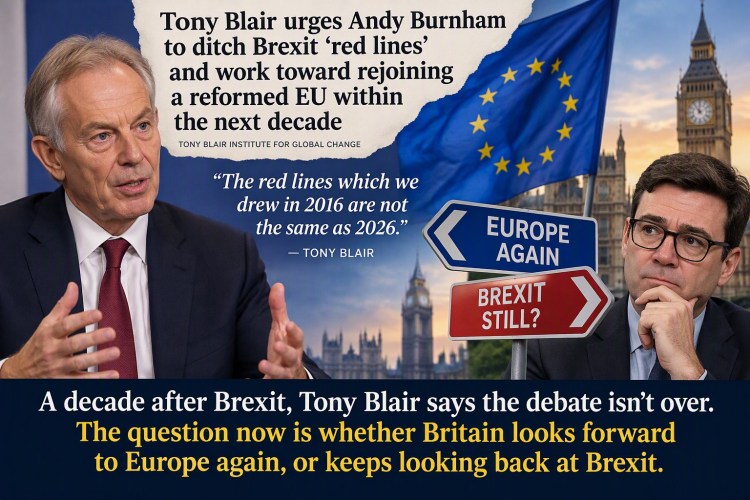
Tony Blair has urged Prime Minister Andy Burnham to ditch Brexit “red lines” and work toward rejoining a reformed EU within the next decade.
Tony Blair has said the government must clearly signal its intent to return to a formal relationship with the EU, provided the bloc undergoes significant reform, after Prime Minister Andy Burnham refused to rule out including the goal in Labour’s next election manifesto.
Sir Tony Blair has urged Prime Minister Andy Burnham to tell European leaders that the UK wants to re-enter a formal relationship within the next ten years, provided the EU improves its decision-making and gets its house in order.
Sir Tony Blair emphasised that while Britain should seek a formal relationship with a reformed EU of nation-states capable of global power, it must otherwise remain prepared to operate as an independent nation while cooperating on mutual interests.
The Tony Blair Institute today launched a major report proposing a pathway to rejoining the EU that urges both sides to abandon red lines over the customs union, single market, and freedom of movement in favour of pragmatic, long-term decisions.
The report calls for immediate UK-EU collaboration on a defence fund, AI, and a European Energy Security Partnership, claiming that a shared North Sea energy hub and reconnected electricity markets could save billpayers up to £370 million annually.
The document argues that Britain should help reform the European Political Community into a more efficient body, noting that a June YouGov poll showed 55% of voters support rejoining the EU compared to 34% opposed.
Prime Minister Andy Burnham is scheduled to meet EU leaders at a major summit later this year to outline the UK’s future relationship with the 27-member organisation.
Sir Tony Blair wrote that the UK needs a new approach that reframes the European relationship not as “reversing” Brexit, but as securing a modern partnership tailored to today’s changed global landscape and the British national interest.
The report warns that the current UK-EU arrangement will cause long-term productivity to drop by 4% and trade to fall by 15%, leaving both sides lagging behind the US and China amid an intense great-power competition.
TBI director Tone Langengen stated that while Europe reorganised around peace after the Second World War and integration after the Cold War, it must now reorganise itself around the defining condition of today: power.
Tone Langengen emphasised that because countries are competing to secure the capabilities underpinning 21st-century influence, Britain must help lead this shift by building its power in defence, energy, and technology as an equal European partner rather than refighting the arguments of 2016.
Tony Blair does not hold an official position in the UK government, instead operating externally as an informal advisor to Labour leadership and as the executive chairman of his think tank, the Tony Blair Institute for Global Change.
Tony Blair is intervening because his think tank argues that the UK and Europe are rapidly losing global influence to the US and China, making a modernised UK-EU strategic partnership essential to securing British national and economic interests.
While Prime Minister Andy Burnham holds ultimate decision-making power, British leaders traditionally operate within a vast ecosystem of think tanks, advisors, and senior statesmen who publicly and privately lobby to influence government strategy.
Many argue that a Prime Minister’s primary duty is to provide independent leadership based on their personal conviction, and that over-reliance on external advisors risks undermining their democratic mandate and accountability to the voters.
A clear majority of Britons now regret Brexit, with many citing a lack of clear information during the 2016 campaign and a general disconnection from complex political issues.
The UK was a member of the European Union and its predecessor for 47 years, officially joining on 1 January 1973 and formally departing on 31 January 2020.
Many economists and political analysts have pointed out that during its 47 years of membership, the UK benefited from seamless trade, significant economic growth, and strong European cooperation, showing that the system effectively worked regardless of public understanding.
While the system functioned well economically, voters ultimately chose to leave because a majority prioritised reclaiming national sovereignty and gaining total control over immigration and borders.
While leaving the EU ended free movement, it initially created a “Brexit paradox” of record-high net migration and increased Channel crossings, though recent data confirms net migration has since halved and small boat arrivals have dropped to their lowest levels since 2021.
Brexit has reduced the UK’s GDP, suppressed business investment, and introduced trade barriers that have worsened the national economy and public services.

