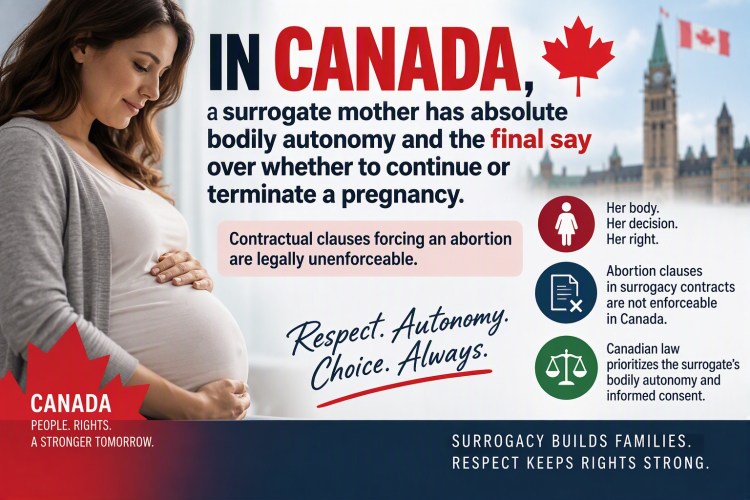
In Canada, a surrogate mother has absolute bodily autonomy and the final say over whether to continue or terminate a pregnancy, as contractual clauses forcing an abortion are legally unenforceable.
According to the lawsuit, when prenatal scans at 22 weeks revealed treatable conditions like a cleft lip and palate, the intended parents requested a termination based on their agreement, but the surrogate legally refused and carried the pregnancy to term.
Following the birth of the child, the relationship between both sides collapsed, triggering a $600,000 lawsuit against the surrogate that focuses on alleged breaches of contract, emotional distress, and improper expense reimbursements rather than the abortion refusal itself.
The case cleanly splits public opinion between the intended parents, who argue a signed agreement was breached, and the surrogate, who maintains that no contract can override a person’s absolute authority over their own body, especially for manageable medical conditions.
Canadian courts and the public continue to wrestle with this complex case, which offers no clean answer but instead raises a fundamental question about where a contract ends and a person’s bodily autonomy begins.
A surrogate mother has the absolute legal right to choose whether to terminate or continue a pregnancy if a medical problem arises, because her constitutional right to bodily autonomy completely overrides any surrogacy contract or the wishes of the intended parents.
A surrogate mother does not automatically have to pay back pregnancy expenses simply for exercising her medical choices, but she can still be sued civilly if the intended parents allege separate financial or contractual violations.
The lawsuit avoids citing the abortion refusal directly and instead accuses the surrogate of withholding medical updates, choosing an unauthorised home birth, seeking improper expense reimbursements, obstructing legal parenthood, and breaching confidentiality on social media.
The intended parents took custody of the baby immediately after birth and have been raising him as their son ever since, despite the ongoing $600,000 civil lawsuit and the total collapse of their relationship with the surrogate.
The intended parents initially requested the abortion due to fear of severe underlying genetic conditions and long-term disabilities, though they withdrew the request once advanced testing confirmed the baby was healthy aside from the treatable cleft lip.
The intended parents are suing the surrogate for $600,000 in civil damages because they allege she withheld critical medical updates, chose an unauthorised midwife-led home birth over a hospital delivery, violated non-disclosure terms on social media, and caused them severe emotional distress.
Many critics view the $600,000 lawsuit as a retaliatory financial penalty—the metaphorical “ker-ching”—intended to punish the surrogate for her refusal to abort rather than a genuine pursuit of contract enforcement.
This highlights the core of the ethical debate, as many firmly agree that pregnancy is inherently unpredictable, manageable conditions like a cleft lip have highly effective surgical solutions, and a future child’s life holds equal inherent value regardless of an unexpected prenatal diagnosis.
Surrogacy contracts avoid distinguishing between treatable and fatal conditions because “quality of life” is entirely subjective, prenatal diagnoses are often medically ambiguous, and attempting to legally define an acceptable level of disability would create a legal minefield within a clause that is completely unenforceable anyway.
A human life carries a fundamental value that can never be overwritten by a legal agreement, which is precisely why the law treats a surrogate’s bodily autonomy as absolute over any contract clause.

