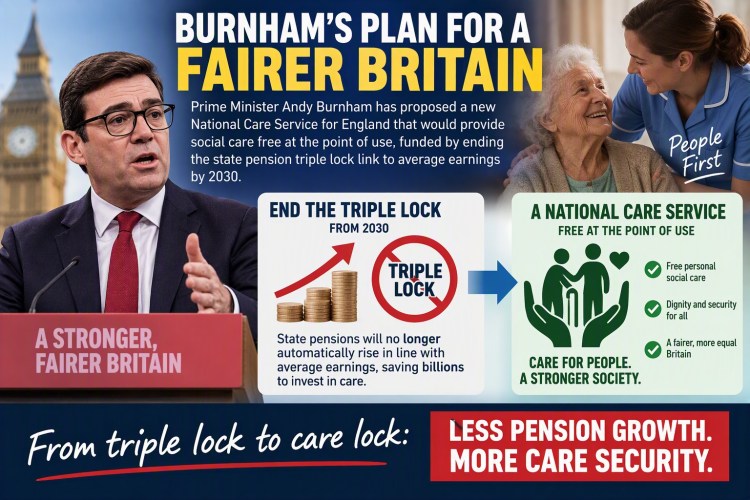
Prime Minister Andy Burnham has proposed a new National Care Service for England that would provide social care free at the point of use, funded collectively by ending the state pension triple lock link to average earnings by 2030.
Supporters view the proposed National Care Service as a historic, life-changing expansion of the welfare state akin to the 1940s creation of the NHS, while critics strongly object to its funding via cuts to the state pension triple lock and its exclusion of working-age disabled adults.
While critics argue the proposal “robs Peter to pay Paul” by reducing future state pension increases to fund social care, Prime Minister Andy Burnham contends it is a fair trade-off that protects older generations from catastrophic care costs and losing their life savings.
While patients and advocacy groups are strongly demanding a return to guaranteed face-to-face appointments and human receptionists, the NHS is increasingly implementing digital triage and AI gatekeeping to manage severe GP shortages and overwhelming patient demand.
Due to severe workforce shortages and a shift toward larger group practices, seeing a different GP at every visit has become a major systemic issue in England, even though research shows that having a regular doctor who knows your history improves health outcomes and reduces hospital admissions.
It is incredibly exhausting and stressful to retell your entire medical story to a new doctor every time, especially when severe GP shortages and a high reliance on temporary staff force patients to constantly repeat their histories and face inconsistent medical opinions.
While navigating private healthcare can feel like a maze of mixed quality, using independent Care Quality Commission (CQC) ratings and the General Medical Council register can help you find a reliable, highly rated private consultant who will personally manage your care from start to finish.
Because the vast majority of people cannot afford private medical treatment, the public relies completely on the NHS, making the breakdown in face-to-face GP continuity a deeply frustrating and unequal issue for millions of families across England.
It is deeply alarming and tragic to read about medical failures, and such incidents are formally investigated in England by the Health Services Safety Investigations Body (HSSIB) and the Care Quality Commission (CQC) to identify systemic errors and enforce patient safety standards.
Investigations only happen after the damage is already done, which is why patient safety advocates argue the focus must shift entirely from reviewing tragedies to preventing errors through mandatory safe staffing levels, continuous training, and robust, system-wide safety checks.
Under English law, healthcare workers face criminal prosecution for gross negligence manslaughter and can be permanently struck off by the General Medical Council (GMC) for reckless or incompetent actions, though safety experts warn that prosecuting honest human errors would cause staff to hide mistakes and make hospitals more dangerous.
To bring criminal charges for gross negligence manslaughter, the Crown Prosecution Service (CPS) must prove the medical professional owed a duty of care, breached it by acting exceptionally badly, and created a serious, obvious risk of death that directly caused the patient’s demise.
While a historical culture of institutional secrecy sparked widespread public fear that medical errors were being brushed under the rug, the NHS has introduced the Patient Safety Incident Response Framework (PSIRF) alongside the independent Health Services Safety Investigations Body (HSSIB) to mandate the open, transparent logging of safety events and eliminate cover-ups.
While it is a common and understandable fear that a massive institution will try to outmanoeuvre a vulnerable person, the legal system handles claims through NHS Resolution, which operates under strict statutory rules that resolve 84% of clinical negligence claims out of court to avoid forcing frail or inexperienced patients through a stressful trial.
To ensure the policy is fully prepared, Prime Minister Andy Burnham has appointed Baroness Louise Casey to lead an independent commission tasked with finalising the funding mechanics and structural design of the National Care Service before it is included in the next manifesto.
While supporters praise Prime Minister Andy Burnham’s bold early policies as a historic break from the status quo, political analysts and critics warn that severe economic headwinds and internal party risks could threaten his long-term position.

