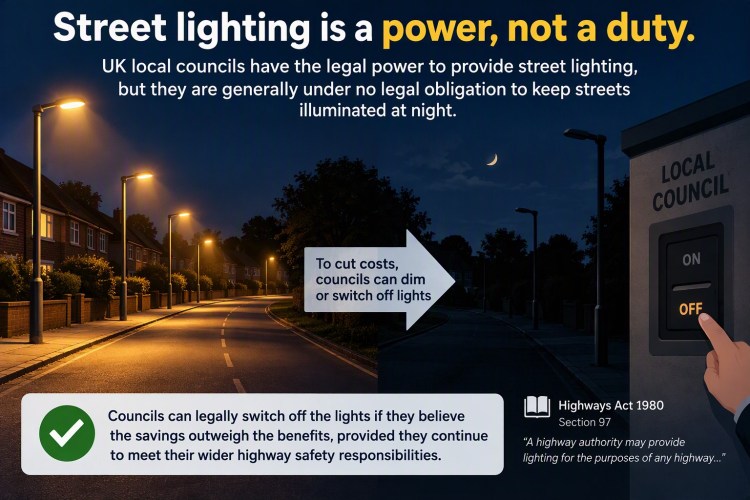
While local councils have the legal power to provide street lighting under UK law, they are not legally mandated to keep streets lit at night, leaving them free to turn off or dim lights to cut costs.
Norfolk is celebrated for its exceptionally dark skies and designated Dark Sky Discovery Sites, which offer prime conditions for viewing cosmic events like the aurora borealis while continuing to balance environmental preservation with community safety concerns.
Norfolk County Council’s decision to extend overnight blackouts faces intense opposition from local campaigners who argue that turning off streetlights heightens the fear of crime and compromises personal safety, particularly for women out alone.
Over the past 15 years, a majority of councils across England and Wales have implemented measures to dim or entirely switch off streetlights overnight, allowing some local authorities to save millions of pounds annually while reducing energy usage.
To plug gaping budget deficits, cash-strapped local authorities, including Croydon, Cornwall, Havering, and Hampshire, are escalating their street-lighting cuts by extending overnight blackouts or dimming thousands of lights.
Norfolk County Council stated that the cost of running its 54,000 streetlights had more than doubled over a two-year period, reaching approximately £4 million annually.
Norfolk County Council has saved £15 million since 2008 by installing energy-efficient LED bulbs, dimming lights, and implementing midnight-to-5:00 AM blackouts for nearly 20,000 streetlights, and it now intends to expand both the targeted streets and blackout hours following consultations with police and residents.
In November, more than 200 students from the University of East Anglia signed a petition calling for streetlights near the campus to stay on later, following a survey in which 94% of student respondents stated they would feel safer if the roads remained illuminated.
This local pushback echoes the warnings of national campaign groups who contend that darker neighbourhoods heighten the fear of crime and severely compromise public safety, particularly for women and vulnerable pedestrians.
The national campaigning organisation Our Streets Now and the anti-stalking charity the Suzy Lamplugh Trust have raised urgent concerns regarding local council streetlight cuts, with Our Streets Now explicitly stating that women’s safety is being treated as an “afterthought.”
While research on the effects of darker streets on crime remains conflicting, a 2022 University College London study focusing on Oxfordshire and Berkshire unexpectedly found that car break-ins halved when streetlights were turned off during the middle of the night.
An in-depth review for the College of Policing covering 13 studies, however, found that violent and property crime fell by an average of 21% when street lighting improved.
Local authorities heavily dispute the idea that streetlights have no purpose, maintaining that overnight dimming and blackouts are strictly measures for financial survival and carbon reduction rather than a government plan to restrict public movement.
Road safety organisations and motoring groups emphasise that turning off streetlights between midnight and 5:00 AM significantly increases driving hazards, particularly when motorists encounter pedestrians in dark clothing who are nearly invisible in unlit conditions.
Age advocacy groups emphasise that winter is already an incredibly isolating time for older people, and cutting streetlights further strips away their independence by making them too terrified to leave their homes during the long hours of darkness.

