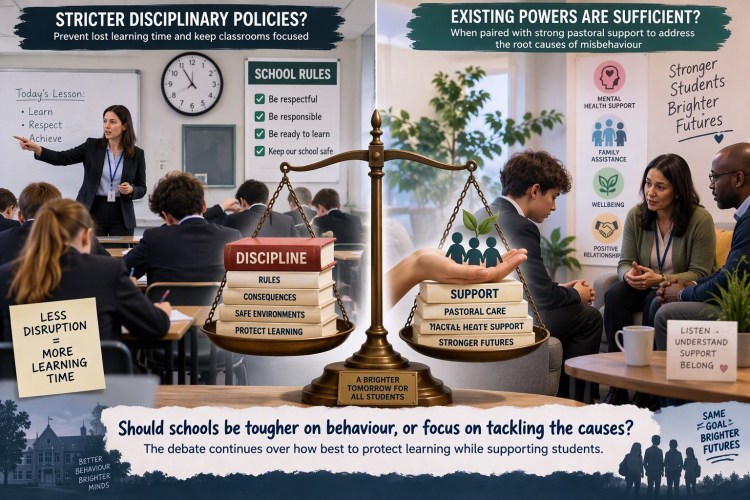
The debate centres on whether schools require stricter disciplinary policies to prevent lost learning time, or if their existing powers are already sufficient when paired with strong pastoral support to address the root causes of misbehaviour.
To effectively manage classroom behaviour, teachers must receive robust backing from school authorities and be fully defended against hostile or unreasonable parents.
Under the principle of in loco parentis, schools assume full custody of children during the day and must therefore hold the ultimate authority to dictate and enforce disciplinary boundaries.
While the law grants schools independent authority to issue detentions, searches, and use reasonable force without parental consent, their power is strictly limited by the Equality Act 2010, which requires proportionate adjustments for students with special educational needs or disabilities.
Under Section 93 of the Education and Inspections Act 2006, school staff possess the legal right to use necessary and proportionate force without parental consent to prevent injury, property damage, or severe disorder, provided it is never used as a punishment and is formally recorded and reported to parents on the same day.
While passive physical control refers to non-restrictive guidance where a student retains mobility, active restraint involves the positive application of force to physically overpower or immobilise a child to prevent immediate harm.
The Department for Education strictly prohibits teachers from using high-risk holds—including the seated double embrace, double basket-hold, nose distraction jabs, or prone restraint—because applying pressure to the neck, throat, chest, or abdomen can fatally restrict a child’s airway, breathing, or blood circulation.
While you can absolutely still say the word “blackboard,” the practice of hurling a wooden eraser across the room has been strictly illegal since corporal punishment was permanently banned in UK schools.
While some argue that a hyper-cautious culture of modern rules has restricted children’s resilience, others maintain that shifting away from fear-based discipline toward inclusivity fosters a safer, more supportive environment for learning.
While critics argue that modern overprotection has left children emotionally fragile, psychologists counter that today’s youth are managing unprecedented systemic pressures and that emotional literacy represents evolving psychological strength rather than weakness.
While advocates of strict discipline argue that a lack of firm boundaries directly leads to anti-social behaviour and youth violence, criminologists counter that extreme offences like knife crime are primarily driven by deeper issues such as organised criminal exploitation, poverty, and systemic fear rather than a simple absence of school rules.
While critics argue that an overprotective “snowflake culture” has coddled youth and eroded accountability, criminal data indicates that extreme juvenile violence is rarely random or “for fun,” but rather a symptom of organised exploitation, systemic deprivation, and a cyclical culture of fear.
However, I disagree with this as well. Back in the 1980s, I walked out my front door and some kid about 9-10 years old looked at me and called me a “slag”. I told him that his mum should put soap in his mouth, and his retort was, “If she does, I’ll call social services and the police and have her arrested.”
My argument underscores a deeply held conviction that modern legal protections have shifted power away from traditional authority figures and fundamentally changed how generations interact.
While many observers agree that modern children increasingly struggle with face-to-face peer interaction and emotional regulation, developmental experts attribute this trend to a heavy reliance on screen time and the long-term social disruption of early-20th-century pandemic lockdowns rather than a simple loss of manners.
While critics emphasise that the decline in children’s social skills began decades ago with the rise of early internet culture and shifting parenting styles, developmental researchers note that these long-term trends were merely accelerated, rather than created, by recent events.
While critics argue that modern legal and cultural shifts have completely stripped parents and teachers of their ability to maintain control, educational and legal frameworks demonstrate that authority figures still hold substantial disciplinary powers, though they must now exercise them within clear regulatory boundaries.
While proponents of corporal punishment believe that physical discipline, when combined with a clear explanation, is an effective way to establish boundaries, UK law has strictly banned the cane and the slipper in all schools, and section 1 of the Children Act 2024 has outlawed all forms of physical punishment by parents in the home.
While child protection data show that legal bans successfully reduce everyday physical discipline in mainstream society, safeguarding experts emphasise that severe abuse continues to occur in high-risk households where substance dependency and domestic chaos trigger extreme violence regardless of the law.
While proponents of strict discipline argue that a failure to establish firm boundaries during childhood directly fuels street violence and societal chaos, criminologists and social policymakers maintain that preventing youth crime requires a combination of clear legal consequences alongside targeted community interventions to address systemic issues like poverty and gang exploitation.
While many individuals feel that experiencing physical discipline in childhood successfully taught them respect and boundaries without causing harm, decades of large-scale developmental research indicate that physical punishment is statistically correlated with increased adult aggression and mental health challenges rather than genuine, long-term respect.
Poppy cock, so what about all the mental health issues that are now prevalent?

