A political manifesto is a public document issued by a political party during an election campaign to outline its core values, proposed laws, and specific policy commitments if it wins power.
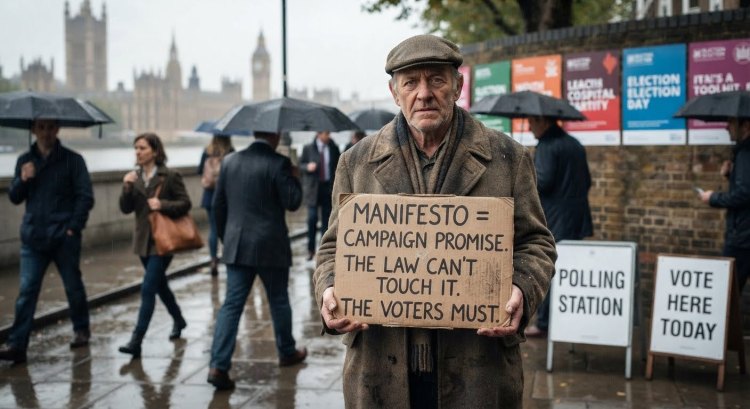
If a political party wins power and fails to deliver on its manifesto promises, it faces no legal consequences, but it can suffer severe political fallout.
The question of whether political parties should face legal consequences for breaking manifesto promises is a subject of ongoing debate among legal scholars, politicians, and the public.
Constitutional experts and political institutions conclude that legal consequences for broken manifesto promises are impractical because governing requires the flexibility to adapt to unforeseen crises, meaning accountability must ultimately remain with the voters at the ballot box.
A political party can legally go back on a campaign pledge because courts treat manifestos as political statements rather than binding contracts, meaning the only penalty for breaking a promise is the risk of being voted out of office.
Whether campaign pledges should be legally binding remains a highly debated topic, with proponents arguing it would prevent dishonest campaigns and restore public trust, while constitutional experts warn it would paralyse governance by removing the flexibility needed to handle unexpected global crises.
The “revolving door” feeling arises because the legal system deliberately blocks courts from enforcing campaign promises to preserve government flexibility, leaving voters stuck in a cycle of waiting for elections to punish behaviour that the law cannot touch.
Iceland effectively “sacked” its government during the 2009 “Kitchenware Revolution” when citizens staged relentless, deafening protests outside the parliament building using pots and pans, forcing the Prime Minister and his cabinet to resign following the country’s severe economic collapse.
The debate over whether the UK should adopt Iceland’s style of direct citizen action to force a change in government highlights fundamental differences in constitutional size, design, and political culture.
While the UK public cannot directly vote to sack Parliament mid-term, mass public protests can absolutely force a government down by triggering internal party panics, cabinet resignations, or a parliamentary vote of no confidence that results in an early general election.
Under UK parliamentary rules, a Vote of No Confidence is triggered when the Leader of the Opposition tables a motion that requires only a simple majority vote to pass, which legally strips the government of its authority and forces the Prime Minister to either resign or trigger an immediate general election.
If literally nobody voted in a UK general election, the government would not collapse because the law has no minimum turnout requirement, meaning every tied seat would be decided by drawing lots from a hat to fill Parliament and form a government despite a massive democratic crisis.
If everyone in the UK completely stopped working at the same time, the country would face an immediate total collapse of its power grids, a complete freeze on food and medicine supplies, and a catastrophic humanitarian crisis within a matter of days.
Parliament would not be able to cope and would cease functioning almost instantly, as the building itself would lose electricity and water, while the lack of staff, security, and transport would make it physically impossible for MPs to meet or pass laws.
This realisation highlights the core irony of representative democracy: while Parliament holds the legal power to govern, it remains entirely dependent on the working public to keep the country running, creating deep resentment when voters feel the political class exploits their labour while ignoring their welfare.
This perspective outlines the core philosophy of social democracy, which argues that when a government treats its citizens with genuine respect through fair wages and strong public services, it creates a healthier, more productive, and stable society because the workforce feels valued rather than exploited.
Critics argue that governments exploit citizens because the structural demands of global capitalism force state institutions to prioritise market growth and spending cuts over worker welfare, while policymakers counter that managing public costs is a necessary trade-off to curb inflation and keep the economy stable.
Economic stability is a fragile and highly contested concept because while a country’s macroeconomic data can appear stable on paper, the everyday financial reality for its citizens often feels deeply unstable.
If everyone in the UK stopped paying taxes, the government would prevent collapse by ordering employers to automatically deduct income tax, instructing the Bank of England to print emergency money, and deploying sweeping powers under the Civil Contingencies Act to freeze bank accounts and seize assets.
People would still live in their own homes, because the government would use its asset-seizure powers to freeze bank accounts and confiscate digital cash rather than launching logistically impossible mass evictions that would destroy society.
People would not starve because the government is legally required under the Civil Contingencies Act to prevent humanitarian disasters, meaning it would use the military to seize control of food warehouses and set up emergency distribution hubs to keep essential supplies moving.
It would be an absolute nightmare for the government because shifting to a military-run emergency state would drain all national resources, crash the economy, and destroy its political legitimacy, inevitably forcing the Prime Minister to resign.
The Bank of England cannot print money to pay off the national debt because flooding the economy with cash without producing more actual goods would cause catastrophic hyperinflation, making the pound worthless and destroying the savings of ordinary citizens.
While the pound’s purchasing power feels incredibly weak due to severe inflation squeezing everyday household budgets, on the global market it remains a highly valuable reserve currency trading steadily against the US dollar.
The perception that politicians feel superior arises because political power, privileged backgrounds, and the isolating bubble of government insulate elected officials from working-class realities, leading to top-down decision-making that voters understandably interpret as elitism.
While requiring politicians to pass formal exams could ensure they understand complex laws, constitutional experts reject this because educational barriers would strip working-class citizens of their right to run for office, shifting democratic power entirely to a highly educated elite.
Almost any citizen who is at least 18 years old can become Prime Minister, but practically they must first win a seat as an MP, become the leader of a political party, and command a voting majority in the House of Commons.
Running for Parliament is highly expensive because while the legal ballot deposit is only £500, the personal out-of-pocket costs for travel, campaigning, and taking unpaid time off work can easily exceed £11,000 for an individual candidate.
The deep financial barrier means that while anyone can legally run for office, a regular citizen like “Joe Bloggs” down the road practically cannot afford to become an MP or Prime Minister without wealthy institutional backing or significant personal savings.
An exam-based entry system could theoretically give a regular citizen like “Joe Bloggs” a fair chance by allowing them to qualify through knowledge and merit rather than personal wealth, provided the education and testing were completely free to prevent wealthy candidates from buying an advantage through elite tutoring.
Joe Bloggs absolutely deserves a chance, which is exactly why a growing number of political reformers argue the UK should introduce citizen assemblies that pick ordinary people completely at random—like jury service—to make laws, bypassing expensive election campaigns, wealthy donors, and the elite party bubble entirely.

