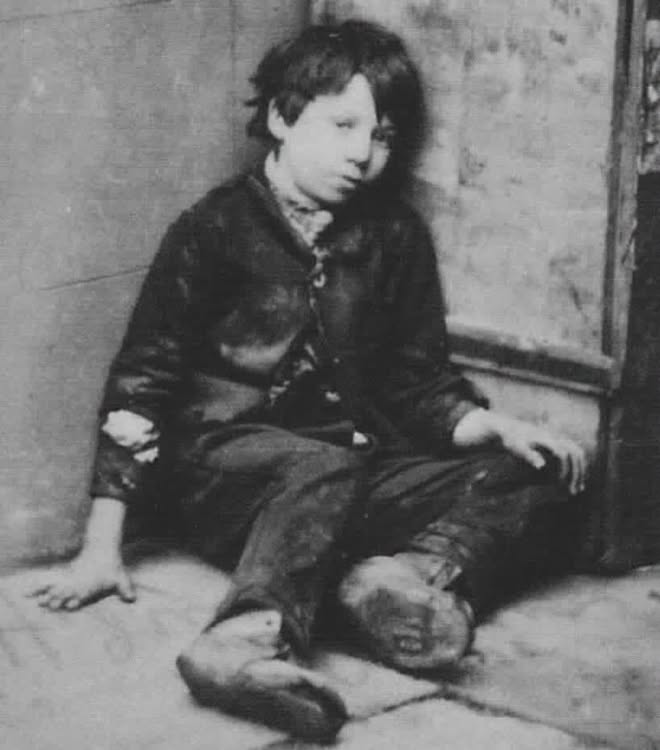
This haunting Victorian photograph captures a homeless boy exactly as he was found on the streets before being rescued by Barnardo’s Home, offering a stark glimpse into the harsh realities faced by vulnerable children in Victorian Britain and highlighting Dr Thomas Barnardo’s pioneering use of photography to expose social deprivation and fundraise for his “Ever Open Door” shelters.
While thousands of Barnardo children were saved from Victorian slums and given shelter, trades, or foster care in Britain, nearly 33,000 were subjected to controversial, government-backed child migration schemes that sent them to Canada and Australia as cheap agricultural or domestic labour, where many permanently lost contact with their families and endured severe hardship and abuse.
The Barnardo children suffered gruelling forced labour, routine beatings, severe starvation, and rampant sexual abuse by predatory host families and institutional staff, while also enduring profound emotional cruelty through the systematic erasure of their identities, the withholding of family mail, and deep social isolation.
The British government was fully aware of the widespread neglect and exploitation as early as 1875 through official parliamentary reports, yet it chose to ignore the warnings, pass enabling legislation, and financially subsidise the child migration schemes for nearly another century because it saved taxpayers money and populated the colonies.
Dr Thomas Barnardo and his charity directors were fully aware of the horrific conditions, as proven by multiple high-profile abuse trials, criminal convictions of their own overseas directors, and official internal reports, yet they chose to cover up, downplay, and continue the schemes to protect their global reputation and corporate fundraising.
Dr Thomas Barnardo remains a deeply polarising historical figure because while his passionate devotion saved roughly 60,000 children from immediate starvation and death in London’s slums, his fanatical moral certainty and imperial arrogance led him to unlawfully separate families and perpetuate forced child migration schemes that ultimately exposed thousands of those same children to horrific, systemic abuse.
The British child migration scandal was uncovered and brought to global attention by Margaret Humphreys, a courageous British social worker who exposed the systemic abuse in 1987 and subsequently founded the Child Migrants Trust to reunite thousands of stolen children with their families.
In 1986, British social worker Margaret Humphreys first stumbled upon the massive child migration scandal after she was asked to help an Australian woman locate her British birth certificate, only to discover the woman was not an orphan as she had been told, but had been forcefully deported while her mother was still alive and living just miles away.
When Margaret Humphreys began exposing the scandal, she faced relentless institutional denial, professional sabotage, and explicit death threats from religious orders and state bodies desperate to protect their secrets and reputations.
The Child Migrants Trust operates as the sole independent professional organisation dedicated to restoring the stolen identities of former British child migrants by conducting international family tracing, administering the UK-funded Family Restoration Fund for travel, and providing specialised trauma counselling and legal support for compensation claims.
The UK and Australian compensation schemes allow survivors to receive financial redress for the historic child migration scandal, offering a flat-rate payment of £20,000 from the UK for the harm of forced separation, alongside individual financial payments of up to $150,000 AUD and psychological care from the Australian National Redress Scheme for institutional abuse, with applications for the latter strictly closing on 30 June 2027.
Survivors and their families can locate the historical shipping logs and care records needed to prove eligibility for compensation by applying to the Barnardo’s Making Connections Service for personal care files, utilising the Child Migrants Trust for specialised archival tracing, or searching digitised passenger lists held in public repositories like the National Archives of Australia and the UK National Archives.

