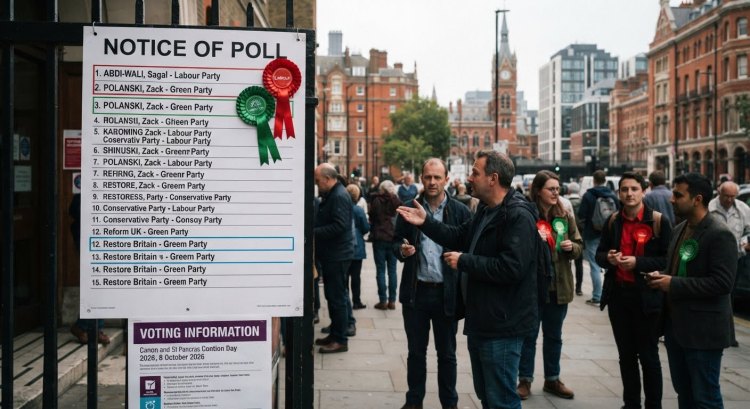
The Holborn and St Pancras by-election is widely seen as a two-horse race between the front-running Labour Party and the challenging Green Party, as a fragmented right-wing field leaves the Conservatives, Reform UK, and Restore Britain with virtually no path to victory.
According to the party’s platform, Restore Britain is contesting the seat to highlight rapid demographic shifts in the capital and provide a voice for voters concerned about immigration and national identity.
While critics argue that rapid demographic shifts have strained public services and eroded the city’s traditional identity, others maintain that London’s diversity drives its economic status and that its affordability issues stem from long-term housing shortages.
While research from the Greater London Authority and utilities indicates that hundreds of thousands of unauthorised residents live in London, opinion remains deeply split between those who feel rapid demographic shifts have alienated traditional citizens and those who view global diversity as a core asset to the nation’s capital.
Although critics argue that high immigration levels bring individuals who strain public services, refuse to integrate, or harbour hostile views, official government statistics show that 90% of social housing goes to British citizens, while economic data indicates that foreign nationals have high overall employment rates.
Restore Britain’s platform explicitly calls for the mass deportation of unauthorised migrants and far-reaching removals of foreign nationals to protect public services and restore national identity, though critics and legal scholars contend that these proposals are legally unfeasible, economically damaging, and discriminatory.
While parties like Restore Britain contend that the growth of Islamic communities in urban areas poses a critical threat to traditional British values and must be reversed, census data show that Muslims comprise about 15% of London’s diverse, multi-faith population, with broader civic consensus maintaining that freedom of religion is a core legal right.
While Restore Britain campaigns on the premise that it is the only party willing to enact the sweeping immigration and deportation policies necessary to reclaim London’s traditional identity, opposing political platforms reject this approach as an unfeasible and exclusionary rejection of the capital’s multicultural reality.
While electoral data and recent by-elections suggest that a vote split between Reform UK and Restore Britain mathematically advantages the Labour Party under the first-past-the-post system, Restore Britain maintains that competing is necessary to pressure the political landscape and offer an uncompromising platform on border control and national identity.
While political analysts confirm that the UK’s first-past-the-post system heavily penalises a fractured right-wing vote and rewards the kind of strategic voting seen on the left, right-leaning voters remain deeply divided between pragmatists who urge unity behind Reform UK to defeat Labour and ideologues who argue that competing under an uncompromising platform like Restore Britain is the only way to achieve genuine change.
Public commentary across social media reveals a fierce disagreement between pragmatists warning that a vote split between Reform UK and Restore Britain guarantees a Labour victory and dedicated ideologues who insist that Restore Britain is the only party offering an uncompromising platform on national identity.

