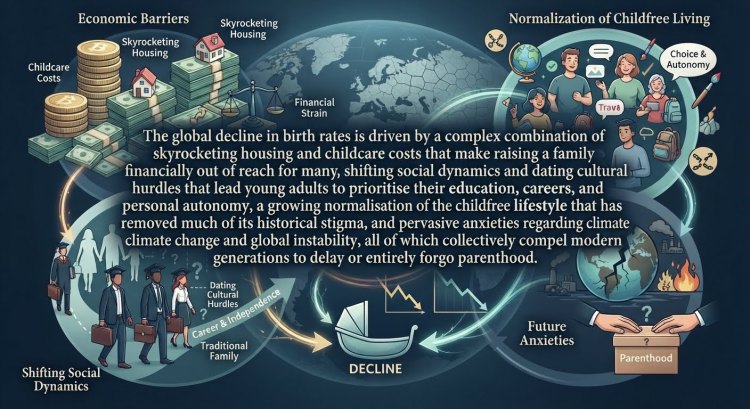
The global decline in birth rates is driven by a complex combination of skyrocketing housing and childcare costs that make raising a family financially out of reach for many, shifting social dynamics and dating cultural hurdles that lead young adults to prioritise their education, careers, and personal autonomy, a growing normalisation of the childfree lifestyle that has removed much of its historical stigma, and pervasive anxieties regarding climate change and global instability, all of which collectively compel modern generations to delay or entirely forgo parenthood.
The global shift toward fewer births threatens the foundational structure of modern economies by collapsing the worker-to-retiree ratio, which leaves a shrinking tax base struggling to fund the skyrocketing healthcare and pension costs of an ageing population, while simultaneously triggering acute labour shortages that force school closures, drag down overall GDP growth, and compel governments to take drastic measures like raising retirement ages and aggressively increasing immigration to fill the empty roles.
The UK’s steep demographic decline—marked by the fertility rate hitting a historic low of 1.39 children per woman—is triggering a massive structural crisis that will see pensioners outnumber children by 3 million within a decade, collapsing the tax base needed to sustain the state pension triple-lock, creating a projected £429 billion drag on GDP, and forcing a radical reshifting of public services that is already driving primary school closures while threatening to overwhelm an ageing NHS.
While the UK’s compounding economic math of shrinking tax pools, soaring pension costs, and an overstretched public purse undoubtedly signals a permanent end to the social and economic landscape of previous generations, this demographic cliff simultaneously acts as a historic catalyst for fundamental transformation by forcing businesses to aggressively deploy automation, creating an entirely new consumer economy tailored to wealthier and active older citizens, and shattering long-standing political inertia to finally overhark how social care, the NHS, and modern workplace flexibility are structured for the future.
Although declining birth rates mean the global population is projected to peak at around 10.4 billion in the 2080s before beginning a gradual, long-term contraction that will result in a much older and smaller society, humanity faces a profound structural and demographic reshaping rather than total biological extinction because this shift is a voluntary economic and cultural choice rather than a loss of reproductive capacity, with high-fertility regions like Sub-Saharan Africa continuing to drive growth while giving future generations centuries to adapt their infrastructure through automation and policy changes.
As the UK transitions to a smaller, older population, working people will face a heavier individual economic burden as they are forced to work longer as the state pension age rises. At the same time, taxes will inevitably increase via direct hikes or frozen personal thresholds to cover a projected state spending surge from 40% to 49% of GDP. The NHS will undergo a radical structural overhaul, shifting its limited resources away from maternity and paediatrics to manage a doubling of the population aged 85 and over through long-term geriatric and palliative care.
While you should be reasonably concerned about the inevitable intergenerational squeeze that will force younger people to pay higher taxes and work longer to support an ageing population while enduring heavily strained public services, you do not need to panic about a total societal collapse because the UK retains powerful economic levers like attracting young international workers and rapidly deploying workforce automation and AI to boost individual productivity, all of which will ultimately force politicians to pass necessary structural reforms to stabilise the economy.

