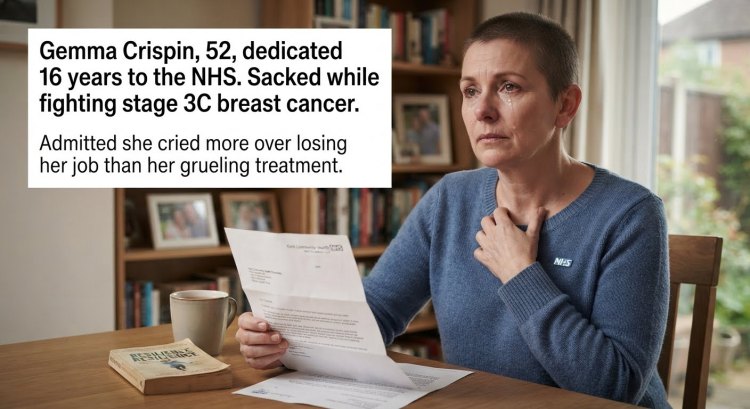
Gemma Crispin, a 52-year-old former NHS paediatric nurse, was dismissed by her trust after 10 months of sick leave following a stage 3C breast cancer diagnosis, later sharing that she cried more over losing her job than her gruelling cancer treatments.
Gemma Crispin shared that losing her job caused her more distress than her actual illness after the Kent Community Health NHS Foundation Trust dismissed her because they could no longer sustain her absence, despite her explicit plans to return once fully recovered from stage 3C breast cancer.
Gemma Crispin added that while a cancer diagnosis naturally brings an overwhelming number of unexpected fears and challenges to face, she never for a moment anticipated that her job security would be one of them, because her steady intention and plan had always been to return to her dedicated nursing role as soon as she recovered.
In formal correspondence, the Kent Community Health NHS Foundation Trust stated that occupational health advisors had deemed her unfit for work in any capacity, noting that while alternative roles and reasonable adjustments were considered, they were ultimately found unviable, leading the trust to officially uphold her dismissal following an appeal in June.
Although an employment solicitor indicated that Gemma Crispin had strong grounds for a claim, she admitted that the immense financial and emotional burden of her ongoing cancer journey ultimately prevents her from pursuing any formal legal action.
Gemma Crispin stated that the situation has caused a massive financial strain, explaining that just as she is reaching the end of her treatment and hoping to return to a normal life, she feels as though everything has been pulled out from under her.
While NHS staff with over five years of service are typically entitled to six months of full pay and six months of half pay, a trust can still legally dismiss an employee on the grounds of medical capability before that sick pay is fully exhausted if occupational health reviews determine they are completely unfit for work and the absence can no longer be operationally sustained.
Although anyone diagnosed with cancer is automatically protected against discrimination under the Equality Act 2010, and an employment solicitor confirmed that Gemma Crispin had strong grounds to take her trust to an Employment Tribunal, she was ultimately prevented from pursuing legal action by the immense financial and emotional burden of her ongoing treatment, highlighting a painful reality where severely ill individuals often lack the resources to legally challenge a medical capability dismissal.
Although the Equality Act 2010 provides vital protection for cancer patients, employers can exploit a legal “get-out clause” known as objective justification, which allows them to bypass discrimination claims by proving that a capability dismissal is a “proportionate means of achieving a legitimate aim”—an operational loophole that Gemma Crispin’s trust successfully utilised by documenting that occupational health had deemed her completely unfit and that alternative roles were operationally unsustainable.
There is a severe lack of actual structural support for individuals facing aggressive illnesses, exposing a distressing systemic gap where legal protections under the Equality Act exist on paper, but vulnerable employees are left without the financial resources, physical energy, or independent advocacy required to challenge a large employer’s capability dismissal procedure.

