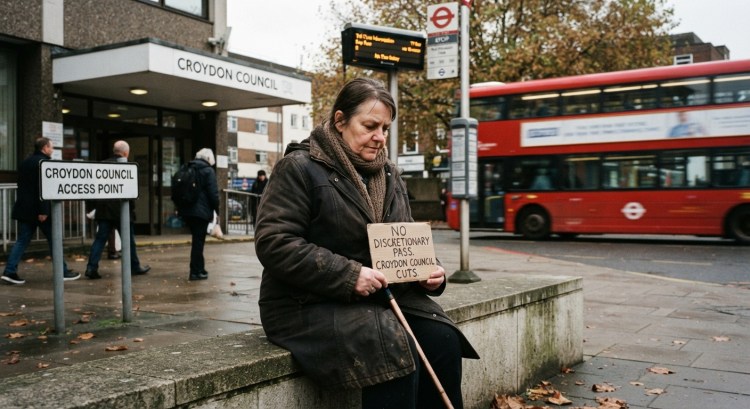
Croydon Council plans to stop issuing discretionary free travel passes to new applicants with disabilities who do not meet the strict national eligibility rules.
Croydon Council plans to stop giving discretionary free travel passes to new disabled applicants to save money on non-essential services.
Croydon’s local scheme provides free travel within London for disabled residents who do not qualify for the nationwide pass.
The scheme gives free travel to local social care users aged 18 to 59 with a physical disability or mental illness.
Croydon is cutting this travel scheme as part of a four-year plan to save money.
The travel pass cuts will save £140,000 as part of a larger £83.7 million saving target.
Croydon is making these cuts because its debt could reach £900 million by 2030.
Existing pass holders will keep their free travel rights if the budget is approved in February.
Campaigners and politicians warn that the travel cuts will isolate vulnerable residents and block their access to healthcare.
Councillor Mark Adderley called the travel cuts an outrageous attack on Croydon’s most vulnerable residents.
He warned that this minor saving risks severely destroying the quality of life for disabled adults.
He warned that the cut will leave more vulnerable adults isolated and forgotten by the system.
The council insists these difficult cuts are necessary to prove its financial discipline to government overseers.
The council’s report notes that most other London boroughs have already ended these extra travel schemes.
The council stated that its current travel scheme is more generous than most because it provides extra passes beyond the legal requirement.
The council stated it must make difficult cuts to match other boroughs and secure its long-term financial stability.
The council promised to help eligible residents get the national pass or alternative London travel discounts.
The plans are currently drafts, with a final decision expected early next year.
Many cash-strapped councils are already selling off properties to balance their budgets.
Croydon Council has put public properties up for sale—including a retail park, community centres, and Scout huts—to cut its massive debt.
Some financially struggling councils are selling off council homes to help balance their budgets.
Struggling councils are selling these homes to private buyers and property investors on the open market.
There is no official timeline for all council homes to be sold off, as the government is actively changing rules to protect social housing.
Without council homes, people will be forced to live in expensive private rentals or emergency temporary housing.
Major cash-strapped councils like Birmingham, Southwark, and Edinburgh are actively selling off homes to raise money.
Councils do not evict existing secure tenants when selling homes, as residents have strong legal protections to stay.
Council tenants on a fixed term cannot be evicted during their contract because their legal protections transfer to the new landlord.
The shortage of council homes is expected to push more people into homelessness and temporary accommodation.
Over 135,000 households are in temporary housing, and when local space runs out, councils must place families in other areas or emergency hotels.
The housing crisis and a lack of affordable homes are primary reasons why birth rates are dropping.

