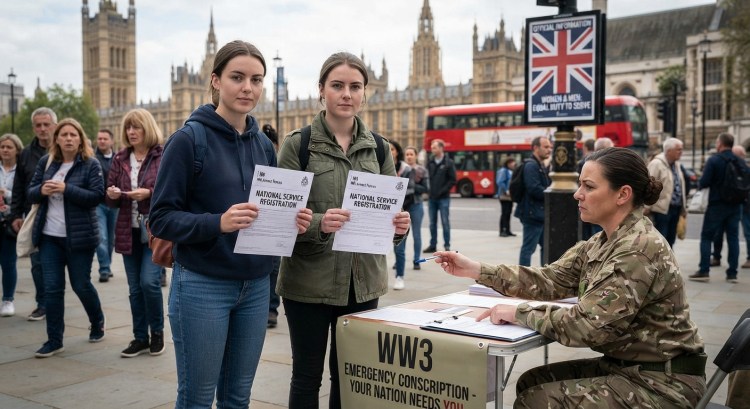
If World War 3 happens, the UK could draft young, single women into the military, building on World War II precedents and strong public support for gender equality in wartime service.
The head of the British Army has warned that political leaders will soon tell the public they must make personal sacrifices to prepare for the growing threat of war.
The head of the British Army told Sky News that every citizen will be asked to make personal sacrifices to defend the country.
To lower high US fuel prices caused by a war with Iran, President Trump made a deal to buy Russian diesel while blaming Ukraine for the crisis and urging its leader to step down.
Although the UK has not used mandatory military service since 1960, rising threats from Russia have sparked debate about bringing it back to boost troop numbers.
Six months before World War II officially broke out in 1939, the UK began conscripting men aged 20 and 21 for military training.
By the end of 1941, the UK expanded conscription to older men and women, though women were drafted into supporting roles rather than frontline combat.
In the spring of 1939, rising international tensions forced Prime Minister Neville Chamberlain’s government to prepare for a potential war against Nazi Germany.
In May 1939, Parliament passed a law requiring around 240,000 young single men to register for six months of military training.
In December 1941, Parliament passed a law making all unmarried women and childless widows aged 20 to 30 liable for the draft.
The UK expanded national service in 1941 because too few volunteers were joining civilian defence and military support units.
Former Defence Secretary Grant Shapps stated that the world is entering a pre-war era, while General Sir Patrick Sanders urged for an expanded army to boost the nation’s readiness for conflict.
Conscription ended in the UK in 1960 when the last soldiers drafted under the National Service scheme were discharged.
During the 2024 general election, Conservative leader Rishi Sunak proposed a mandatory national service scheme for 18-year-olds, which the Labour Party dismissed as a gimmick.
A survey found that 38% of under-40s would refuse to serve in a new world war, and 30% would refuse even during an imminent invasion.
The same survey found that 72% of the public supports conscripting women alongside men if a military draft is introduced.
During World War II, people who refused to fight had to prove the sincerity of their beliefs before a special court to avoid military service.
Many experts fear that modern global conflicts have brought the world closer to World War Three than at any point since the Cold War.
There is no threat of an actual land war or invasion in the UK, but leaders warn the country is already facing digital threats like cyberattacks.
The UK government recommends that households stock a three-day supply of bottled water, tinned food, and battery-powered essentials to prepare for major emergencies.
Although most people believe a major crisis could happen, only a tiny fraction are actually stocking up on emergency supplies.
Many people ignore the advice due to high costs and scepticism, prompting the UK government to plan its largest home defence exercise in decades to test national resilience.
The Cabinet Office’s new campaign will teach households to handle blackouts, while a massive defence exercise secretly tests how officials respond to hostile sabotage.
While the UK government acknowledges that everyday financial survival is the public’s main focus, official resilience guidelines are meant to encourage those who can afford it to prepare so that emergency services can focus their limited resources on the most vulnerable during a crisis, a strategy that has drawn sharp criticism from charities who point out that millions of families facing soaring food costs have absolutely no extra money to build emergency stockpiles.
Public comments regarding the government’s preparedness advice range from deep scepticism and accusations of fearmongering to valid frustrations over the high cost of groceries, though some practical citizens are quietly building basic three-day emergency kits.

