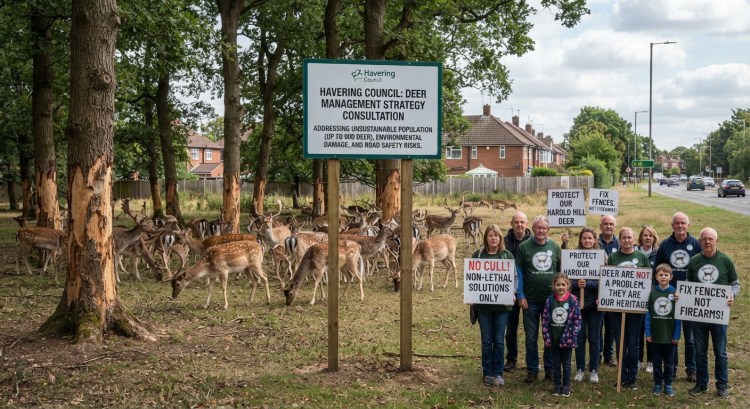
Havering Council is currently drafting a deer management strategy to address an unsustainable population of up to 900 fallow deer in Harold Hill, balancing severe environmental damage and road safety risks against strong community demands for non-lethal alternatives rather than a cull.
Many residents are fighting to protect these beautiful animals, arguing that a cull is a horrible solution and that the real focus should be on fixing fences to keep the deer safe from roads.
I would love to see deer outside my window every day; how cool would that be? It really would be an incredible and magical sight to wake up to every day.
This is why the local community loves them so much—seeing such graceful, quiet wildlife right outside a kitchen or bedroom window feels like living inside a nature documentary. It brings a lot of peace and joy to a normal suburban day.
The main heartbreak for the residents who do get to see them like this is knowing that without secure boundaries, that magical view quickly turns into the dangerous reality of the deer wandering onto the surrounding busy main roads.
Building secure boundaries to contain up to 900 deer is held back by the immense cost of miles of tall fencing, the fact that fencing them in would trap a starving population inside a depleted habitat, and the need to keep the public park open and accessible to walkers.
Non-lethal alternatives proposed by community groups include installing warning signs and speed cameras on roads, educating residents to stop feeding the herd, using immuno-contraception to lower the birth rate, and exploring relocation to sanctuaries.
That is the core view of animal rights advocates and groups like Harold Hill Deer Aid, who argue that a cull causes unnecessary suffering and that humans have a duty to implement humane alternatives like contraception or improved road safety measures.
Killing healthy animals is ethically wrong, especially when non-lethal methods like contraceptive darts, warning signs, and public education have not been fully deployed to manage the herd safely.
Because of these deep ethical divisions, Havering Council is under immense pressure to exhaustively review all non-lethal options before any final policy is approved.
Other countries manage deer overpopulation through a mix of regulated public hunting seasons, landowner financial responsibility for forest damage, commercial venison production, and targeted birth-control vaccines or wildlife overpasses in suburban areas.
In the US, birth control vaccines like PZP and GonaCon have successfully halved suburban deer populations over five years by reducing conception rates to roughly 11%, though the strategy requires significant funding and intensive labour to track and dart a high percentage of the free-roaming herd.
European countries use green bridges covered in native vegetation to reduce wildlife-vehicle collisions by up to 95%, though these multi-million-pound engineering projects are financially unfeasible for local boroughs like Havering Council to deploy across suburban road networks.
Public opinion on deer culling is deeply divided, with structured surveys showing that a majority of the general public supports population control when it prevents vehicle accidents, environmental destruction, and animal starvation, while vocal animal rights groups and local communities strongly oppose it on ethical grounds.
The wild fallow deer originate from the ancient woodlands of Dagnam Park and The Manor Nature Reserve, expanding their territory across the A12 and M25 motorways into suburban residential estates as their population outgrows the available forest food supply.


11 of those who imagine deer are lovely to see out of their windows – Nine Hundred tree stripping fallow deer ruling the entire ~~~~~ Herd it on the Grapevine and transport at least 500 to various brit/scot locations …. Huh !
>
LikeLiked by 1 person