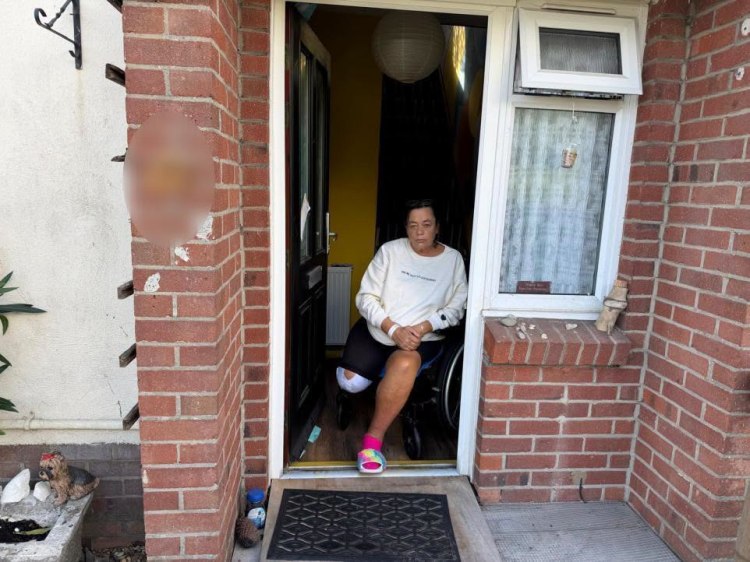
Michelle Sandever, an amputee grandmother from Poole, feels trapped and suicidal inside her home after claiming BCP Council refused to fund essential wheelchair modifications and instead pressured her to move out.
This heartbreaking reality highlights how devastating a lack of basic accessibility can be for a person’s independence and mental health.
Michelle Sandever claims that BCP Council has repeatedly refused her requests for basic modifications like an accessible ramp, instead using a spare bedroom as leverage to pressure her into moving out.
Michelle Sandever questioned the state of her basic human rights as she expressed a simple, desperate wish to be able to leave her own home freely and independently.
Under the UK Human Rights Act 1998 and the Equality Act 2010, local authorities have a strict statutory duty to protect a disabled person’s right to dignity and autonomy by making reasonable physical adjustments, such as installing ramps, to ensure they are not left at a substantial housing disadvantage.
Under the Equality Act 2010, the “reasonable adjustments” clause applies directly to Michelle Sandever’s dispute because BCP Council’s refusal to adapt her home due to an under-occupancy policy (the spare bedroom) legally conflicts with its duty to remove physical barriers for disabled tenants.
Michelle’s daughter, Sian, shared that her mother has completely lost the will to live and has never been so deeply devastated in her entire life due to the crushing impact of her housing situation.
Under UK housing guidelines, the “reasonable adjustments” duty explicitly extends to bedroom allocation policies, meaning councils must permit an extra bedroom if a tenant needs it to store essential mobility equipment or medical supplies, or to accommodate an overnight carer.
In Michelle’s case, refusing to adapt her current home on the basis that she has a spare room ignores the reality that her belongings are currently boxed up into a “cardboard city,” preventing her from safely navigating her home or using an electric wheelchair. Legally, the council should be evaluating whether that extra space is a functional necessity for her long-term independence, rather than viewing it purely as an under-occupied room to claw back.
The Housing Ombudsman and UK case law have firmly established that councils commit severe maladministration when they penalise disabled tenants for having a spare bedroom, ruling that extra rooms are often a functional necessity for storing bulky medical equipment or accommodating care, and cannot be used as an excuse to deny vital home adaptations.
Due to a chronic national shortage of accessible bungalows and rigid “over-55” age restrictions on social housing stock, thousands of UK wheelchair users are trapped on priority waiting lists for years or forced into degrading “single-room captivity” downstairs because suitable ground-floor properties simply are not being built.
When a person becomes disabled in the UK, the chronic gatekeeping, rigid policy checkboxes, and institutional neglect within the housing and social care systems send a clear, dehumanising message that their independence and fundamental dignity are no longer a priority.
Even if a disabled tenant agrees to downsize, moving to a ground-floor flat or bungalow rarely guarantees accessibility because older properties are routinely plagued by narrow corridors, threshold steps, and small layouts that cannot structurally accommodate a full-time wheelchair user without extensive, costly renovations.
Many disabled tenants who agree to downsize to ground-floor properties arrive to find that none of the promised adaptations has been completed, leaving them stranded in the exact same hazardous and inaccessible situation they were trying to escape.
To make matters worse, forcing disabled tenants to relocate for accessible housing often uproots them from their local communities, leaving them isolated and far away from the vital family support networks they rely on for daily care.

