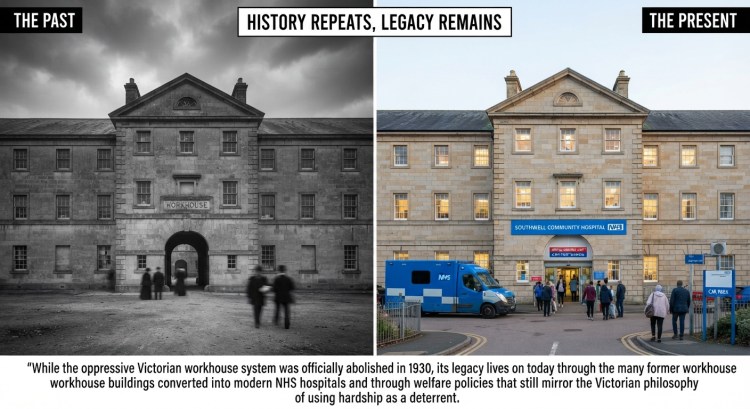
While the oppressive Victorian workhouse system was officially abolished in 1930, its legacy lives on today through the many former workhouse buildings converted into modern NHS hospitals and through welfare policies that still mirror the Victorian philosophy of using hardship as a deterrent.
Bringing back physical workhouses today is legally and politically impossible due to human rights laws against forced labour, the immense financial cost of running residential institutions, and massive public backlash, though critics argue their harsh philosophy of using discomfort as a deterrent already exists within the modern welfare system.
The resurrection of a workhouse system is legally blocked by Article 4 of the UK Human Rights Act and the European Convention on Human Rights, alongside International Labour Organisation treaties, which strictly prohibit slavery, servitude, and forcing vulnerable citizens into compulsory labour.
While the UK Parliament could technically change domestic law with a simple majority vote, doing so would require dismantling the country’s constitutional framework, tearing up the Good Friday Agreement, and completely withdrawing from major international treaties like the European Convention on Human Rights and United Nations labour conventions.
While the UK Parliament can pass ordinary emergency laws in a matter of days, changing fundamental human rights treaties to reintroduce workhouses cannot happen at the drop of a hat because it would instantly trigger constitutional delays in the House of Lords, massive domestic court battles, and the immediate collapse of international trade agreements.
While history proves that no political or legal system is permanently unchangeable, resurrecting an institution as extreme as the Victorian workhouse would require an unprecedented collapse of modern democracy and a complete rewrite of global civilisation’s moral and legal rules.
The sudden arrival of the cost-of-living crisis proves that massive economic and social shocks can blindside an entire society, demonstrating why we can never say never to radical systemic shifts over time.
While nobody expects a return to medieval sanitation or Victorian workhouses anytime soon, the unpredictable nature of history proves that modern systems are fragile, and anything remains possible when catastrophic societal collapse occurs.
Just like fashion cycles bring back styles once thought permanently outdated, historical trends and social structures often repeat themselves when similar economic pressures and human behaviours resurface across generations.

