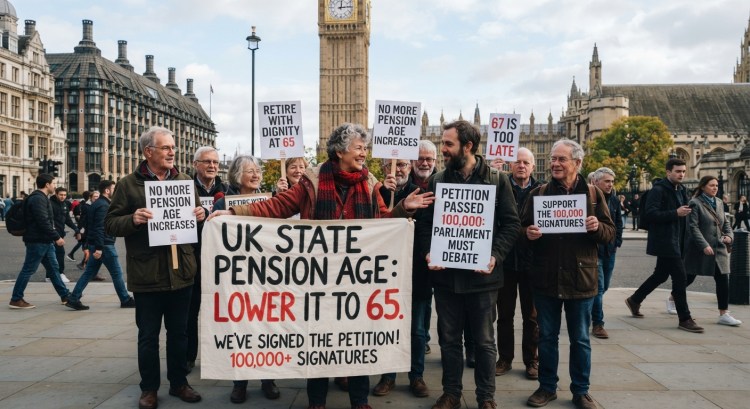
An online petition calling for the UK State Pension age to be lowered to 65 has passed 100,000 signatures, officially triggering consideration for a parliamentary debate despite the Government stating it has no plans to lower the age from its current trajectory toward 67.
The UK State Pension age is currently rising from 66 to 67, a phased transition taking place between 6 May 2026 and 6 April 2028 that applies to anyone born after 5 April 1960, establishing a flat state retirement age of exactly 67 for those born between March 1961 and April 1977.
While the majority of people are statistically projected to reach their pension based on average lifespans, approximately 1 in 7 UK adults currently die before reaching retirement age, and the average healthy life expectancy is just 60.7 years, meaning thousands of people are forced to spend their final working years in poor health or pass away before ever receiving a single penny of state support.
The UK’s sharp geographical postcode lottery means that while people in affluent southern areas like Richmond can expect to live in good health past age 70, those in deprived areas like Blackpool or the North East see their healthy life expectancy plummet to between 50 and 57 years, forcing them to endure up to 17 years of chronic illness before reaching the State Pension age of 67.
Historically, the UK State Pension age was never 60 for everyone; rather, from the inception of the modern system in 1948 until 2010, it was set at 60 for women and 65 for men, before subsequent legislation equalised the retirement ages for both sexes and began the gradual climb toward 67.
The current trajectory of the UK State Pension age is the result of a sequence of laws passed by successive governments, beginning with John Major’s Conservative government passing the Pensions Act 1995 to equalise the age at 65, followed by Tony Blair’s Labour government introducing the rise to 67 and 68 in the Pensions Act 2007, and finally David Cameron’s Coalition government accelerating that timeline through the Pensions Acts of 2011 and 2014.
When a person dies before reaching retirement age, the National Insurance contributions they paid are completely absorbed by the government to fund current public spending because there is no personal pot of cash to refund or pass down, though a surviving spouse or civil partner may be eligible to inherit a portion of their State Pension entitlement under very strict, limited conditions.
While the dynamic of individuals dying early effectively acts as a structural financial offset for the state, the government is not accumulating a fortune or a surplus because National Insurance operates strictly as a pay-as-you-go tax system where current contributions are immediately wiped out by the UK’s massive £146 billion annual State Pension expenditure, a bill driven higher by a rapidly ageing population.
The comparison to a Ponzi scheme is frequently made by critics because the UK State Pension relies entirely on using money from new entrants (current workers) to pay off older participants (current retirees) rather than investing the money to grow real assets, though it differs fundamentally through its public transparency, legal framework, and the government’s power to alter tax rates or eligibility ages to keep the model functional.
While private Ponzi schemes are strictly illegal because they rely on fraud, hidden accounting, and deceptive promises of guaranteed returns, the UK State Pension is entirely lawful because it is a transparent social contract established by Parliament and backed by statutory taxation powers, allowing the government to legally adjust tax rates, National Insurance contributions, and eligibility ages out in the open to keep the system financially viable.
While HM Treasury holds the executive responsibility for balancing the UK’s books and allocating budgets, the actual verification of public spending is conducted by the independent National Audit Office (NAO), which systematically scrutinises the accounts and reports directly to the House of Commons’ Public Accounts Committee to ensure public funds are handled lawfully.
The auditing process itself is entirely legitimate and independent, as the National Audit Office routinely exposes, investigates, and heavily criticises accounting errors, project failures, and billions in government waste across all civil service departments without political interference.
While MPs do not receive outright free personal meals or private property, their political roles are financially supported because the House of Commons provides a multi-million-pound annual catering subsidy to lower dining costs in Westminster bars and restaurants, alongside an accommodation allowance that fully covers the rent, utility bills, and hotel costs for non-London MPs needing a second home to attend Parliament.
The argument that MPs receive too much money is a widespread public concern, with critics pointing to their £91,346 basic annual salary, extensive taxpayer-funded expense packages, and lucrative outside business opportunities as being heavily out of touch with the financial realities of ordinary citizens.
This deep frustration highlights a widely held public view that the vast difference in wealth, housing perks, and secure pension arrangements creates an ideological bubble, preventing politicians from truly understanding the severe impact their policy decisions have on everyday families struggling with the cost of living and a rising retirement age.
This fundamental representation gap is heavily backed by data, showing that while 60% of the UK public identify as working-class, only about 5% of sitting MPs come from manual or routine occupations, meaning the vast majority of lawmakers lack personal lived experience of economic hardship and must instead rely on local constituency surgeries or civil service statistics to comprehend how their welfare and pension choices impact daily lives.
Whether individual MPs genuinely care is a subject of heavy debate, as academic surveys reveal that while many backbench politicians are deeply driven by public service and spend hours handling thousands of desperate local casework files, a severe structural divide remains because a politician’s capacity to act is heavily limited by their party’s voting rules, corporate lobbying, and a personal lack of working-class lived experience.

