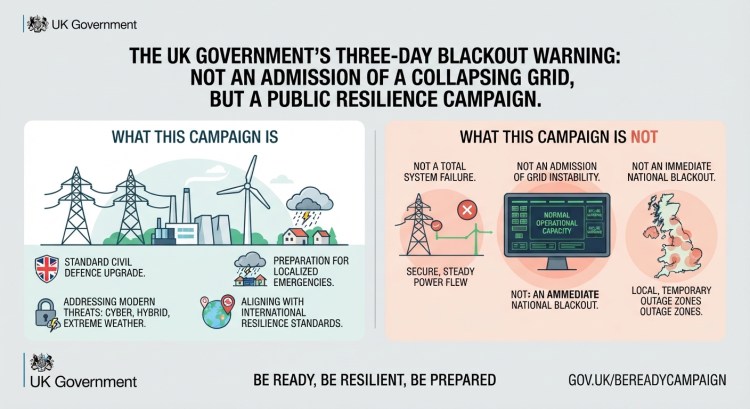
The UK government’s new three-day blackout warning isn’t an admission of a collapsing grid, but a public resilience campaign to prepare households for localised emergencies caused by extreme weather, cyber threats, and modern infrastructure challenges.
The shift toward a fragile, hyper-digital, “just-in-time” society has created structural vulnerabilities to cyber warfare and grid instability, prompting governments to adopt a distributed-resilience strategy that relies on citizen preparedness to prevent centralised emergency services from being overwhelmed during a systemic crisis.
The view that these campaigns represent a government failure underscores a stark reality: by advising citizens to stockpile supplies, the state acknowledges that its hyper-digital infrastructure is vulnerable to rapid disruption and is shifting the initial burden of survival onto households to prevent centralised emergency services from being instantly overwhelmed by a crisis.
The factual data reveals two valid interpretations: either these warnings are a stark admission that government infrastructure has been left dangerously vulnerable to modern threats, or they represent a pragmatic, standard civil-defence strategy to ensure communities can survive the initial shock of a major disruption.
When faith in public institutions is entirely gone, these warnings are viewed as a profound breach of the social contract: an admission that after years of tax-funded mismanagement, the state cannot protect its citizens from predictable infrastructure failures and is offloading the burden of basic survival onto individual households before a crisis even hits.
The view that infrastructure warnings and geopolitical tensions are a managed experiment mirrors a deep distrust of institutional power, suggesting that governments use a continuous crisis narrative and the threat of conflict to enforce public compliance, distract from catastrophic national debt, and implement sweeping economic resets that exploit everyday citizens.
Choosing not to prepare is a direct rejection of constant crisis narratives, reflecting a widespread fatigue with institutional scaremongering where people prioritise daily peace of mind over a hypothetical emergency that they feel uses fear to shift accountability away from the state’s own infrastructure failures.
While supply chains proved highly adaptable during the pandemic because core utilities remained fully operational, a major cyber-attack or grid failure presents a completely different structural threat by instantly taking down the electricity, digital communication, and payment networks that supermarkets absolutely rely on to restock shelves and process sales.
The concern that official warnings will fuel public anxiety is well-founded, as publicly advising citizens to stockpile provisions risks creating a self-fulfilling prophecy where fear of shortages triggers immediate panic-buying and artificial shelf-emptying long before any actual emergency occurs.
Public reactions to the campaign reveal a deeply polarised response: while critics and low-income families brand the guidance as a “tone-deaf” insult to those who cannot afford extra provisions, thousands of fearful citizens have immediately panicked, driving massive sales surges for tinned food, bottled water, and emergency tech across the country.

