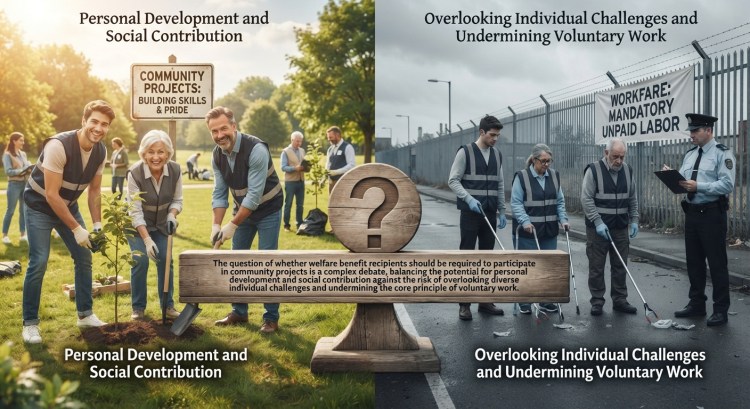
The question of whether welfare benefit recipients should be required to participate in community projects is a complex debate, balancing the potential for personal development and social contribution against the risk of overlooking diverse individual challenges and undermining the core principle of voluntary work.
Transitioning community service programs into paid public works projects would offer standard wages and employment rights instead of forcing recipients into unpaid tasks.
While welfare advocates and labour organisations view mandatory unpaid community work as a coercive and exploitative system that people are forced to accept for basic survival, proponents argue it is a reciprocal social contract designed to provide work experience and civic routine.
Under proposed community work programmes, benefit claimants are typically assigned to manual, clerical, or public service tasks such as environmental cleanups, public property maintenance, and administrative assistance in local libraries and charities.
The paradox of work being available for public service but not as paid employment is a central criticism of workfare programs, highlighting the economic debate between using welfare recipients for unpaid maintenance and funding regular, paid public sector jobs.
The argument that claimants performing mandatory work should receive a standard wage packet, pension contributions, and full employment rights is championed by labour unions who view the tasks as standard employment, whereas opponents maintain these schemes are a temporary condition of state support intended solely for employability training.
Opponents argue that basic public service tasks do not offer genuine technical skill-building for claimants, whereas proponents maintain that the true value lies in cultivating foundational soft skills, establishing a daily routine, and securing a recent work reference.
Opponents frequently point out that the sudden availability of these community tasks proves that essential public work exists and needs doing, arguing that the government should fund these duties as proper, paid employment rather than packaging them as an unpaid requirement for receiving welfare.
While critics and human rights advocates argue that conditioning essential welfare benefits on mandatory, unpaid labour meets the ethical definition of forced labour, courts have ruled that these programs do not legally constitute modern slavery under international treaties because they are categorised as civic training rather than systemic exploitation.
The perspective that mandatory workfare is a form of modern slavery remains a powerful ethical critique among welfare activists, who maintain that any system forcing individuals to perform unpaid labour under the threat of losing basic survival income is inherently coercive, regardless of how governments or legal frameworks officially classify the programs.
Public commentary on mandatory workfare reveals a stark division: grassroots activists and labour unions condemn the schemes as exploitative, coerced labour that replaces real jobs, while government officials defend them as essential skill-building programmes legally distinct from forced labour.

