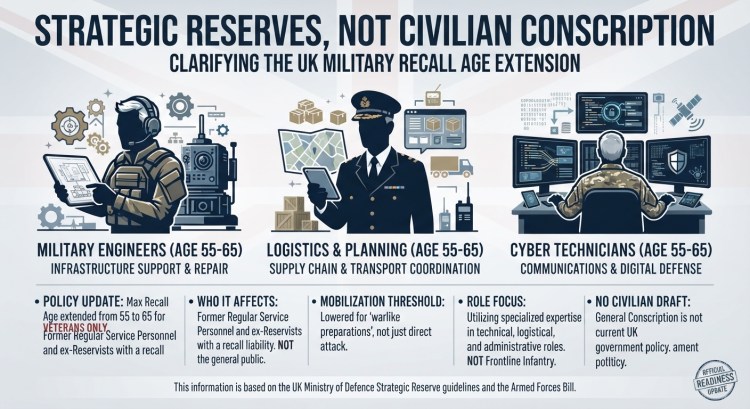
The UK government has extended the maximum recall age from 55 to 65 specifically for military veterans and ex-service personnel in the Strategic Reserve, not the general civilian public.
While the UK government officially maintains a volunteer-only military and has no active plans for mandatory service, defence experts indicate that any future implementation of civilian conscription would follow strict prioritisation protocols and legally begin with younger adults aged 18 to 24.
Former Army Chief Lord Dannatt outlined that the UK’s sequential contingency plan for a major conflict would systematically mobilise volunteer reservists first, followed by recalled military veterans, and then younger civilians aged 18 to 24 before ever involving the wider public.
Former Army Chief Lord Dannatt has stated that Britain’s established mobilisation plan would first deploy volunteer army reservists and then recall former service personnel up to age 65 before ever considering conscription for the general civilian population.
Defence officials acknowledge that a large-scale recall would face massive logistical hurdles, including severe shortages in basic military kit and a significant database gap where the Ministry of Defence has completely lost track of many veterans’ current locations.
Former Army Chief Lord Dannatt confirmed that Britain would not begin by compelling civilians with no military experience to join the armed forces, as the existing pool of trained reservists and former service personnel would be utilised first.
Historical precedent demonstrates how rapidly mobilisation rules can expand during a major crisis, as seen in World War II when UK conscription began only for men aged 20 to 22 but quickly widened to include men up to age 51 for military service, men up to age 60 for civil defence, and women.
In 1939, the National Service (Armed Forces) Act initially applied only to single men aged 20 to 22, but the escalating demands of World War II quickly forced the UK government to extend liability to men up to age 51 and introduce compulsory service for women.
By 1942, the mobilisation threshold had risen dramatically, with the National Service Acts expanding to conscript women from December 1941 and requiring men up to age 51 for the military, alongside men up to age 60 for mandatory civil defence duties.
Former Army Chief Lord Dannatt outlined the UK’s sequential military mobilisation process, stating that the government would deploy the Army Reserve first, then recall Regular Reservists to active service, before ever considering civilian conscription starting with 18-to-24-year-olds.
Public comments across online platforms primarily express anxiety over sensationalised “World War 3” headlines, scepticism regarding the physical fitness of older individuals, and dark humour concerning existing military equipment shortages, alongside users clarifying that the rule strictly targets experienced veterans rather than ordinary civilians.
While the UK government has explicitly ruled out sending British troops to fight in Ukraine, defence officials have identified Russia, China, Iran, and North Korea as the primary state threats driving the country’s national readiness updates.
Because the Strategic Reserve relies entirely on vetted veterans who already possess foundational skills, the plan focuses on quick refresher training rather than basic training, while weapons remain strictly secured within active military bases to be issued only to individuals integrated into a controlled chain of command.
The Ministry of Defence rules state that refugees and asylum seekers are legally prohibited from joining the British Army, as military recruitment is strictly limited to British, Irish, and specific Commonwealth citizens who can pass rigorous national security vetting.
While critics argue that government defence campaigns provoke unnecessary conflict and distract from domestic issues to maintain political power, defence officials maintain that clear communication regarding military readiness is a vital transparency measure to protect the public and deter external threats.

