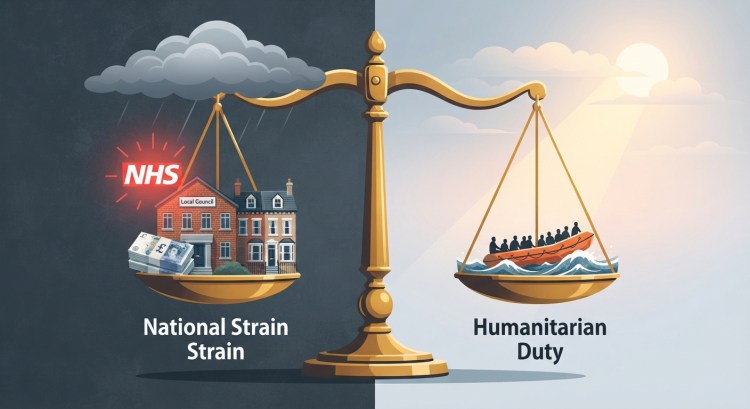
The UK’s asylum policy is a subject of intense debate, with critics arguing that expanding refugee routes places an unsustainable burden on overstretched public services and struggling families, while supporters contend that safe and legal pathways are a vital humanitarian obligation that helps prevent dangerous irregular migration.
In the year ending June 2026, the UK government issued 124,930 safe and legal humanitarian route grants—a 12% decrease from the previous year—which were distributed across nationality-specific visa schemes for Ukrainians and Hong Kong residents, refugee resettlement programmes, and family reunion visas.
In the year ending June 2026, 38,086 individuals were detected arriving in the UK via unauthorised routes—a 22% decrease from the previous year—with 33,374 of those arrivals crossing the English Channel in small boats that averaged an increasingly dense 65 people per vessel.
In the 2024/25 financial year, the UK government spent £4.76 billion on the total asylum system—a 12% decrease from the previous year’s record £5.38 billion—with £2.1 billion of that budget spent specifically on housing asylum seekers in hotels at an average daily cost of £5.5 million.
The proposed Immigration and Asylum Bill includes a provision under which adult refugees will be required to repay a flat-rate contribution of approximately £10,000 to recover the taxpayer costs of state-funded accommodation and support once their income crosses a specified earnings threshold.
Under a newly launched capped framework modelled on Canada’s private sponsorship system, UK-based charities and non-profits are being invited to become accredited “lead sponsors” to coordinate community groups in providing accommodation, integration care, and employment support for refugees, with arrival numbers expected to scale from the hundreds into the low thousands.
The first phase of the UK’s new charity-led refugee sponsorship scheme will target seven specific origin countries—Bangladesh, Egypt, India, Kenya, Malaysia, Pakistan, and Uganda—focusing exclusively on displaced individuals who were already officially registered in those territories before 1 October 2026.
Under the newly expanded refugee sponsorship framework, accredited lead charities must prove they possess the independent staffing capacity and localised networks to manage multi-year integration support, while the community groups they oversee are required to secure a minimum of £9,000 in upfront funding and source two years of vetted, independent accommodation.
Under the UK’s refugee sponsorship framework, prospective sponsor groups must obtain formal, written consent from their local authority—which retains full veto power based on the availability of local schools, healthcare, and safe housing—before the Home Office will approve any individual resettlement application.
Public and political reactions to the refugee sponsorship framework and the wider Immigration and Asylum Bill remain deeply polarised, with critics arguing the system surrenders border control and worsens strains on overstretched local resources, while supporters welcome the humanitarian pathway but heavily criticise the companion £10,000 accommodation repayment charge.
The debate over the country’s geographic and economic capacity is highly contentious, with critics maintaining that a small island nation cannot indefinitely absorb additional population pressures without degrading infrastructure and public services, whereas economic and demographic analyses suggest that targeted working-age migration is vital to expanding the workforce, supporting public finances, and funding those very systems.
In its long-term fiscal sustainability reports, the Office for Budget Responsibility (OBR) forecasts that while net migration lowers government borrowing and national debt in the short-to-medium term by expanding the working-age tax base, it acts as a temporary demographic buffer rather than a permanent solution to state pension sustainability because migrants eventually age and generate their own long-term public spending pressures.
According to Migration Advisory Committee data published by the Migration Observatory, the lifetime fiscal impact of immigration varies heavily by route, with main applicants on standard Skilled Worker visas generating a substantial net positive contribution of +£689,000 per person due to strict salary thresholds, whereas lower-paid care workers (-£36,000) and family visa partners (-£109,000) incur a net lifetime deficit because their lower average earnings generate less tax revenue relative to their long-term usage of public services.

