Back in May 1998, a much younger Andy Burnham took a spin in a manual wheelchair at Wembley Stadium to test its accessibility. Nick Wilson has pointed out that it has been 28 long years since the Prime Minister last sat in a wheelchair. Pavement infrastructure hasn’t improved much since the late ’90s, so it’s time for a refresher.
Our streets are basically designed as a live-action, low-budget video game where the local council is actively trying to defeat you.
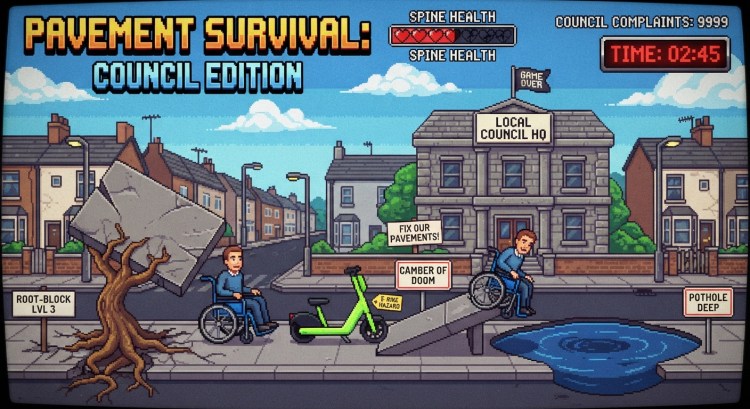
The local council has basically surrendered the high street to a botanical uprising, leaving giant paving slabs flipped into jagged mountain ranges and tree trunks blocking the path so completely that you need a stunt license and a monster truck suspension kit just to get past them to the post office.
Just when you think you’ve successfully crawled over the tree root mountain range, you turn the corner and find yourself staring down a wall of brightly coloured rental bikes scattered across the path like a giant, chaotic game of pickup sticks.
Leaving these dockless hire bikes sprawled across the pavement is basically the urban infrastructure equivalent of a toddler throwing their toys across the living room floor—except these toys weigh 30kg and completely block the path for wheelchair users, people with mobility aids, and parents with prams.
A bike that has completely given up on life and is lying flat across the pavement, acting as a massive concrete hurdle.
Forget “micro-mobility solutions.” Let’s call them what they actually are: hideous, neon-green corporate litter that has turned a simple trip to the local corner shop into a high-stakes obstacle course.
It turns out the futuristic, cutting-edge secret to accessible cities isn’t quantum physics, AI-powered pavement tracking, or expensive smartphone apps. It is a mind-blowing, sci-fi piece of engineering called a flat piece of pavement with a sloped bit of concrete at the end.
It is arguably the simplest design concept in human history, yet local councils treat the installation of a proper dropped kerb like they are trying to split the atom using only a plastic spoon.
When a council actually remembers to install a dropped kerb, it usually falls into one of three catastrophic design categories.
They drop the kerb, but leave a cruel, mandatory 2-inch vertical concrete lip at the bottom. For a wheelchair front caster wheel, that tiny lip is the structural equivalent of hitting a brick wall at Mach 1, instantly testing both your seatbelt and your dental insurance.
They beautifully drop the kerb on your side of the street. You cross the road with a smile on your face, only to arrive on the other side and find a pristine, vertical 6-inch wall of solid granite. You are now stuck in the gutter like a piece of urban debris, looking at the opposite pavement like a stranded sailor looking at dry land.
A perfectly flush dropped kerb that terminates directly into a deep, water-filled crater in the road tarmac. You successfully roll down the ramp, only to instantly submerge your front wheels into the abyss. Congratulations, you’ve gone from pedestrian to submarine captain.
“Hey @AndyBurnhamMP, we don’t need a multi-million-pound tech strategy or a 10-year parliamentary committee report. We just want proper pavements and flush dropped kerbs that don’t double as a BMX stunt ramp. Come try the @disabled.adventurer #WheelchairChallenge and see why a basic sloped piece of concrete is the ultimate urban luxury!”

