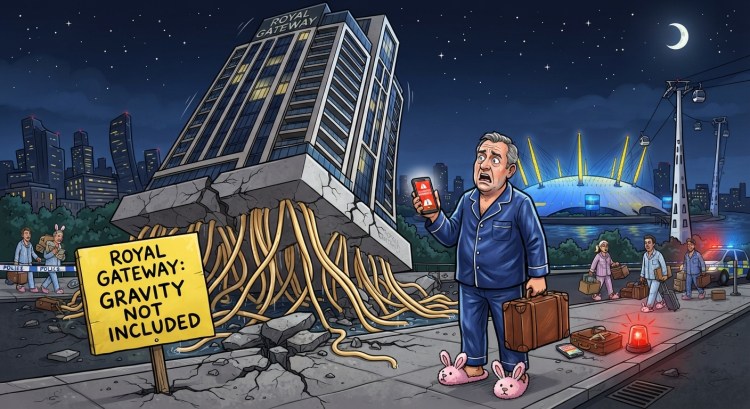
Nothing says “welcome home” quite like a 2:00 AM emergency evacuation because your nine-year-old apartment building has a massive, “danger to life” crack in its concrete slabs, leaving over 250 households paying mortgages on ghost-town flats while crowdfunding their own emergency hotel rooms.
It turns out the buildings aren’t just structurally challenged—they are officially “at imminent risk of total collapse” because the original construction blueprints apparently treated gravity as a loose suggestion rather than a law of physics.
The building is currently doing its best impression of a Jenga tower on a cruise ship because the concrete transfer slabs are “undersized and significantly overstressed,” meaning the entire complex is essentially trying to complete a heavy gym session on legs made of wet spaghetti while the concrete visibly cracks under the pressure.
Your 1960s building was clearly constructed by a chain-smoking Soviet-era engineer who assumed a nuclear strike was imminent, whereas modern new-builds look like they were designed on an iPad by an intern who forgot that buildings have to hold human beings.
The entire five-tower Royal Gateway development has officially become a luxury ghost town, complete with fancy “danger to life” warning signs taped to the glass, while hundreds of evicted tenants live out of suitcases in nearby hotels.
All five residential towers are now completely dead silent. The only signs of life are the occasional heartbroken residents being escorted inside by security guards like prisoners, given a strict 15-minute timer to shove their entire lives into a few IKEA bags before being kicked back out onto the street.
Despite Newham Council issuing terrifying legal notices demanding immediate temporary works to stop the buildings from imploding, reporters on site have confirmed that absolutely no fixing is happening. Instead, a handful of guys in high-vis jackets are just standing around staring at the sagging concrete slabs, presumably waiting for gravity to take a day off.
Displaced leaseholders are currently achieving the worst financial outcome possible: paying the full mortgage, service charge, and council tax on a hollow concrete box they aren’t legally allowed to enter, while maxing out their credit cards to pay for emergency serviced apartments in Canary Wharf.
Hundreds of private tenants and homeowners have been left completely homeless after being evacuated from the riverside complex in their pyjamas, discovering that their prime real estate location right next to the O2 Arena and the Emirates Air Line cable car comes with the ultimate modern luxury amenity: a building that might spontaneously implode.
Families were booted onto the freezing east London streets in literal nightwear at 3:00 AM. Nothing says “high-end London living” quite like standing on a pavement in your slippers, staring at a skyscraper you pay £2,500 a month for, and being told by fire crews that the floorboards are about to become the ceiling.
The complex features a perfect 50/50 mix of smug homeowners who thought they had secured their “forever asset” and private tenants who just wanted a short commute. Now, they have finally found common ground: standing in a Premier Inn lobby, mutually bonding over the fact that their bank accounts are being drained for a luxury ghost town.
Predicting the exact date these towers will be declared legally safe is like trying to guess when the UK will get a summer that lasts more than four consecutive days—the official answer is a resounding, legally binding “until further notice.”
Engineers are still in the absolute infancy of staring at the original architectural drawings, trying to figure out how someone looked at a massive 20-storey block and thought, “Yeah, a slab of concrete the thickness of a digestive biscuit should hold that up just fine.” Until they finish diagnosing the exact level of structural failure, nobody is even allowed to bring a hammer to the site.

