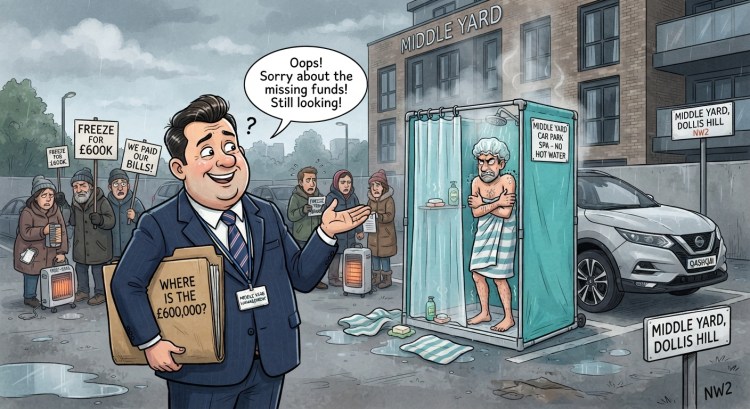
Imagine paying your gas bill every single month, only to find out you’re showering in a freezing car park because your building management pulled off the ultimate “the dog ate my £600,000” excuse.
Welcome to Middle Yard in Dollis Hill, where 120 apartments have been living the 19th-century lifestyle since 23rd October 2026 because someone forgot to forward the utility money.
Residents have been diligently paying their monthly energy bills, assuming everything was fine. Meanwhile, the development was casually racking up a staggering £600,000 energy debt (£300k for gas, £300k for electricity).
The building’s freeholder (Union Developments) used a billing company (mySycous) to collect the cash, but a new management company (Rendall & Rittner) took over in May. Rendall & Rittner claims they had absolutely no idea about the giant financial crater until the gas company showed up with the scissors.
To make up for the total lack of heating and hot water, management kindly provided communal portable showers in the building’s car park. Nothing says luxury London living like washing your hair in flip-flops next to a Nissan Qashqai in late October.
Management says they are “urgently negotiating” to turn the gas back on, though they’ve noted it’s “too early to speculate” on who actually lost the £600,000. In the meantime, residents have been handed plug-in heaters, presumably to help them watch their electricity meters spin into outer space.
This is the ultimate middleman multi-level marketing scheme, but instead of selling essential oils, they’re selling freezing cold showers.
In a normal world, you pay the gas company, and the gas company gives you fire. But in the wonderful world of UK leaseholds, your money has to go on a majestic, multi-stop gap year before it ever reaches a radiator.
Modern flat complexes love to boast about having a “communal energy system.” Translation: You don’t have your own boiler. You share a giant commercial mega-boiler with 120 neighbours, which means you’re tied to a massive commercial business contract, not a protected household account.
Because it’s technically a “business account,” the energy companies don’t care if it’s freezing in October. If a normal house owes money, there are laws to stop them from freezing you out. If a business account owes £300,000 for gas and another £300,000 for electricity, the grid treats you like a bankrupt Woolworths and simply snips the wire.
Residents were tap-dancing into their warm morning showers for years, completely oblivious to the fact that their monthly payments were apparently vanishing into a Bermuda Triangle of property management paperwork.
The new management company is now playing a high-stakes game of financial archaeology to find out which corporate pocket the £600,000 is currently hiding in. Meanwhile, the residents are left holding plug-in heaters, praying their fuse boxes don’t launch into orbit.

