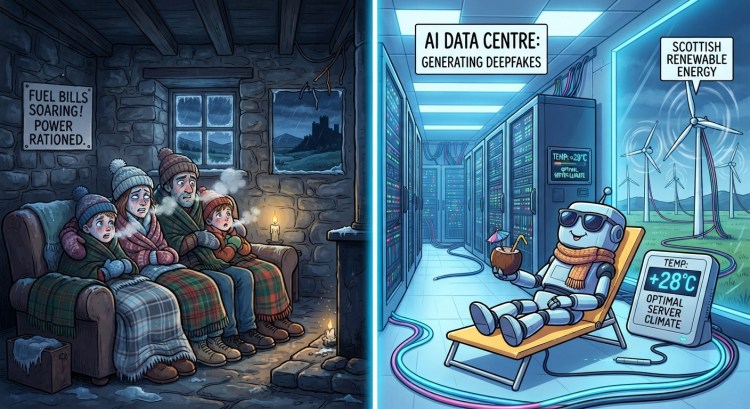
Scotland’s upcoming AI data centres have officially achieved peak irony: they are set to consume so much power that local humans might actually freeze while the robots stay cosy and warm. According to newly leaked government emails, ministers were privately warned that the upcoming tech boom could trigger soaring fuel bills, local energy blackouts, and standard-issue infrastructure chaos for ordinary citizens.
Essentially, Scotland is about to host the world’s most expensive digital house guests—the kind that eat all your food, use all your electricity, leave you with the bill, and don’t even offer to do the dishes.
The Freedom of Information (FoI) files read like a corporate thriller where the villain is a server rack.
The Deputy Director for Domestic Climate Change explicitly warned that locals will “bear the brunt” of skyrocketing prices and shaky power grids, all while receiving “little direct benefit.” You get the blackout; ChatGPT gets to learn how to write mediocre poetry.
Tech companies have proposed over 24 massive facilities across Fife, Falkirk, and the Borders. Campaigners point out that if they all plug in at once, they will demand over 7,000 megawatts. To put that in perspective, that is more than double Scotland’s entire winter peak load.
While the government originally hyped these up as economic engines, campaigners have pointed out that once a data centre is built, it mostly just requires a guy named Dave to walk around with a can of compressed air and a feather duster. The employment yield is practically invisible.
On top of eating all the electricity, these servers need massive cooling systems. Officials noted that Scotland is facing rising water stress, meaning local rivers and fisheries might have to compete with an algorithm trying to generate a corporate logo.
Faced with the reality that voters don’t want to sit in the dark so a server in Dumfries can process deepfakes, the government has scrambled into regulation mode. Ministers will now require mandatory environmental assessments for giant projects, proving once and for all that while AI can predict the future, it still can’t figure out how to pay an energy bill.
Other countries are reacting to the AI data centre invasion like a homeowner discovering a swarm of uninvited, incredibly thirsty raccoons in their basement. Some are slamming the door shut, while others are making the robots buy their own power grids.
The release of the internal documents has triggered a wave of public fury across Scotland. Campaigners, community leaders, and local politicians have made their feelings very clear—and they are pulling no punches.

