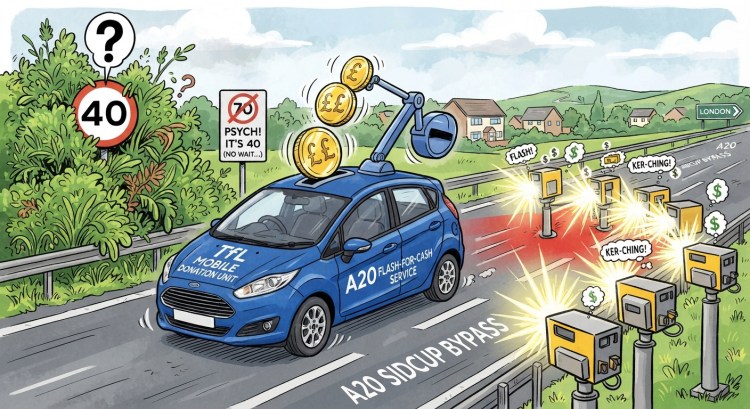
Jamie Foster got caught speeding four times on a single road trip home. It turns out his Ford Fiesta wasn’t just a hatchback; it was a mobile donation machine for Transport for London (TfL).
The 30-year-old sofa salesman became an accidental flash photography model on the A20 near Sidcup after TfL sneakily slashed the speed limit from a breezy 70mph to a painful 40mph. Foster, whose driving record was as clean as a brand-new showroom sofa, suddenly racked up points faster than a loyalty card.
He wasn’t alone in his misery, though. The A20 cameras went absolutely rogue, trapping over 100,000 drivers in what many called the ultimate bureaucratic cash grab. Drivers argued the new 40mph signs were basically playing hide-and-seek behind overgrown trees, making it nearly impossible to spot the change before the cameras went flash.
To legally dismantle a UK speeding ticket, you have to stop thinking like a driver and start acting like an incredibly annoying, pedantic detective.
Forget the classic excuses. Telling the police that “the sun was in my eyes,” “I was bursting for the loo,” or “my Ford Fiesta just has a mind of its own” will get you nowhere. Instead, your best weapon is bureaucratic revenge.
While common driving myths claim a camera is illegal if it’s painted grey, hiding in a bush, or not announced by a massive neon sign, the sad truth is that stealthy, camouflaged ninja cameras are completely legal. However, the tech inside them has to follow strict rules.
Dr Subha Bagchi somehow managed to prescribe himself four consecutive speeding tickets during a single commute. It turns out that while he is highly skilled at putting human beings to sleep, his luxury Lexus was doing a fantastic job of waking up every speed camera on the A20.
The 52-year-old consultant anaesthetist was just trying to get to the hospital to save lives when he fell victim to Transport for London’s (TfL) favourite magic trick: shrinking the speed limit from a breezy 70mph to a painful 40mph. Dr Bagchi, whose previous driving record was as immaculate as a freshly scrubbed operating theatre, suddenly found himself collecting penalty points faster than medical qualifications.
Apparently, TfL didn’t quite care that an anaesthetist rushing to a shift is generally a good thing for public health. Instead, their automated trap treated his Lexus like a Hollywood star on a red carpet, hitting him with four separate, aggressive flashes of paparazzi photography on the exact same stretch of tarmac. You’d think after the second flash he would have noticed, but when you’re mentally preparing for surgery, you’re usually thinking about patient vitals, not TfL’s secret revenue-generating bushes.
Thankfully for the good doctor, the justice system eventually stepped in and ruled that TfL’s speed limit signage was a complete and utter shambles. This means his multi-ticket “crime wave” was officially null and void—proving that, for once, a doctor was the one receiving the cure for a massive headache.
Coleen Blackburn achieved the ultimate “his and hers” matching set of traffic violations without even trying.
As a cautious driver with long-term health issues who was already traumatised by a previous accident, Coleen was nursing her Mini down the A20 with the extreme gentleness usually reserved for transporting a tray of open eggs. She was explicitly trying not to drive like a maniac, cruising along tentatively in a zone she thought was a 50mph or 70mph limit.
Unfortunately, Transport for London’s microscopic new 40mph signs turned the road into a psychological trap. Even with her ultra-cautious, grandma-approved driving style, her Mini was still snapped by the paparazzi cameras.
But the true comedy of errors unfolded the very next week when her husband drove down the exact same stretch of road and also got nabbed. You have to appreciate the domestic harmony here: couples who accidentally break fictional speed limits together stay together. Just imagine the dinner table conversation after the second letter arrived: “Well, dear, at least we have something in common besides the mortgage.”
With the courts declaring Transport for London’s speed order a total legal shambles, the Blackburn household can finally stop arguing over who the worse driver is and start drafting a joint invoice to get their money back.
The exact legal loophole that collapsed the entire A20 case is a work of pure, unadulterated bureaucratic comedy: The TfL manager who signed the paperwork to lower the speed limit was legally a nobody who didn’t actually have the power to do it.
While drivers spent months complaining about invisible signs, overgrown bushes, and a rogue 50mph sign put up by a local prankster, the ultimate “get out of jail free” card had absolutely nothing to do with the road itself. It was entirely down to a spectacular office botch-up.
To legally change a speed limit in the UK, a local authority has to issue a formal piece of paperwork called a Traffic Regulation Order (TRO). This isn’t just a sticky note; it must be signed off by a specifically designated official who has been formally granted the power, in writing, to make that change.

