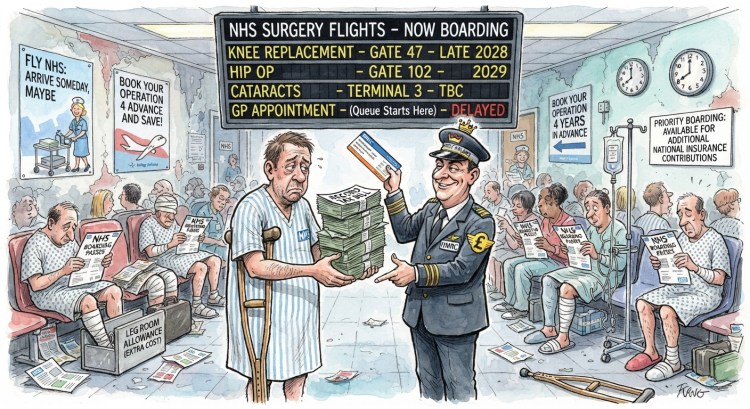
Living in Britain right now is basically paying a First Class subscription to Ryanair—except instead of paying extra for legroom, you’re paying a post-war record tax burden just to be told your knee surgery is boarding at Gate 47 sometime in late 2028.
According to the OBR, we are on track to smash the post-war tax record set in 1948–49. Back then, the country was literally rebuilding from the Blitz and rationing butter; today, we’re paying the same slice of GDP just to fund a country where potholes have their own postcodes.
Thanks to frozen tax thresholds (“fiscal drag”), getting a 3% pay rise to afford Lurpak now officially classifies you as a high-earning oligarch in the eyes of HMRC.
Britain’s national pastime isn’t football—it’s queuing, and NHS England has taken it to an Olympic level with 7.38 million treatments on the waiting list. At this point, a waiting list isn’t a medical schedule; it’s a pen-pal programme with a hospital receptionist.
Trying to book a GP appointment involves dialling at 07:59:59, pressing 1 for English, 2 to hear a three-minute lecture about not abusing the staff, and 3 to be told you are caller number 47—only for the line to cut out at 08:04 because all the slots have gone to people with faster fibre broadband.
According to the British Medical Association, roughly a quarter of A&E patients wait over four hours. Look on the bright side: if you go in with a sprained ankle, by the time you’re seen, it’s either healed naturally or you’ve grown old enough to qualify for your free bus pass.
As economists at the Nuffield Trust politely point out, our record taxes aren’t actually buying shiny new MRI scanners. Instead, the Treasury is mostly using your payslip to pay off national debt interest, keep the state pension triple-locked, and buy high-vis jackets for people to stand next to broken escalators.
In short, you’re funding a luxury service, receiving a “thoughts and prayers” service, and apologising to the receptionist when they finally hang up on you.
Prime Minister Andy Burnham and Health Secretary Yvette Cooper have just unveiled a £40 million winter masterplan to save the NHS—which, in British political terms, is roughly the cost of three Premier League reserve midfielders and an HS2 feasibility study.
The pitch is simple: give GPs cash to check on 300,000 vulnerable patients early, before a minor winter sniffle turns into an ambulance ride and a three-day stay on a hospital corridor trolley.
According to Pulse, the government didn’t actually find £40 million down the back of the Downing Street sofa. They just took £40 million out of existing 2026/27 GP budgets and handed it back to GP networks in a shiny new envelope. It’s the fiscal equivalent of stealing twenty quid out of your partner’s purse, buying them a bunch of garage flowers, and expecting a thank-you card.
Under the DHSC scheme, GP networks get £126 per eligible patient to run home assessments, medication reviews, and respiratory clinics. For £126 in London, you can barely get a plumber to look at a boiler, let alone keep an entire human being out of A&E until April.
The British Medical Association pointed out that moving money from individual surgeries into larger networks could actually leave local practices worse off. Nothing says “fixing GP access” quite like accidentally bankrupting the local surgery.
Meanwhile, the Royal College of Nursing gently reminded the government that nurse-led clinics generally require actual nurses—a minor logistical detail that appears to have been left as an exercise for the reader.
If you aren’t in that specific group of 300,000 high-risk patients, your NHS experience remains unchanged. You will still be participating in the 8:00 AM Phone-In Lottery, listening to royalty-free panpipes on hold while 7.38 million treatments sit ahead of you in the national queue.
In short, Burnham’s plan is like trying to put out a house fire by moving water from the kitchen sink into a slightly fancier watering can—and then holding a press conference to celebrate your bold new firefighting strategy.

