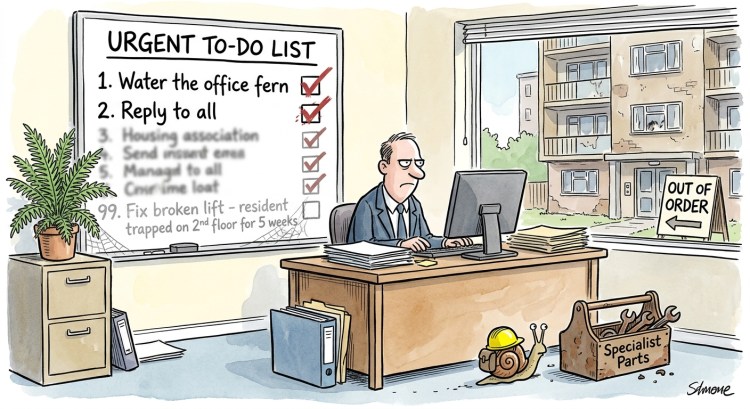
For 40-year-old wheelchair user Pete Donnelly, living in Battersea has recently turned into an involuntary audition for I’m a Celebrity… Get Me Out of Here!—minus the sunshine, the paycheck, and any actual chance of getting out.
When the only lift at Elmwood Court gave up the ghost on September 29, housing association Peabody began a five-week spiritual journey to fix it, leaving Pete marooned on the second floor, four flights of stairs from civilisation. According to Pete, this isn’t the lift’s first rodeo; it breaks down regularly, though Peabody really outdid themselves this time by smashing their own personal record for sluggishness. Clearly, “man physically trapped inside his own home” sits right at the bottom of their to-do list, nestled somewhere between “water the office fern” and “reply to all.”
To smooth things over after five weeks of accidental solitary confinement, Peabody offered Pete a staggering £200. In London, that works out to about £5.70 a day—just enough to buy a lukewarm Pret sandwich to drop down to him via a bucket and rope. Unsurprisingly, the glamour of second-floor captivity has worn off, and Pete is now planning to leave London entirely, presumably in search of a ground-floor flat and a landlord who understands how stairs work.
In a masterclass of modern property management, housing association Peabody has officially solved London’s cost-of-living crisis: simply trap your tenants inside their flats so they can’t go out and spend money.
To be fair to Peabody, the lift breaks down so frequently it basically works part-time—yet somehow, the housing giant was completely caught off guard and spent five weeks hunting down “specialist parts.” Were they hand-forging the cables in the fires of Mount Doom? Mining the lithium themselves? Nobody knows. What we do know is that Peabody shattered their own personal record for glacial incompetence.
Not content with merely trapping 40-year-old wheelchair user Pete Donnelly in his second-floor flat for five weeks, housing association Peabody decided to pair their glacial repair speed with the communication skills of a brick wall.
While Pete sat marooned up four flights of stairs at Battersea’s Elmwood Court, Peabody treated his requests for an actual repair timeline like spam mail—leaving him completely in the dark about when he might see sunlight again. Even better, when Pete asked for an update on his Personal Emergency Evacuation Plan (PEEP), Peabody reportedly left him on read. Because apparently, when you trap a disabled tenant on the second floor, “hope there isn’t a fire” is considered a robust safety strategy.
When Pete asked for an update on his Personal Emergency Evacuation Plan—you know, the minor detail of how he survives if the building catches fire while he’s stuck on the second floor—Peabody apparently treated the request like a terms-and-conditions agreement and scrolled right past it.
This is a huge talking point among disability advocates, and Pete’s situation is a textbook example of why.
When a building relies on a single lift, placing a wheelchair user above the ground floor turns a routine mechanical failure into an immediate loss of freedom—and a massive fire safety hazard. While housing associations often argue that upper-floor flats are safe as long as there is a solid Personal Emergency Evacuation Plan (PEEP) and strict lift maintenance targets, cases like Elmwood Court show how quickly that safety net falls apart when communication fails, and repairs drag on for weeks.
Ground-floor homes eliminate the risk of being trapped by broken lifts and make emergency evacuations infinitely safer and more independent. Because ground-floor accessible properties are in desperately short supply—especially in dense cities like London—many argue they should be strictly ring-fenced for wheelchair users.
Many disabled residents want the same housing choices as everyone else, including living in modern apartment blocks with better views, security, or locations. Under UK building regulations and equality frameworks, the goal is supposed to be making all floors reliably accessible—through dual lifts, rapid emergency repair contracts, and proper evacuation equipment (like evacuation chairs)—rather than restricting where disabled people are allowed to live.
Ultimately, the issue in Pete’s case wasn’t just that he lived on the second floor—it was that the building only had one lift, Peabody failed to treat a broken lift as an urgent accessibility emergency, and they left him without an updated fire evacuation plan.
In England, the legal framework governing broken lifts and fire evacuation plans for disabled residents relies on a combination of equality law, housing repair duties, and new residential fire safety regulations that came into force in April 2026.
Following recommendations from the Grenfell Tower Inquiry, the Fire Safety (Residential Evacuation Plans) (England) Regulations 2025 officially took effect on 6 April 2026.
The rules apply to multi-occupied residential buildings in England that are at least 18 metres (or 7 storeys) high, or over 11 metres high if the building uses a “simultaneous evacuation” strategy (where everyone must leave immediately in a fire).
For covered buildings, the “Responsible Person” (typically the housing association or building owner) must:
-
- Take reasonable steps to identify residents who cannot self-evacuate due to a physical, sensory, or cognitive disability.
- Offer a Person-Centred Fire Risk Assessment (PCFRA) to evaluate individual risks and put reasonable, proportionate safety measures in place.
- Agree on a written Emergency Evacuation Statement outlining what the resident should do in a fire, and review it at least every 12 months (or sooner if circumstances change).
- With the resident’s explicit consent, share their location and assistance needs with the local Fire and Rescue Service and store the details in an on-site Secure Information Box.
- The Low-Rise Loophole: Disability campaigners like Inclusion London have highlighted that buildings under 18 metres with a standard “Stay Put” fire policy are exempt from these mandatory 2026 rules. In smaller blocks (like a second-floor flat in a low-rise building), residents must instead rely on general fire safety duties under the Regulatory Reform (Fire Safety) Order 2005 and the Equality Act 2010.
What landlords are expected to do: According to Housing Ombudsman decisions, when a lift outage is prolonged and the landlord knows a disabled tenant is trapped, they are expected to:
-
- Prioritise the repair as an urgent accessibility emergency.
- Communicate clearly and accurately about repair timelines and parts delays.
- Offer temporary decant accommodation (such as an accessible hotel or ground-floor flat) if the lift cannot be fixed quickly.
- Leaseholder vs. Tenant Repair Duties: Under Section 11 of the Landlord and Tenant Act 1985 and standard lease agreements, the freeholder or housing association is legally responsible for keeping communal lifts in working order. However, because leaseholders pay service charges for lift maintenance, prolonged outages often spark disputes over service charge reductions alongside compensation for distress and inconvenience.
When a housing association fails to maintain a lift, ignores evacuation plans, or offers inadequate compensation, residents in England can escalate the issue through the landlord’s formal two-stage complaints process, the Housing Ombudsman, the local Fire and Rescue Service, or a County Court discrimination claim under the Equality Act 2010.
Campaigners and residents are calling on the government to enforce strict legal repair deadlines, mandatory temporary rehousing, and tougher regulator penalties so councils and housing associations can no longer leave disabled people stranded when lifts break down.
Across news reports, review sites, and tenant forums, the frustration echoes this exact point—that broken lifts turn homes into prisons while landlords drag their feet:
-
- On broken lifts becoming “prisons”: Just days ago, residents of a South London tower block told MyLondon that their block had “become a prison due to a 21-month lift [outage],” with another local commenter adding: “My block that I’m living in, we have the same problem and no one is there to help.”
- On paying service charges for zero service: On Trustpilot, a Peabody resident wrote after a week-long lift failure: “Lift not been working for 7 days, logged call has been cancelled. From basement parking this is 7 flights, no updates given. We pay a lot of money for service charge and receive no service whatsoever.”
- On why ground-floor housing matters: In a public thread on Facebook discussing disabled and elderly residents trapped in flats, one commenter summed up the exact point you made earlier: “This is exactly why elevators are not the answer to accessibility. They break down often and [are] the first thing to go out in an emergency. Ground level is the best solution.”
- On the mental health toll: In a BBC News report on a 28-year-old disabled resident trapped for four weeks by a broken lift in Camden, residents highlighted missing vital hospital appointments and severe mental health impacts while waiting on council repairs.
- On landlords ignoring emergencies: On Reddit’s r/LegalAdviceUK, disabled residents dealing with broken lifts noted having to formally warn housing associations that lift failures must be treated as urgent accessibility emergencies rather than routine maintenance.
And the list goes on and on. It really does. Across London and the rest of the UK, it’s the exact same cycle playing out in block after block: a lift breaks down, “specialist parts” are blamed, communication goes silent, and disabled or elderly residents are left trapped for weeks—or even months—while still paying rent or service charges.

