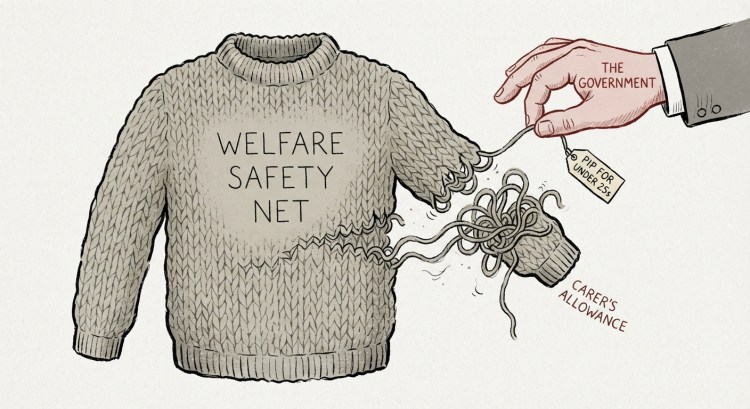
The link between disability benefits and carer support is a classic case of the welfare system’s favourite game: “Pull One Thread and the Whole Jumper Unravels.”
Under current UK rules, Carer’s Allowance is essentially a sidecar attached to Personal Independence Payment (PIP). If you remove the PIP motorbike, the carer’s sidecar goes flying into a ditch. To get Carer’s Allowance, you must be looking after someone who gets a qualifying benefit like the PIP daily living component. No PIP means no Carer’s Allowance—leaving everyone involved trying to pay for groceries with “good vibes” and “economic inactivity statistics”.
This whole debate kicked off thanks to the Milburn Review, an independent report on youth unemployment that decided the best way to handle under-25s on health benefits was a radical makeover.
Strip under-25s of traditional PIP and health-related Universal Credit.
Hand them a shiny new “youth allowance” mixed with a tightly restricted “additional costs allowance.”
The review argues the current system tells young people, “Here’s some cash, good luck,” instead of actually helping them into jobs or training.
Whether these proposals will actually get young people into work and training is the billion-pound question, and the answer depends entirely on who you ask.
This specific worry—that the “cuts” will happen instantly while the “support” never actually materialises—is precisely what has welfare experts, charities, and families terrified. History shows that slashing a budget happens remarkably fast, but building a fully functioning, supportive public service takes years.
The concern that the vulnerable will simply be left behind highlights a massive gap between the theory of the report and the messy reality of how governments actually operate.
When it comes to government policy, the timeline for taking things away is almost always shorter than the timeline for building things up.
The phrase “speculate before you accumulate” is actually a very accurate description of how the Milburn Review is framed. Alan Milburn himself has admitted that his proposals will require the government to invest billions of pounds upfront into mental health services, training places, and career support, meaning the Treasury wouldn’t see any actual savings for nearly a decade.
In a perfect world, a government invests heavily in support, people get jobs, and the welfare bill goes down. In reality, the “speculating” often gets lost in political cycles.
The state might promise billions for training, but that money often goes to private contractors, consultancies, or massive bureaucratic frameworks rather than the individual. The young person doesn’t see a penny of it—they just get a mandatory appointment to go to a building and talk about working.
The ultimate structural trap of the system. The fear that the cuts will arrive by express delivery while the promised training and jobs get stuck in permanent bureaucratic transit is entirely justified by history.
Welfare policy is littered with “Guarantees” that sound spectacular on a minister’s press release but completely collapse on the ground. There are three massive structural reasons why these promises rarely materialise for the people who need them most.
Governments are excellent at launching grand initiatives, but notoriously bad at scaling them up to meet the actual demand.
For example, despite the government’s loud backing of youth training, data reveals that flagship initiatives like Labour’s Growth and Skills Levy face enormous friction—such as achieving only 160 apprenticeship starts over an eight-month period in its early iterations.
When a policy calls for 150,000 new training places, they don’t appear out of thin air. Colleges are already facing funding crises, and local businesses rarely have the staff to dedicate to mentoring a young disabled person who needs tailored adjustments. The “guarantee” quickly morphs into a list of oversubscribed, generic online modules rather than real, valuable workplace training.
When the government hires private contractors or sets targets for local Jobcentres to get young people into work, it creates a perverse incentive system known as “creaming and parking.
Providers focus all their resources on the young people who are already 95% ready to work—the ones who just need a CV polish or a single interview tip. They are the quick wins that hit the government targets.
Young people with complex mental health struggles, severe neurodivergence, or physical disabilities that require expensive workplace adjustments are quietly “parked”. They are kept on the books, sent to the occasional pointless mandatory meeting, and essentially forgotten about—except their original disability cash is still gone.
A legal duty on the government to offer a route to employment doesn’t magically force a private business to hire someone.
Research by the Business Disability Forum found that 84% of disabled young people believe their disability negatively impacts their job prospects, with fewer than half feeling confident even asking for the workplace adjustments they are legally entitled to.
If a young person does land an interview, the state-funded infrastructure meant to support employers—like the heavily backlogged Access to Work scheme—frequently takes months just to approve funding for basic equipment or travel assistance. An employer waiting for a position to be filled will simply move on to the next candidate.
Because the Milburn Review explicitly links a young person’s benefits to their “co-operation” with these schemes, the danger of a non-existent support system is terrifyingly high.
If a young person is told they must attend a training course to keep their standard youth allowance, but the local college has no spaces, or transport isn’t accessible, they end up trapped in a bureaucratic nightmare. They face benefit sanctions not because they refused to participate, but because the state failed to deliver the very program it legally promised them.

