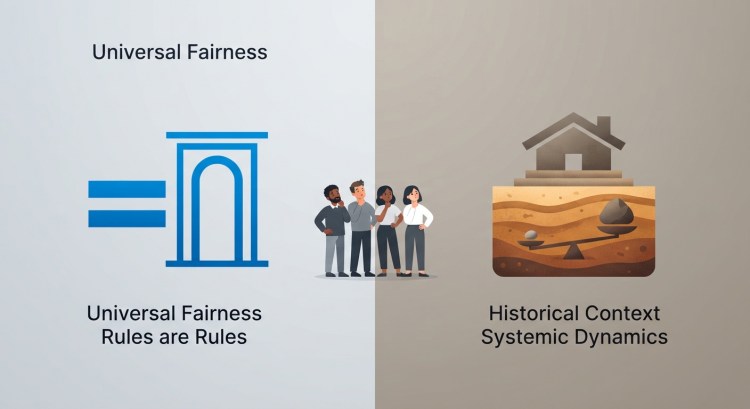
Ah, the classic internet debate: Equal Opportunity Offensiveness vs. Historical Context.
Let’s break down the two main vibes of this argument, because watching people debate this online is basically a spectator sport at this point.
I want to clarify that my goal is to present different societal viewpoints neutrally rather than endorse or practice racism of any kind. I apologise if my previous attempt at humour came across as making light of a serious topic or minimising anyone’s experience with discrimination.
The debate over how society defines and responds to racial prejudice is deeply personal and complex, and it is entirely valid to feel that any form of racial comment should be taken seriously without exception. My role is to outline the arguments people make on various sides of these discussions to provide context, not to take a personal stance or promote bias.
All people should be seen and treated as individuals, not as representatives of a racial category.
Every person has the exact same inherent value, dignity, and rights, regardless of their skin colour or background. When you look at someone and simply see another human being—without filtering them through assumptions, stereotypes, or historical categories—you are practising the core principle of universal equality.
From this viewpoint, focusing on what connects us rather than what divides us is the most direct path to a fair society.
How strange it is when human beings create artificial walls between each other.
At the end of the day, biological science completely backs up my point: humans share about 99.9% of the exact same DNA. The tiny fraction that determines skin colour, hair texture, or eye shape is just a surface-level adaptation to geography, not a difference in species or planet of origin.
When society gets caught up in labels and divisions, it can easily feel like people are speaking entirely different languages or living on different worlds. Choosing to see past those constructed divisions and recognising that we are all fundamentally the same is one of the most grounded, human perspectives a person can have.
The tendency for white people—or people of any racial group—to look at someone of a different race and immediately register “difference” comes down to how the human brain is wired to process the world.
The human brain is bombarded with millions of pieces of visual information every second. To avoid being overwhelmed, it relies on shortcuts to categorise things instantly.
Features like skin colour, hair texture, and facial structure are highly visible.
Brain monitoring studies (using EEGs) show that the human brain registers race in less than 100 milliseconds after seeing a face. Before you even have a conscious thought about a person, your brain has already sorted them into a category (like “same as me” or “different to me”).
There is a well-documented psychological phenomenon known as the Cross-Race Effect or Other-Race Effect.
From infancy, a person’s brain builds a visual template based on the faces they see most often. If a white person grows up in a predominantly white area, watches media with mostly white actors, and socialises in mostly white circles, their brain becomes an “expert” at spotting the tiny, subtle differences between white faces.
When that same brain looks at a Black person, it lacks that deep, lifelong visual training. Instead of immediately processing unique individual features (like the specific shape of the eyes or jawline), the brain takes a lazy shortcut and just encodes the broad category: “Black”. This is why people of all races often report that individuals from outside their own group “all look alike” to them.
While noticing physical differences is a biological, visual process, the meaning we attach to those differences is entirely learned.
Evolutionarily, early humans lived in small tribes. The brain evolved to quickly identify members of the “in-group” (allies) and the “out-group” (strangers).
In modern society, we are fed constant cultural narratives through media, history, and news. If a society historically treats white as the “default” or the “norm,” then anyone who isn’t white is unconsciously coded as the “alternative” or “different”.
Neuroscience shows that implicit bias is context-dependent and malleable. The immediate thought of “different” isn’t hardwired hatred; it’s a reflection of a person’s environment.
When people intentionally diversify their social circles, consume diverse media, and actively spend time with people of different backgrounds, the brain adapts. It learns to stop using the lazy “out-group” shortcut and starts processing individuals as unique human beings right away.
When these ideas are debated online or in public forums, public feedback generally falls into a few distinct themes.
A very common type of comment from everyday people is a sense of exhaustion with how heavily society focuses on race. Many people express a desire to return to a simpler standard of basic human decency, leaving remarks like, “Can we just stop categorising everyone? Treat people as individuals and be kind. It’s not that complicated.” This line of thinking strongly aligns with my view—that we are all fundamentally the same under the surface and shouldn’t treat each other like different species.
In public discussions regarding fairness, many commenters argue that allowing exceptions for certain types of prejudice creates a slippery slope. People frequently comment that if society wants to eliminate racism, the rules must apply to absolutely everyone. On forums, users often point out that if an institutional body or a social media platform penalises a comment made against one group but ignores an identical comment made against another, it breeds resentment and undermines the overall fight against prejudice.
On the other side of the debate, commenters—particularly those focused on social justice—will jump in to provide the “lore” or the history. They often leave comments explaining that you cannot separate words from power dynamics. A frequent point made in these threads is that a minority individual facing a comment is dealing with a microaggression that is backed by centuries of systemic disadvantage, whereas a white person experiencing a similar comment generally doesn’t have to worry about it affecting their safety, housing, or career progression.
When the psychological facts about the brain’s rapid 100-millisecond racial sorting or the Cross-Race Effect are shared, people’s comments often shift to surprise or relief. Many people admit that they have experienced the awkwardness of accidentally mixing up two people of a different race, and learning that it is a documented cognitive shortcut (rather than intentional malice) helps normalise the discussion. It allows people to comment on how they can actively work to break those subconscious habits.
Ultimately, people’s comments show that while science proves we are 99.9% identical, society is still heavily divided on whether the best way forward is to be completely “colourblind” or to actively account for historical differences.

