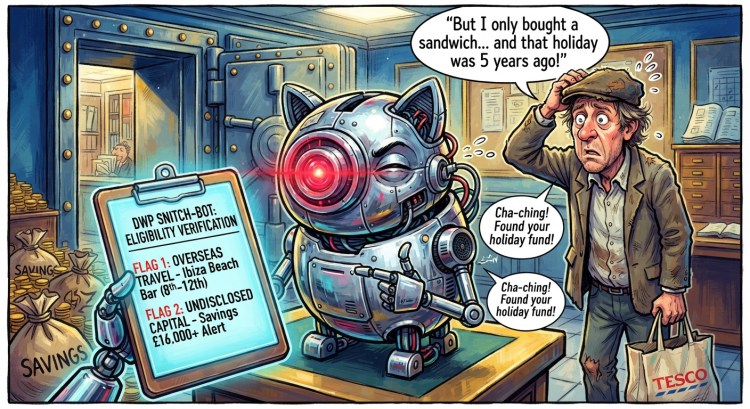
The Great Upfront Bank Snooping Plan: RIP
The original masterplan was peak “tech-bro efficiency.” The government wanted you to essentially hand over your internet banking password via an Open Banking portal before you could get a single penny of Universal Credit.
It was scrapped for two incredibly hilarious, yet painfully predictable reasons.
Legally, they had to ask for your permission to look. Turns out, if you tell someone, “Hey, can we rummage through your bank statements to prove you’re lying to us?” most people say, “I’d rather you didn’t, thanks.”
Building a giant government super-portal capable of smoothly logging into millions of different banking apps without bursting into flames was deemed an IT disaster waiting to happen.
Instead of the DWP knocking on your digital front door, they’ve just hired the banks to act as neighbourhood gossips. The UK’s 15 biggest banks have been given automated filters to passively watch for two very specific things that make civil servants sweat.
If your savings account starts looking a bit too healthy (specifically over £16,000), a digital alarm bell rings.
If your debit card suddenly pings at a beach bar in Ibiza when you’re supposed to be job-hunting in rainy Manchester, the bank notes down the date. Stay abroad too long, and you get flagged.
Don’t worry, a stressed bureaucrat isn’t sitting in an office in Whitehall critiquing your lifestyle choices. The banks are legally banned from sharing the fun stuff.
They don’t know you spent £25 on chicken nuggets.
Your OnlyFans Subscriptions. Completely safe from government scrutiny.
They can’t see you down to your last £4.20 on a Thursday night; they only get alerted if you pass the threshold.
Essentially, the government stopped trying to pick your digital pockets upfront and settled for putting a tracking chip on the bank’s computers instead.
Can they see if I have any other bank accounts?
Yes, but only if they’re with the same bank. The automated snitch-bot protocol has a very strict boundary: it can’t look across the fence to other banking brands.
The algorithm scans the account where your Universal Credit is paid. If that account triggers a flag (like hitting a balance threshold), the bank is legally required to check and report all other accounts you hold under their roof.
If you get Universal Credit into a NatWest current account, NatWest will automatically scan your NatWest ISA, your NatWest savings account, and any NatWest joint accounts you share with a partner.
NatWest has absolutely no idea if you have a secret £20,000 tucked away in a Barclays or Monzo account. They cannot see it, so they cannot flag it.
Under the Eligibility Verification Measure (EVM) rules, the DWP is strictly forbidden from doing a cross-bank dragnet search.
They do not have a master key to the UK banking system.
They do not routinely pull your credit file (like Experian) to hunt for ghost accounts during these automated checks.
The system is entirely “siloed”—each bank only looks at its own digital ledger.
While the automated system won’t catch an account at a different bank, a human investigator will.
If your primary bank triggers a flag and the DWP opens a formal fraud investigation, human handlers step in with separate, much heavier legal powers. If it gets to that stage, they can demand financial records from any bank in the UK, apply for court orders, and look at your tax history to see where interest is being paid.
So, while the automated robot is blind to your accounts at other banks, the human investigators definitely aren’t if they have a reason to look.

