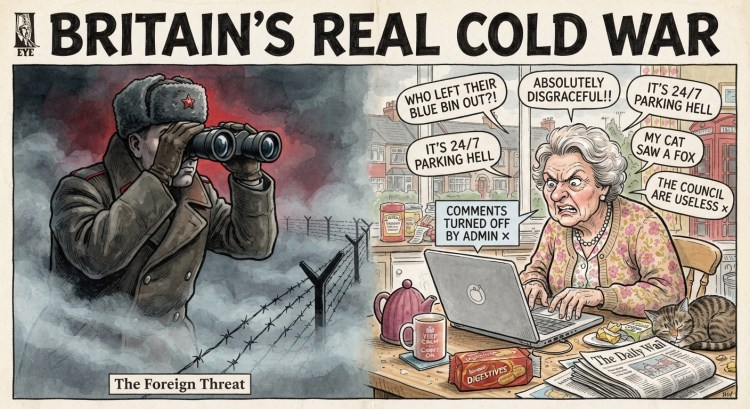
When people warn that Britain’s biggest threat isn’t Moscow, it’s “our own,” political satirists and exhausted commuters generally agree that the real Cold War is being fought in the comment sections of local Facebook groups.
While intelligence chiefs at MI5 and MI6 solemnly warn that the global security environment is the most perilous since World War II, observers of British daily life argue that foreign adversaries barely need to lift a finger when we are already doing such a thorough job of winding each other up.
According to defence officials and NATO analysts, hostile foreign states are working overtime to sow chaos in the West through cyberattacks, sabotage, and disinformation.
Intelligence agencies warn that Russian operatives are trying to disrupt critical infrastructure and polarise the public.
Comedians often point out that any Russian troll farm trying to divide Britain is wasting its budget—all you have to do to spark a civil war in a British village is suggest putting a new cycle lane near the high street or debate whether the jam goes on before the cream.
Meanwhile, social commentators and satirists argue that the true menace to national stability is completely homegrown.
Critics of modern British culture joke that the KGB could only dream of the surveillance capabilities currently wielded by a retiree on the Nextdoor app investigating who left a recycling bin out on a Thursday.
Political commentators frequently note that while authoritarian regimes rely on state propaganda to demoralise the population, Britain achieves the exact same effect by announcing a new 20-year infrastructure project, cancelling half of it, and replacing the rest with a temporary traffic light.
As panel shows like Have I Got News for You often highlight, the country isn’t going to be brought to its knees by a foreign superpower—it’s going to collapse because two neighbours spent six months in a passive-aggressive standoff over an overhanging Leylandii hedge.
In short, security experts say we need to defend our borders from external aggression, while British homeowners say we mostly need to defend our driveways from Derek at Number 42.
If you look at modern Britain, comedians and retail analysts alike would agree that the country isn’t sleepwalking into authoritarianism—it’s just clicking “Add to Basket” on a £1.89 garlic crusher with free shipping.
While political commentators fret that voters aren’t paying enough attention to Westminster, social satirists argue that the average Briton has simply looked at the state of Parliament, looked at a crocheted frog wearing a tiny cowboy hat on Etsy, and made a completely rational choice.
According to political scientists and polling firms like Ipsos, public fatigue with politics is running high—and satirists have a few theories on why Temu and Etsy are winning the battle for British minds.
As comedians often point out, if you order a suspiciously cheap air-fryer liner from Temu, there is at least a 60% chance it arrives within ten days and vaguely resembles the photo—a delivery record that would instantly qualify it to run the Department for Transport.
Psychologists note that people turn to retail therapy when they feel powerless. You can’t stop interest rates from rising or fix the NHS, but you can spend forty minutes comparing 47 identical LED toilet nightlights at 11:30 PM, and honestly, that feels like leadership.
When you bring up the fate of the nation at the pub and get hit with a breezy “sorry, not into politics, mate,” comedians and cultural observers agree you have just witnessed Britain’s greatest self-defence mechanism in action.
In the UK, saying “I’m not into politics” rarely means “I have no opinions.” According to British social etiquette, it actually translates to: “I am three pints deep, I’ve paid £7.40 for this lager, and I am not letting you ruin my Friday night with a TED Talk about fiscal policy.”
Social commentators and pub philosophers have decoded what your mates are really thinking when they deploy that phrase.
“I saw what happened to the group chat in 2016”: Political scientists note that millions of British friendships are still suffering from PTSD after the Brexit referendum turned a simple discussion about fishing quotas into a four-year blood feud. Nobody wants to risk a sequel over a bowl of dry-roasted peanuts.
“I have strong opinions, just not on Westminster”: As comedians often point out, the exact same bloke who claims he “doesn’t follow current affairs” will instantly deliver a 45-minute, passionately researched monologue on VAR officiating, why Match of the Day has gone downhill, or the criminal shrinkage of a packet of Monster Munch.
“Please don’t make me do homework”: Bringing up politics in a British pub feels less like a chat and more like someone unexpectedly handing you an A-Level exam paper while you’re trying to eat scampi fries.
When people say the British public is “politically illiterate,” comedians and political observers tend to agree that it’s less of a learning disability and more of a survival strategy.
After all, trying to understand how the UK government actually works requires the kind of stamina usually reserved for reading an IKEA flat-pack manual in the dark while someone yells at you about council tax.
Political satirists and researchers at places like the Hansard Society point out that Britain didn’t exactly design its political system to be user-friendly.
As comedians frequently joke, Westminster operates like a Victorian cosplay society. Nobody knows what a “Select Committee,” a “Three-Line Whip,” or “Black Rod” actually does, and at this point, most MPs are too afraid to ask. If you tell the average voter that a bill is in the “Ping-Pong stage,” they’ll naturally assume politicians are playing table tennis—which, honestly, would be more productive.
Education campaigners note that British schools teach you how to calculate the hypotenuse of a triangle and the chemical symbol for potassium, yet somehow forget to mention how a general election works, what a manifesto is, or why your bin collection keeps changing days.
Social commentators observe that most Britons don’t read 100-page party manifestos; instead, we judge politicians strictly on deeply scientific criteria—such as whether they look weird eating a bacon sandwich, or if they have the trustworthy face of a regional newsreader.
Satirists are quick to defend the British public, noting that while we may be illiterate in constitutional law, we hold PhDs in far more practical subjects.
Put a British voter in front of a ballot paper, and they’ll freeze, yet they can recite the entire voting history, alliance strategy, and emotional breakdown timeline of every contestant on The Traitors or Love Island.
Ask someone who the Chancellor of the Exchequer is, and you’ll get a blank stare; ask them why the high street has three Turkish barbers, two vape shops, and a permanently dug-up roundabout, and they will produce a 40-slide PowerPoint presentation from memory.
In short, the British public isn’t politically illiterate—we’ve just collectively decided that learning the rules of a game where the referees make it up as they go along is a terrible use of a Tuesday evening.

