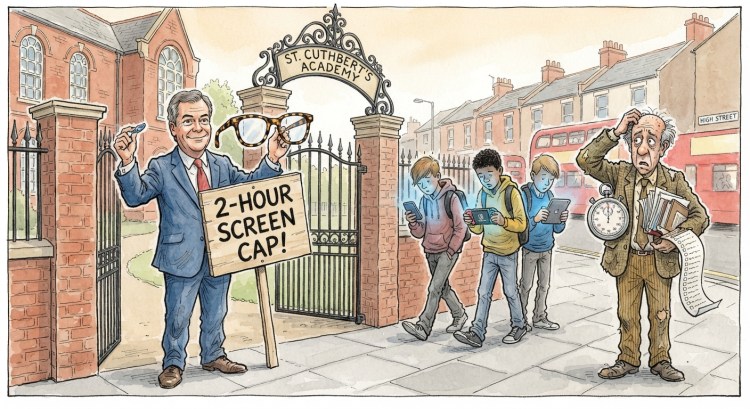
In a bold pivot back to the 1990s, Conservative leader Kemi Badenoch and Shadow Education Secretary Laura Trott have announced a policy proposal to rescue Britain’s youth from the glowing abyss of classroom tablets and bring back the heavy, spine-bruising glory of paper textbooks.
While the Conservatives are pitching this as a heroic stand for eyesight and literacy, the current Labour government and education critics have pointed out a few minor logistical hiccups—such as how you actually police a teenager’s screen time once they leave the school gates.
According to the Conservative Party announcement, a future Tory government would roll out the following retro upgrades.
Early years classrooms would go completely screen-free, primary schoolers would only touch a keyboard for computing lessons, and secondary students would face a strict two-hour daily screen cap—homework included.
The party plans to launch a £250 million textbook fund to hand out three physical textbooks per pupil, paid for by raiding the £900 million schools currently spend on educational technology (EdTech).
The Tories want to halt plans for digital exams and slash coursework so students can no longer ask a chatbot to write their history essays five minutes before the bell.
Parents would get the legal right to opt their kids out of screen-based homework, which will surely delight children everywhere until they realise it just means doing worksheets with a biro instead.
Backers of the plan say it is time to stop treating classrooms like Apple Stores.
The Conservatives point to warnings from over 150 medical experts and the Health Professionals for Safer Screens campaign, who argue that staring at screens all day is wrecking children’s sleep, speech, eyesight, and ability to sit up straight.
Shadow Education Secretary Laura Trott noted that nearly a million kids spend almost every lesson on a device with little proof it actually makes them smarter. Plus, you cannot accidentally open TikTok on a laminated paperback.
The Department for Education and Labour politicians were quick to poke holes in the nostalgia trip.
A Department for Education spokesperson pointed out that schools buy their own tech, and that £900 million pays for boring, essential things like safeguarding software, attendance registers, and accessibility tools for students with special educational needs—not just shiny iPads.
Critics noted that almost all UK exams are already taken with pen and paper, making a pledge to “halt” digital exams feel a bit like pledging to stop flying cars.
Observers have wondered how teachers are supposed to enforce a two-hour daily screen limit at home, short of stationing a teaching assistant outside every teenager’s bedroom door with a stopwatch. Meanwhile, the Department for Education noted it is already writing its own screen-time guidance, while critics suggested fixing crumbling school roofs and teacher shortages might be slightly higher on the to-do list.
Public reaction on social media to the Conservative Party’s plan to swap classroom tablets for pens and paper has split the internet right down the middle—pitting nostalgic parents thrilled to smash the family iPad against teachers, tech workers, and sarcastic commenters wondering if slate chalkboards are next on the manifesto.

