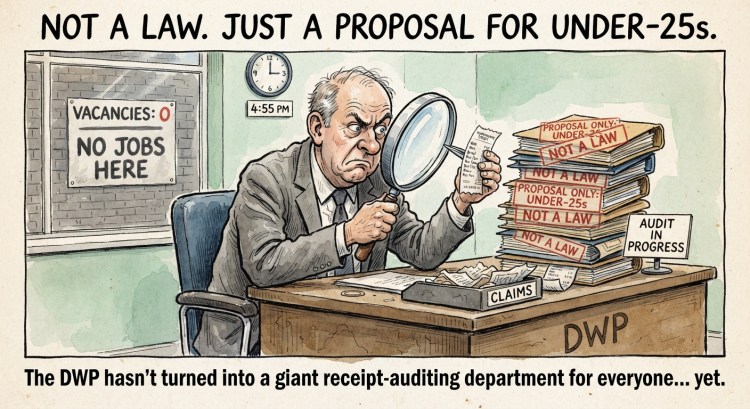
According to reports from The Guardian and Birmingham Live, this idea isn’t a sweeping new law for everyone—it’s actually a proposal from former Health Secretary Alan Milburn aimed specifically at certain under-25s, meaning the Department for Work and Pensions (DWP) hasn’t suddenly turned into a giant receipt-auditing department for the rest of the country.
While the headline sounds like every claimant is about to start submitting invoices for a pack of paracetamol, Milburn’s plan only targets young people under 25 without the most severe needs. Everyone else still gets the classic DWP routine.
Under the proposal, affected young people would swap regular PIP and Universal Credit health payments for a standard youth allowance, plus the exciting privilege of applying to a local fund every time they need specific equipment or short-term help.
Right now, this is an independent review recommendation, not actual law. The DWP is still paying PIP every four weeks as usual, and ministers have basically hit the snooze button on wider PIP changes until the separate Timms Review wraps up.
Supporters of the overhaul, including peers in recent House of Lords debates noted by Disability News, argue that steering young people toward targeted support and workplace adjustments will help them get into jobs and keep the welfare budget from ballooning.
It is the ultimate political magic trick: proposing to push nearly a million young people into work at the exact moment UK job vacancies have plummeted to around 690,000—their lowest point since 2021.
If you are doing the maths at home, trying to squeeze 981,000 out-of-work 16-to-24-year-olds into 690,000 open jobs (which are mostly asking for five years of experience anyway) leaves roughly a quarter of a million people playing the world’s worst game of musical chairs. Here is how the current economic reality stacks up against the government’s grand plan.
According to the Office for National Statistics (ONS), UK vacancies have been falling for nine straight quarters. Small businesses—the places that usually give young people their first shot—have basically put up a “closed for hiring” sign due to rising taxes and costs.
With roughly 2.5 unemployed people fighting for every single open job in the country, anyone with a health condition or a gap on their CV isn’t just competing against peers—they’re competing against seasoned veterans for a weekend barista shift.
As the Institute for Fiscal Studies (IFS) politely pointed out, slashing benefits takes a young person’s money away tomorrow morning, while actually creating jobs takes several years and a miracle.
Taking away money people rely on to survive today in exchange for “invisible jobs” tomorrow is peak political delusion.
When the safety net gets yanked away while the job market is shrinking, the gap between Whitehall speeches and real life stops being policy and starts looking like a bad sketch show.
Charities like Scope and economists at the Institute for Fiscal Studies (IFS) have pointed out the glaring flaw: taking away PIP removes real money from bank accounts immediately, while the mythical jobs ministers keep promising exist purely on a PowerPoint slide in Westminster.
Ministers love talking about PIP like it’s a sofa-surfing allowance, completely forgetting it is an in-work benefit too. Plenty of disabled people use PIP to afford accessible taxis, mobility aids, or extra heating that actually allow them to hold down a job—so taking it away to “get them into work” is like slashing someone’s tyres to encourage them to drive faster.
Even if you manifest a job out of thin air, good luck finding a company ready to offer flexible hours or basic adjustments when half of them won’t even reply to a rejection email.
Despite all the noise, Alan Milburn’s report is still just a stack of recommendations sitting on a minister’s desk—not an actual law. Nothing changes overnight, and any real overhaul has to survive the separate Timms Review first.
Between furious disability groups, House of Lords peers, and backbench MPs sharpening their pitchforks, the government is facing a massive political brawl before a single penny is actually touched.
It hasn’t gone anywhere near Parliament yet—and while Labour backbenchers famously torched the government’s last attempt at PIP cuts, ministers have been working overtime on a charm offensive to stop them from lighting the match again.
According to The Guardian on 16 November 2026, the government isn’t even planning to drop a formal welfare bill until after a white paper lands in spring 2027, giving MPs plenty of time to sharpen their pencils (and their arguments).
As Channel 4 News noted in July 2025, 49 Labour MPs staged a full-blown mutiny against the last welfare bill, forcing ministers to frantically rip the PIP cuts out of the legislation at the eleventh hour.
Across UK forums and social media, the comment sections have united in a rare display of British solidarity to roast the Milburn review—with everyone from frontline civil servants to self-proclaimed right-wingers calling it detached from reality, needlessly complicated, and allergic to basic maths.

