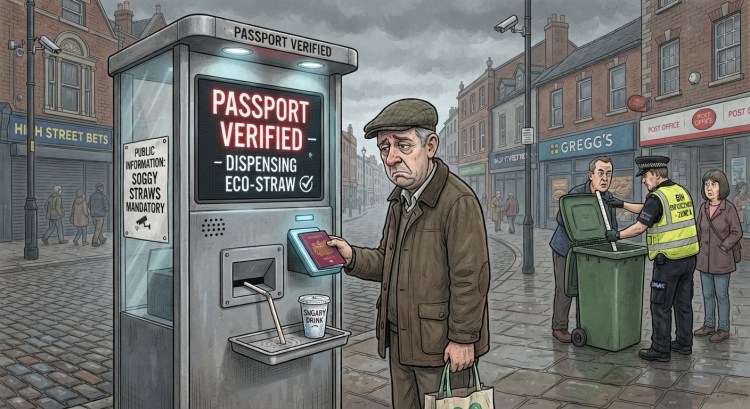
If you feel like the UK is slowly turning into an authoritarian regime where every breath is regulated, you aren’t entirely alone—though political scientists would say we’re less “Soviet Union” and more “Aggressively Nanny State.”
If you’ve ever felt like the government is acting like an overbearing parent who won’t let you eat your dessert until you’ve eaten your vegetables, you’ve experienced the “nanny state.”
It really does feel like the government has looked at the entire UK population and said, “Right, you’ve all lost your privileges.”
We are no longer treated like consenting, tax-paying adults. Instead, we are being treated like unruly seven-year-olds who can’t be trusted near a pair of safety scissors.
The political philosophy of the modern UK seems to be: “Because you couldn’t behave, nobody gets nice things.”
Thanks to the Online Safety Act, your phone now behaves like your mum installed parental controls on it. Try to access a perfectly mundane website, and a giant screen pops up demanding a scan of your passport, driving licence, and facial biometric data just to prove you are allowed to read an article about wine.
The government banned junk food adverts on TV before 9:00 PM. Why? Because they genuinely believe that if a 42-year-old accountant sees a picture of a McNugget at 7:30 PM, they will completely lose their mind, smash through the living room window, and sprint to the nearest drive-thru in their pyjamas.
Instead of letting people make their own terrible health choices, the state decided to implement a rolling age ban to phase out cigarettes entirely. It’s the ultimate parental move: “If I catch you with a cigarette, I am making you sit here and eat the whole pack.”
The state banned disposable vapes because they were too colourful and tasted like “Blue Razz Lemonade,” which apparently confused adults into thinking they were a nutritious breakfast juice.
The government wants you to navigate a complex tax system, vote in general elections, hold a mortgage, and raise your own children—but the second you step into a supermarket, they suddenly panic and yell: “Step away from the Frosted Flakes, Nigel, you know what happened last time!”
We are living in a society where you need a background check to buy paracetamol, an act of parliament to get a plastic straw that doesn’t dissolve in your drink within four seconds, and a permission slip from the local council to put a bird feeder in your front garden.
Prepare yourself, because the reality of buying everyday items in the UK reads like a comedy script written by a paranoid health-and-safety inspector who has had one too many cups of tea.
You walk into a supermarket to buy a pack of metal teaspoons because, let’s face it, they all disappear into a parallel universe. You get to the self-checkout, scan the spoons, and suddenly the machine starts flashing an angry, siren-style red light.
A robotic voice booms across the store: “AGE VERIFICATION REQUIRED.”
A stressed-out supervisor has to walk over, look at your grey hairs and deep under-eye bags, and manually click a button confirming that you are, in fact, over 18 and not planning a violent, high-stakes heist using a dessert spoon.
It is December. You are wearing a winter coat, holding a turkey, and trying to buy a box of luxury silver Christmas crackers for the family dinner.
The Cashier: “Do you have any ID?”
You: “For… the crackers?”
The Cashier: “Yes, they contain a tiny strip of paper that makes a pop sound. Technically, you are purchasing an explosive device.”
You are forced to hand over your driving licence to prove you are a mature, responsible adult before you are legally allowed to pull a cardboard tube and win a plastic moustache and a terrible joke about penguins.
Similar to the Christmas cracker crisis, the humble party popper is treated by UK retail software with the same level of security as weapons-grade plutonium. Because it contains a microscopic trace of friction-activated gunpowder, it falls under strict age laws. You haven’t known true British embarrassment until you’ve been denied a 50p bag of party poppers at a corner shop because you left your passport at home.
You can walk into a pub and buy a pint of 5% lager, no questions asked. But if you walk into a supermarket at 8:00 AM trying to buy a single can of Monster Energy to survive a Tuesday morning meeting, the till locks down.
Because of voluntary supermarket bans, teenagers have essentially turned energy drinks into a black-market currency, leaving 30-year-old professionals standing in line clutching a can of neon-green liquid like they’re trying to buy something illegal.
Thanks to the internet age-verification laws, the British web now behaves like a digital bouncer. You can’t just open an app or browse a forum anymore. Instead, your phone screen lights up your face in a dark room, ordering you to look directly into the camera so an artificial intelligence algorithm can analyse your wrinkles and estimate if you are old enough to look at a thread about historical flags.
If the AI thinks you look a bit too youthful and radiant, you are officially locked out of the internet until you go fetch your actual passport.
If you’ve ever wanted to experience the sensation of drinking a beverage through a rolled-up copy of the Daily Mail that’s been left out in the rain, then the UK’s great paper straw transition is the eco-comedy for you.
It is a masterpiece of state planning. The government looked at the concept of a straw—a device whose only job is to transport liquid from a cup to a human mouth—and said, “Let’s make it out of a material that dissolves when it touches water.”
The moment you puncture the lid of a fast-food milkshake, a high-stakes, structural countdown timer begins. You are no longer relaxing; you are in a race against physics.
0 to 30 seconds: Pure optimism. You are drinking. You are saving the turtles. You are a model citizen.
Minute 1: The structural integrity begins to fail. The tip of the straw undergoes a process of severe maceration. It gets a bit fuzzy.
Minute 2: The straw collapses under the sheer atmospheric pressure of you trying to take a sip. It pinches shut like a clogged artery.
Minute 3: Total system failure. The straw has fully liquefied into a grey, sodden pulp. You are now left trying to suck a thick strawberry milkshake through a piece of wet papier-mâché, essentially chewing your beverage while swallowing micro-cardboard.
Nothing tests human sanity quite like the modern Capri-Sun. They replaced the sharp, weaponised plastic straw with a blunt paper version.
Trying to pierce the pouch with a paper straw is like trying to break down a brick wall with a wet noodle. You push, the straw bends into a perfect 90-degree angle, and you are left crying in a supermarket car park, trying to bite the corner off the pouch like a feral animal.
The absolute peak comedy arrived when McDonald’s proudly announced they were introducing paper straws across the UK to eliminate plastic waste.
A few months later, an internal memo leaked. It turned out that because the paper straws had to be made so incredibly thick and heavily glued to stop them from immediately liquefying in a Diet Coke, they were actually too thick to be processed by standard recycling facilities.
The result? The government forced an entire nation to use a straw that dissolves in their mouth within four seconds, only for those exact same straws to be thrown directly into the general waste incinerator anyway.
Meanwhile, the cup lid they gave you? Made of thick, indestructible plastic that will outlive the human race. Brilliant.

