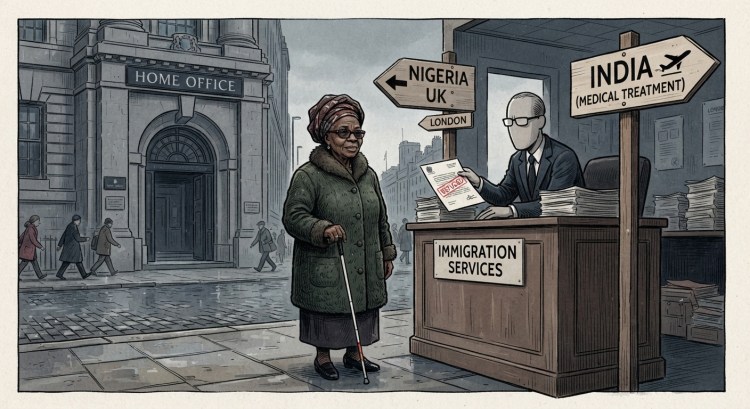
A blind Nigerian pensioner who has lived in the UK for 26 years has been told by the Home Office she can safely go to India, a country she has never visited, for medical treatment.
This refers to a recent news story reported by The Guardian regarding a 67-year-old blind Nigerian woman living in the UK who received a Home Office refusal letter mistakenly referencing medical treatment in India.
The woman, referred to in reports as “Comfort” to protect her identity, arrived in Britain in 2000 and lost her sight shortly after due to acute glaucoma. She was granted leave to remain in 2022 under 20-year long residence rules.
Due to her age and disability, lawyers at Refugee and Migrant Justice applied for an exceptional grant of Indefinite Leave to Remain (ILR) so she would not have to continue renewing her visa.
Under tightened settlement rules announced by Home Secretary Shabana Mahmood in November 2026, applicants on her route may face waiting up to 20 additional years—renewing visas every 30 months—before qualifying for permanent settlement, which would leave her waiting until her 80s.
While the first part of the Home Office’s rejection letter stated she could return to Nigeria because services for blind people exist there, the concluding section stated her circumstances were “not so severe or lacking in potential treatment in India that it would warrant indefinite leave to remain.”
Comfort stated she has never visited India and has no connection to the country. Following media coverage, Home Office sources indicated the reference to India was an error and that an updated, corrected refusal letter was being prepared.
The sixfold increase refers to refugees who entered the UK via irregular routes (such as small boats), whose qualifying wait for Indefinite Leave to Remain (ILR) increases from 5 years to up to 30 years under the new “Earned Settlement” rules announced by Home Secretary Shabana Mahmood on 2 November 2026.
Under the Home Office Earned Settlement framework, the standard five-year pathway to permanent settlement is replaced by a tiered system.
| Refugees (irregular entry, e.g., small boats) | 5 years | Up to 30 years (20-year baseline + 10-year penalty) |
| Refugees (other asylum routes) | 5 years | 20 years (reducible to 10 years if working or studying) |
| Migrants with immigration breaches / public funds | 5–10 years | 20 years |
| Standard work & migration routes | 5 years | 10 years (new default baseline) |
| High earners (£50,271+) & key public service workers | 5 years | 5 years (3 years if earning over £125,140) |
Organisations including Right to Remain and the Work Rights Centre have criticised the decision to apply the extended timelines to people already living in the UK who have not yet secured ILR, including pre-March 2026 asylum claimants.
The case and the broader settlement changes have drawn sharp criticism from Comfort herself, campaigners, disability advocates, and policy commentators, while the government has defended its framework on grounds of fairness.
Speaking to The Guardian, Comfort emphasised her deep ties to Britain—her church, friends, and voluntary work—stating: “I’m a good citizen, not a law-breaker and am begging the Home Office to have mercy on me and grant me indefinite leave to remain now, rather than making me wait 20 more years.”
Regarding the erroneous refusal letter, she added: “I don’t know why the Home Office said I could go back to India. It’s a country I have never visited and have no connection with.”
Head of campaigning Nick Beales described the government’s approach as “cruel and counter-productive,” arguing there is “no public interest in making her continue to renew her visa” and warning that doubling settlement timelines will worsen errors when “decision-makers cannot even differentiate between India and Nigeria.” He also questioned why the Home Office is forcing applicants in their 60s, 70s, and 80s onto 10- to 20-year pathways they are unlikely to outlive.
The charity warned Disability Rights UK that the Earned Settlement model strips away protections for disabled migrants, placing disproportionate hurdles on people whose health conditions prevent full-time employment.
Policy analysts at the Work Rights Centre noted that 78% of individuals and 73% of organisations in the government’s own consultation deemed strict salary thresholds unfair to carers, mothers, and disabled applicants.
In a commentary on the Institute for Government, researcher Shaina Sangha argued that Home Secretary Shabana Mahmood’s overhaul was “badly handled from the start” and failed to anticipate operational and human consequences.
While declining to comment on individual cases, a Home Office spokesperson maintained on GOV.UK and in media statements that the Earned Settlement policy is “guided, above all, by fairness” toward British taxpayers and ensures applications are assessed on individual merits under the immigration rules.

