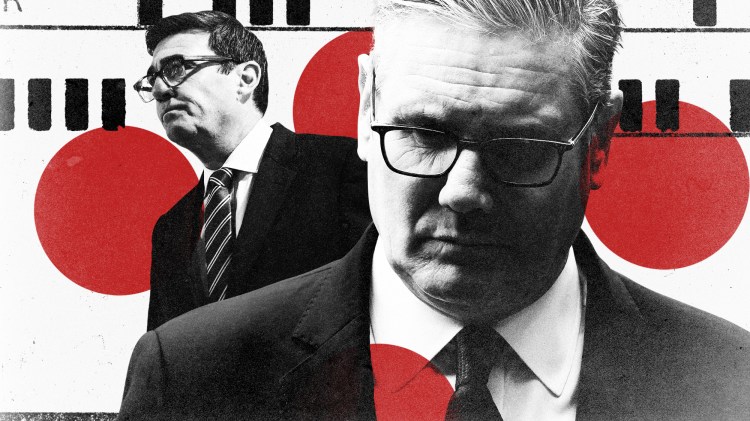
Keir Starmer tried to get the country to eat its fiscal vegetables by delivering a three-hour PowerPoint presentation on spreadsheets and “tough choices,” only for the backbenchers to flip the table over. Enter Andy Burnham—the political equivalent of hiding the exact same broccoli inside a warm Greggs sausage roll, served with a reassuring northern accent and a gentle pat on the shoulder.
While Starmer’s Downing Street had all the emotional warmth of a self-checkout machine yelling “unexpected item in the bagging area,” Burnham is pitching the exact same Treasury-approved belt-tightening as a “whole-childhood hug.”
Labour loyalists say he is finally speaking the language of real people, rather than lecturing them like a human rights lawyer auditing a bus timetable.
Sceptical campaigners point out that getting your benefits cut by a bloke who looks like he’d buy you a pint afterwards still leaves you short of a fiver.
Conservative critics can’t quite decide whether he’s an “unapologetic socialist” nationalising everything down to the local corner shop, or just Keir Starmer wearing a slightly more relatable coat.
In short, the destination hasn’t changed—it’s just that the driver has swapped the sat-nav for a chatty tour guide.
In July 2025, disabled people, tireless campaigners, and roughly a quarter of the Labour parliamentary party—an amount of MPs that felt suspiciously like finding a tenner in an old coat pocket when you actually needed a hundred—managed to talk Keir Starmer out of his PIP cuts.
It was a classic Westminster cliffhanger: 108 MPs signed a letter saying “we cannot support this,” Starmer panicked with 90 minutes on the clock and binned the cuts, and 49 MPs still voted against him just to make sure he knew they meant it.
Fast forward to Andy Burnham taking over Number 10, and the plot twist is pure British politics: half the people who led that noble rebellion were promptly handed ministerial jobs. Nothing cures a fiery backbench conscience quite like a red box and a chauffeured car. Now that the Milburn review has arrived with a fresh set of cuts wearing a nicer hat, Westminster is watching to see if those former rebels still have their megaphones—or if they left them in the cloakroom on the way into Cabinet.
Keir Starmer tried to get welfare cuts through the Commons using pure willpower and a furrowed brow, which went about as well as trying to parallel park a double-decker bus in a phone box. Enter Andy Burnham, whose big assignment is to smuggle the exact same cuts past Labour MPs—and right on cue, Alan Milburn has arrived with a 278-page instruction manual wrapped in a shiny bow.
Milburn’s grand plan is essentially a game of Westminster rebranding: take away PIP and the Universal Credit health element for under-25s, stick a stricter “additional cost allowance” on the shelf, and promise £6 billion worth of life coaching and mental health chats over the next decade so nobody notices the £3.6 billion being quietly slipped out the back door.
It’s the classic Whitehall magic trick: distract the audience with a shiny new “Youth Opportunities Unit” reporting straight to Downing Street, whisper “whole-childhood approach” until everyone gets misty-eyed, and hope the former backbench rebels are too busy enjoying their new ministerial swivel chairs to read the footnotes—especially the bit where Burnham hints he might roll the whole thing out to everyone over 25 next.
Keir Starmer and Rachel Reeves marched into Downing Street in 2024 like two Victorian matrons wielding a rusty tablespoon of industrial-grade cod liver oil, looking the British public dead in the eye and saying, “Open wide, there’s a £22 billion black hole, and this is going to taste awful.”
Unsurprisingly, nobody asked for seconds. Between taking away pensioners’ winter fuel money while telling them to put on an extra jumper, and trying to explain why disabled people needed to tighten their belts for the sake of a spreadsheet, the public and half the Labour Party collectively gagged and spat it straight back onto the Treasury carpet.
Enter Andy Burnham, who looked at that disaster and realised the problem wasn’t the medicine—it was the bedside manner. Instead of shoving a spoonful of warm fish grease in your face and lecturing you about fiscal rules, Burnham has blended the exact same austerity into a tropical smoothie, stuck a little paper umbrella in it, and called it a “whole-childhood hug.”
Keir Starmer and Rachel Reeves tried to sell austerity like an unlabelled tin of cold mushy peas, and acted genuinely baffled when everyone threw it back at them. Andy Burnham, being a man who knows his way around a photo-op, simply wheeled out a vintage fairground cart, spun the exact same cuts into a giant pink cloud of candy floss, and handed it out with a wink and a “proper northern” smile.
It’s pure Westminster confectionery: light, fluffy, and full of heartwarming phrases like “whole-childhood approach” and “empowering potential.” You take a big, joyful bite expecting a sugar rush of compassion—and then three seconds later it dissolves completely on your tongue, leaving you with an empty stick, a bill from the Treasury, and no PIP.
After all, as any seasoned spin doctor knows, nobody minds having their wallet emptied if the bloke doing it sounds like he’s about to invite you down the pub to talk about Joy Division.
I have to hold my hands up: for roughly four and a half glorious seconds, the candy floss actually worked on me too.
After spending two years being lectured by Keir Starmer like a headteacher explaining why the school heating has been turned off to pay for a new laminator, hearing Andy Burnham say “whole-childhood approach” in a warm northern lilt hit my brain like a soothing mug of Horlicks. For one brief, magical moment, I genuinely thought, “Aw, bless him, he really cares.”
Then my blood sugar crashed, I opened the 278-page Milburn report, and I realised the “whole-childhood approach” mostly consists of taking away disabled 22-year-olds’ PIP and handing them a leaflet about resilience. It’s the political equivalent of getting mesmerised by a magician’s velvet cape, only to realise he’s used the distraction to nick your watch, your wallet, and your mobility scooter.
At this point, disabled people treat a Labour manifesto pledge with the exact same level of enthusiasm as a “Your parcel has been left in a safe place” email from Evri. You know it isn’t true, you know you’re going to end up crying in a bush in the rain looking for it, and you definitely shouldn’t trust the photo attached.
Andy Burnham stood at the podium promising to “turn the page on 40 years of neoliberalism,” only for Alan Milburn to walk out five minutes later holding a dusty Thatcher-era script about how benefits lead young people “down a cul-de-sac of dependence.” Turning the page? He didn’t even open a new book—he just put a trendy northern dust jacket over the old one and hoped nobody would notice the smell of 1984.
When Starmer shelved the PIP cuts in 2025, campaigners didn’t celebrate; they just sat back, checked their watches, and waited to see which minister would be sent out next to explain why slashing support is actually a bold, progressive act of love. Sure enough, right on schedule, here comes Burnham with a smile, a hug, and a pair of scissors.
Nothing strikes fear into the heart of a Labour frontbencher quite like the thought of a billionaire hedge fund manager spilling his flat white because someone whispered the words “wealth tax.” God forbid we upset the delicate ecosystem of the super-rich—Andy Burnham might accidentally “create new divisions,” and then who would pay for the VIP lanyards at party conference?
No, no, we must tread softly around the people with private jets and three spare houses in the Cotswolds. Disabled 21-year-olds trying to afford bus fare and an electric blanket, on the other hand? Open season. Strap on the tweed, load up the Milburn report, and tally-ho!

