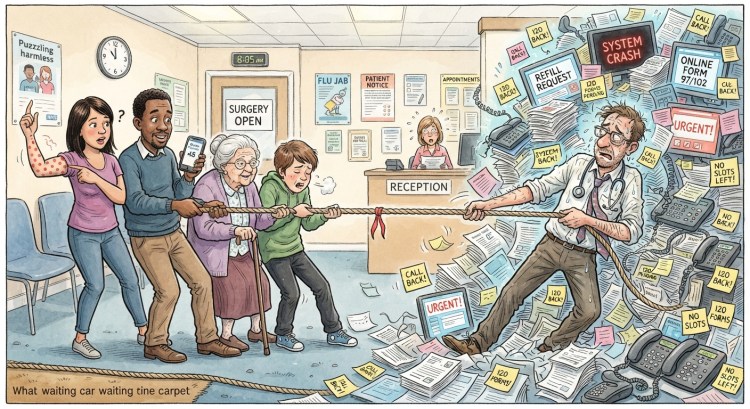
The battle over whether GP surgeries should offer more face-to-face appointments is essentially a tug-of-war between patients who want a doctor to actually look at their weird rash and exhausted GPs who are currently drowning in 8:00 am phone queues and digital triage forms.
While roughly two-thirds of NHS appointments happen in person, the remaining third has turned British primary care into a high-stakes game of medical charades.
Trying to describe a concerning lump over a crackling phone line—or uploading a blurry, poorly lit photo of your throat to an online portal—is nobody’s idea of cutting-edge diagnostics. Sometimes a doctor just needs to poke the thing that hurts.
Patients are tired of waking up at 7:59 am to dial their surgery 147 times, only to be told by a receptionist that all the appointments have vanished into thin air and they should try again tomorrow (or go to A&E for a mild earache).
Online triage forms often ask 45 mandatory questions just to get a prescription refill, leaving anyone without a smartphone, a degree in IT, or the patience of a saint completely stuck.
Seeing the same doctor in person builds trust—whereas speaking to a different locum on the phone every three weeks makes you feel like you’re constantly re-auditioning for your own medical history.
With full-time GP numbers shrinking and patient lists ballooning, demanding an in-person slot for every single query is like asking one barista to hand-craft 400 lattes before 9:00 am.
Nobody actually wants to take half a day off work, sit in a waiting room full of coughing toddlers, and read a 2019 copy of Country Life just to be told their blood test came back normal. A two-minute phone call is a blessing.
Recent NHS rules forced surgeries to keep online portals open all day to stop the 8:00 am phone rush. Ironically, GPs are now spending so much time reading essay-length online symptoms that they have less time to sit in a room with actual humans.
Policy experts warn that forcing surgeries to hit arbitrary face-to-face targets just means doctors end up dragging perfectly healthy people in for blood pressure checks while genuinely sick patients wait longer.
If you scroll through British Reddit threads and Healthwatch reports, the comment section on GP appointments reads like a collective nervous breakdown divided into two deeply exhausted camps.
One Healthwatch respondent summed up modern healthcare by describing how their surgery’s online triage form told them to call the reception desk to book an in-person appointment—only for the receptionist to tell them they needed to go back online and fill out the form again. It’s less “primary care” and more “an escape room with a fever.”
On r/AskUK, patients routinely compare calling their surgery at 8:00 am to trying to get Glastonbury tickets, except the prize is a 4-hour callback window where you aren’t allowed to go to the loo in case the doctor rings and hangs up after two rings.
On the flip side, plenty of Redditors are fiercely defending remote care. As one user put it, nobody wants to sit in a germ-filled waiting room for 45 minutes just for a doctor to say, “Yep, your blood test is fine, keep taking the tablets.”
Patients with weird rashes or mystery lumps are begging for human eyes, complaining that trying to diagnose a strange swelling over a crackling phone line feels like playing Pictionary with their internal organs.
Over on r/GPUK, doctors are lamenting that government rules forcing online portals to stay open all day have turned them into glorified email-readers. Instead of poking sore throats, they’re spending 12 hours a day reading 800-word essays submitted at 2:00 am about a mild toe cramp from 2019.
Clinicians frequently vent that half the people demanding a face-to-face appointment don’t actually need to be touched—they just want to look a doctor in the eye while asking for a sick note or more hayfever spray.

