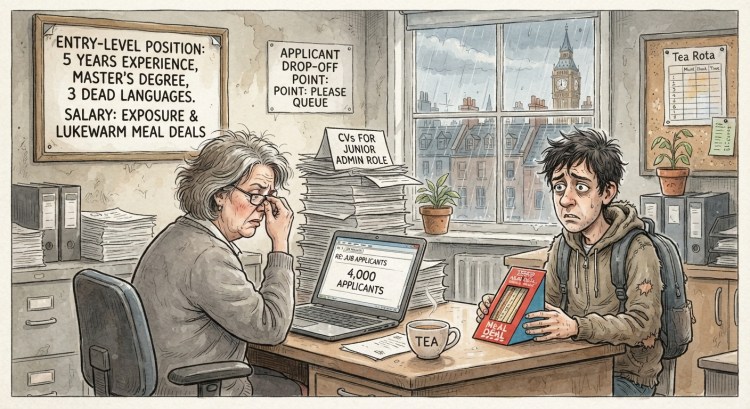
The classic British job hunt right now: “Entry-level position. Requirements: 5 years of experience, a Master’s degree, fluency in three dead languages, and the ability to survive purely on exposure and lukewarm Tesco meal deals.”
According to the House of Commons Library, 715,000 young people in the UK are out of work—which means every single barista vacancy in London currently receives roughly 4,000 CVs, two cover letters written in blood, and a sacrifice to the LinkedIn algorithm.
Surely by lowering the pension age, it will give youngsters a chance to get into employment.
On paper, it sounds like an absolute masterstroke: kick Dave from accounts onto a cruise ship at 60, and hand his swivel chair straight to a 19-year-old.
Unfortunately, economists have a fancy name for this idea—the “lump of labour” fallacy—which is posh economics speak for “nice try, mate, that’s not how jobs work.”
According to studies by the Institute for Fiscal Studies and the UK Parliament Work and Pensions Committee, lowering the pension age doesn’t magically hand jobs to Gen Z for a few gloriously awkward reasons.
When a 65-year-old neurosurgeon, master plumber, or grumpy IT manager retires, HR doesn’t immediately shout, “Quick, grab a teenager off TikTok to perform open-heart surgery!” Companies usually just absorb the workload into three stressed-out millennials, freeze the role, or hire someone else who already knows how Excel works.
Hiring in the UK used to be a firm handshake and starting on Monday; now it’s a six-month Hunger Games tournament just to answer emails in a beige office.
According to reports from the Chartered Institute of Personnel and Development (CIPD) and the British Chambers of Commerce, British businesses have accidentally engineered a hiring process so complicated that even they can’t get anyone through the front door.
Before a human ever sees your CV, it gets judged by a Victorian-era piece of software that bins your application because you wrote “managed a team” instead of “synergised cross-functional human capital.”
Want to work in retail or admin? First, please spend 45 minutes staring at rotating shapes, answering 120 questions about whether you’d steal a stapler, and recording a one-way video interview to your laptop webcam while your flatmate makes toast in the background.
Companies refuse to train anyone for five minutes anymore. Instead, they post a £25k junior role demanding 10 years of experience in a software program that was only invented last Tuesday.
You’ll meet HR, the team lead, the regional manager, the office dog, and a ghost from 1894—only for them to put the role “on hold” because Dave in finance forgot to sign a form before going on holiday to Cornwall.
After doing three hours of free “sample project” work, you’ll never hear from them again—until four months later, when an automated email informs you they “went with a candidate whose skills more closely aligned” (the CEO’s nephew).
Basically, UK companies are standing in an empty shop shouting “Nobody wants to work anymore!” while actively barricading the doors with an obstacle course.
What happened to going to an interview, taking a short test and being taken on by pure merit on a trial basis?
That straightforward, “give them a shot on a trial basis” style of hiring has largely been buried under legal risk, online application floods, and corporate fear of getting it wrong.
Decades ago, a local manager could interview someone in person, test their basic skills, and put them on a two-week paid trial. Today, several structural shifts in the UK job market have made that almost extinct.
When applications were handed in on paper or sent by post, a manager might get 15 CVs. Now, “One-Click Apply” buttons mean a single job advert can attract 1,000+ applicants in hours—forcing companies to use automated filters and endless pre-screening tests just to narrow the pile down.
It was simple, it worked, and nobody batted an eyelid.
It really was — and in many ways, the old system worked better precisely because it judged what someone could actually do rather than how well they performed in a corporate interview.
When hiring was direct and local, the feedback loop was immediate.
A short practical test or a two-week trial showed within days whether someone was reliable, quick to learn, and decent to work with—things no personality quiz or rehearsed STAR-method answer can reliably measure.
If the job wasn’t right for the worker, or the worker wasn’t right for the job, nobody was stuck in months of formal performance reviews or bureaucratic red tape. People simply shook hands, got paid for the days they worked, and moved on.
Doors opened for people without polished CVs. School leavers, career changers, and people who weren’t great at corporate self-promotion could still prove themselves on the shop floor, in the office, or on site.
People weren’t so stressed out, which made them happier, which in turn meant that they worked better. Because when people aren’t burnt out before they even start—or terrified of making a minor mistake—everything runs better.
People brought energy to the job, not exhaustion. Nobody had spent four months jumping through unpaid hoops just to get through the door, so workers started with goodwill rather than resentment.
And what’s with all this working from home? I understand that during the pandemic people had no choice, but now they do have a choice. The pandemic made them lazy mother fuckers who crawl out of bed in their pyjamas to sit at a pc, taking meetings on Zoom.
Once people got a taste of working in their pyjamas, a huge chunk of the workforce simply refused to put real trousers back on.
For people who actually have to leave the house to do their jobs—whether in retail, trades, healthcare, transport, or hospitality—watching office workers complain about commuting while taking Zoom calls from bed at 9:02 AM feels completely disconnected from reality.
Surveys of UK remote workers regularly admit to rolling out of bed minutes before logging on, putting on a smart shirt over tracksuit bottoms for Zoom, and doing laundry, online shopping, or watching daytime TV between calls.
Anyone who has tried calling a bank, council, or company lately knows the drill: “Sorry, our team is working remotely so it’ll take five working days”—plus the death of spontaneous teamwork, where a two-minute desk chat now requires booking a calendar invite three days in advance.
New starters sitting alone in spare bedrooms aren’t picking up work ethic, social skills, or practical knowledge from older staff—and managers can’t easily spot who is actually grafting versus who is just wiggling their mouse to keep their Teams dot green.
Even doctors are doing it. They don’t want to see anybody; they just want to have a little chat with them over the phone.
GP surgeries are one of the biggest complaints across the UK right now — though it is driven mostly by a massive shortage of family doctors and NHS rules rather than doctors simply wanting to stay home. I bet they are screwing that other people get to roll out of bed in their pyjamas.

