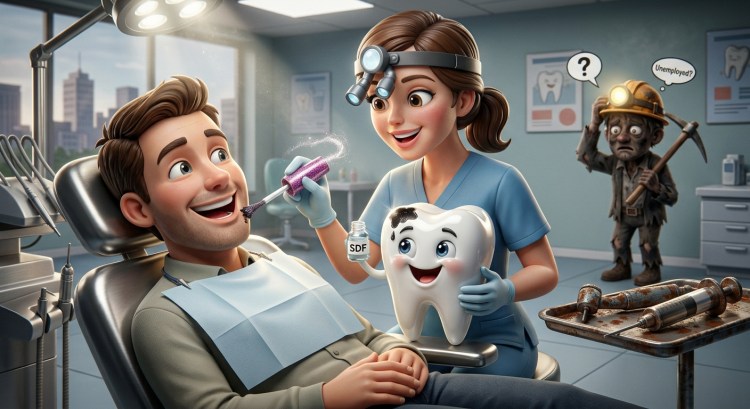
Silver diamine fluoride (SDF) is basically nail varnish for cavities that lets you skip the drill, the needle, and the existential dread of the dentist’s chair. Instead of excavating your tooth like a Victorian coal miner, your dentist just paints a magic liquid onto the decay and calls it a day.
It combines silver (which ruthlessly murders cavity-causing bacteria) with fluoride (which strengthens the weakened tooth). Think of it as a microscopic bouncer and a construction crew working a double shift.
Your dentist dries the tooth, smears a bit of Vaseline on your lips so you don’t end up with polka dots, and dabs the liquid onto the cavity for a couple of minutes. No high-pitched whirring noises required.
A major 2026 trial in JAMA Paediatrics involving 830 kids found that 38% SDF stopped cavities dead in their tracks 54% of the time after six months, compared to just 22.5% for the placebo group.
As the silver hardens the decayed mush, it permanently turns that specific spot pitch black or dark brown. Your healthy tooth stays white, so you get a lovely monochrome look that screams “I value function over vanity.”
If the liquid touches your gums or lips, it will leave a dark stain for one to three weeks. You can tell people you ate an exploding squid-ink pasta.
It freezes the decay; it doesn’t rebuild the tooth. If you have a crater big enough to store a Tic Tac, you will probably still need a proper filling later. It also won’t work if the decay has already reached the nerve.
In the UK, SDF is officially licensed for sensitive teeth, so dentists use it “off-label” to stop decay—meaning you just have to sign a quick consent form acknowledging the whole black-tooth situation.
Sadly, painting your teeth with silver doesn’t grant immunity from sugar, so you still have to brush twice a day like a responsible human.
In the UK, getting your tooth painted with silver diamine fluoride privately costs roughly £50 to £150, while the NHS charges £27.90 (Band 1) or £76.60 (Band 2)—or £0 if you’re lucky enough to qualify for free treatment.
The actual potion itself costs pennies per drop. One tiny bottle can treat a small village, so what you are really paying for is the dentist’s expertise, their rent, and the privilege of keeping their drill safely holstered.
Private dentists set their own prices, with London clinics like Dr Mali Dental Clinic charging around £149. Think of it as paying a small ransom to avoid a needle.
In England, preventative fluoride treatments usually sit in Band 1 (£27.90), while cavity-fixing courses of treatment fall under Band 2 (£76.60). Because SDF is used “off-label” to freeze decay in the UK, finding an NHS dentist who stocks it and offers it can feel like hunting for a unicorn.
Like a budget airline, the headline price might not cover everything. You may have to pay extra for an initial check-up, X-rays, or a top-up coat six months later. If the cavity eventually needs a traditional filling anyway, you will have to pay for that too.
Check if the price includes the exam, X-rays, and any follow-up dabbing before you sit in the chair.
Private white fillings in London easily run from £100 to £350+. Paying £150 to avoid drilling might be a bargain, unless that tooth needs a proper filling a year later anyway.
Because SDF is officially licensed for sensitive teeth rather than stopping cavities, you will get to sign a thrilling consent form promising you won’t sue them when your tooth turns Goth.
For millions of people in the UK, the sound of a card machine declining is way scarier than the sound of a dentist’s drill. Dental phobia gets all the headlines, yet empty wallets and missing NHS slots are the real reasons people wait until a tooth stages a full-scale rebellion.
According to the government’s Adult Oral Health Survey, 23% of adults have delayed dental work because of the price. Another 30% admitted their bank balance dictated what treatment they actually got.
Nearly 4 in 10 people going private only do it because finding an NHS dentist taking new patients is harder than finding a cheap pint in London. A 2026 Healthwatch England report confirmed that cash-strapped households are being forced into pricey private clinics just for basic care.
Dodging a £27.90 NHS check-up to save money is a classic trap. That tiny, painless cavity quietly plots its revenge until it turns into a root canal that costs more than a weekend in Paris.
Public health experts love silver diamine fluoride because it takes minutes and requires zero fancy power tools. Unfortunately, private London overheads still push the bill to £50–£150, meaning it only becomes a budget miracle if more NHS dentists adopt it.
If your bank account is looking tragic, apply for an HC2 or HC3 certificate through the NHS Low Income Scheme. It can wipe out or heavily discount your NHS dental charges.
London spots like Guy’s, King’s, and the Royal London Dental Hospital often offer free or dirt-cheap care. You get treated by eager dental students while a seasoned supervisor hovers over their shoulder, making sure they behave.
If a tooth is throbbing like a nightclub speaker and you are skint, call NHS 111. They can hook you up with an urgent NHS appointment capped at the £27.90 Band 1 fee.
Teeth are undeniably part of the human body—last time anyone checked, your jaw isn’t a detachable accessory—and dentistry actually was free when the NHS began in 1948. It took just three years for soaring demand and tight budgets to break that promise, turning the rest of your body into “free healthcare” and your teeth into a “pay-per-view” spin-off.
Gum disease and mouth infections do not politely stay in your mouth; research links poor oral health to heart trouble, diabetes complications, and lung infections. Your body is a group project, and your teeth are definitely in it.
Tooth decay is still one of the top reasons kids in England end up in hospital having teeth pulled under general anaesthetic. Ignoring a cheap fix early on often turns into an expensive medical drama later.
When the NHS launched, teeth and glasses were completely free, and millions of people immediately queued up to fix years of neglected chompers. Turns out, when things are free, people actually use them.
The Treasury panicked over the bill and slapped charges on dentures and spectacles in 1951. NHS founder Aneurin Bevan hated the idea so much he quit over it.
Unlike hospitals, most high-street dental surgeries are independent businesses running on a cocktail of NHS contracts and patient fees—which is why your GP is free, but your dentist reaches for the card reader.
Campaigners, dentists, and public health experts point out that charging people to prevent problems just makes them wait until everything hurts and costs more. Scotland already scrapped NHS dental charges for under-26s, proving another way is possible.
Governments keep saying universal free dentistry would cost billions, while the NHS dental budget is already stretched thin trying to keep dentists from fleeing for private work.
Instead of making it free for all, the 2026 NHS dental reforms in England focus on urgent care slots, complex cases, and kids’ toothbrushing schemes—so you still get the bill, just with a slightly different wrapper.

