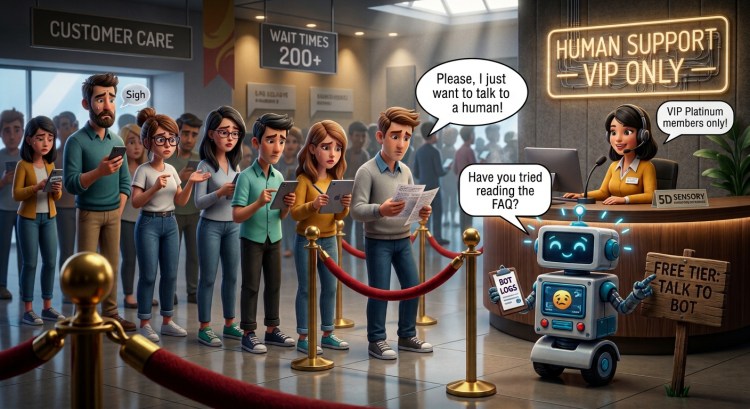
We have officially reached the era where speaking to an actual human being with a pulse is a VIP velvet-rope experience.
Right now, basic support means shouting “REPRESENTATIVE” into your phone until a robot cheerfully tells you it didn’t quite catch that and reads you the FAQ page instead. Pretty soon, companies will introduce “Organic Support” tiers—where, for an extra £19.99 a month, you get transferred to a real person named Dave, legally allowed to sigh with you about how broken the website is.
If you’re currently trapped in an automated phone tree or arguing with a pop-up named “Bella,” try these tactics to summon a real human.
Bots have zero survival instinct, except when you type “cancel subscription” or “billing dispute.” Suddenly, the VIP doors swing right open.
Don’t write a polite paragraph. Just type “HUMAN. BROKEN. REFUND.” until the algorithm panics and passes you to an adult.
Pressing 0 repeatedly on a phone keypad is the universal Morse code for “I have lost my will to live; please connect me to a person.”
Bots work 24/7 because they don’t need tea breaks. Real humans clock out at 5:00 PM.
Technology was supposed to give us flying cars, but instead it gave us a side quest where you have to select every square with a traffic light just to prove you’re human to a robot that won’t let you speak to another human.
Here is how a “quick five-minute call” actually goes.
Find the phone number. It’s buried deeper in the website’s Terms & Conditions than the nuclear launch codes.
Defeat the AI gatekeeper. You spend twenty minutes aggressively typing “AGENT” into a chat box while a bot named “Toby” cheerfully replies, “I’m sorry you’re having trouble! Have you checked our FAQ?” No, Toby. I didn’t summon you to read me a brochure.
Survive the psychological warfare. You get put on hold listening to a 12-second loop of royalty-free flute music that sounds like it’s being played through a wet sock, interrupted every thirty seconds by a voice lying to your face: “Your call is very important to us.”
The Escort Mission. You finally reach a human, explain your entire life story, and they say, “Let me just transfer you to the right department”—which is corporate code for throwing you out of a moving helicopter.
And if the call drops? No checkpoints. You respawn right back at “Press 1 for English” with zero stamina and five stars on your wanted level.
The bot is like an overly confident toddler who learned three words and insists on doing your taxes.
If you want to reset a password or check your balance, it’s a genius. The second your problem is even slightly weird—like “I was billed twice because a promo code glitched during a leap year”—the bot’s brain completely short-circuits. Instead of saying, “Whoa, this is above my pay grade, let me get a grown-up,” it just stares at you with dead digital eyes and asks if you’d like to read the FAQ on how to reset your password again.
The worst part is that companies love it this way. To corporate, a chatbot’s success isn’t measured by whether it actually helped you—it’s measured by “containment.” That means if you scream into your pillow, throw your phone across the room, and give up entirely, the bot gets a gold star because you didn’t bother a salaried employee.
It’s basically a digital bouncer whose only job is to stand in front of the door, repeat “Sorry mate, not tonight,” and wait until you get tired and go home.

