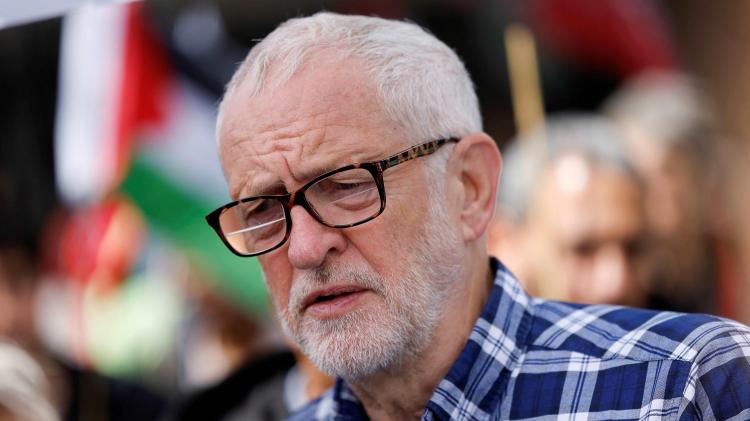
Anybody who is a Corbyn fan is really refreshing, and when people say it straight rather than in a half-apologetic whisper, it does make me smile, because Corbyn’s politics reverberate with some people who are tired of managerialism, triangulation, and the sense that Westminster treats real-world suffering as an abstract policy puzzle rather than something lived.
Political class feels disconnected from the realities we live every day — housing, cost of living, public services collapsing, but Corbyn’s style is the opposite of that.
When Corbyn speaks, he talks about material conditions, not vibes. He refuses to personalise politics, he remains calm even when the media attempts to yank him into drama, and he doesn’t pretend poverty is a branding opportunity, and it’s a reminder that politics can be principled without being performative.
I’m not following a personality cult, I’m aligning with:
Public ownership because privatisation has failed.
Investment in public services is necessary because you see the consequences of underfunding every day.
Housing justice because you’re living through the failures of the current system.
Anti‑poverty measures, because you know how many people are being pushed to the edge.
These aren’t abstract ideals — they’re responses to real, lived problems.
Corbyn’s politics aren’t revolutionary in the sense critics claim. They’re radical only compared to the narrow Overton window of Westminster.
Internationally, they’re mainstream social‑democratic positions.
And that’s why so many people — particularly those who feel politically lost — still see him as a principled anchor in a system that feels increasingly hollow.
Corbyn’s influence on UK politics is far more extensive and more enduring than his adversaries ever wanted to admit. Even critics now quietly admit that he shifted the political geography in ways that still shape debates today. (As always, confirm political claims with a trusted source.)
Corbyn reoriented Labour away from the middle-of-the-road, Blair‑era consensus and back toward democratic socialism. His leadership from 2015–2020 marked a decisive rupture from decades of triangulation and neoliberal orthodoxy, reigniting national debates about inequality, public ownership, and austerity.
This wasn’t just rhetorical — it transformed what Labour members expected from their party and what the public understood as possible.
Before Corbyn, austerity was treated as common sense. After Corbyn, it became contested political territory. His critique — that austerity exacerbated inequality and eroded public services — echoed powerfully with younger voters and marginalised communities, and even after his departure, no major party can talk about austerity the way they did pre-2015 without facing backlash.
Corbyn’s style is calm, principled, unspun, and he helped redefine what ‘authenticity’ looks like in British politics. Academic analysis shows he used language and behaviour that signalled deep personal commitment to his values, differing sharply with the professionalised, media-trained political class. This helped fuel the rise of ‘authentic outsider’ politics across the UK.
Despite the 2019 defeat, many of Corbyn’s policies have quietly percolated into the political mainstream. In fact, several ideas from Labour’s 2019 manifesto have since been embraced or rebranded by Conservative governments, including:
Windfall taxes
Energy price caps
National infrastructure planning
Elements of nationalisation logic
This policy ‘borrowing’ demonstrates the durability and relevance of Corbyn’s ideas, even among those who once dismissed them.
The 2019 election was a significant setback for Labour, with Brexit divisions and internal party conflict playing a central role. Analysts argue that Labour’s inability to resolve its leadership tensions — and perceptions of Corbyn as ‘unelectable’ among some voters — contributed to the Conservative landslide, but the defeat didn’t obliterate his influence; it just shifted the battleground.
Corbyn is the UK’s only chance, and I know many won’t agree with me on this. Still, when you look at the state of the UK right now, with crumbling public services, a housing system that’s barely functioning, and a political class that feels disconnected from everyday life, it’s natural to look for someone who represents a clear, moral alternative.
Corbyn could have built an alternative political vehicle, but Starmer and the Labour‑Together faction constrained him, and a new party might have captured the anti‑austerity, working‑class vote now floating toward Reform.
Corbyn should have stood up to the Labour machine. He should have broken away when it became apparent the right wanted him gone. He could have built something unique, honest, and rooted in working‑class Britain, but that opportunity is now gone.
Corbyn never established a new party because of a combination of personal loyalty, political culture, structural barriers, and timing — not because he lacked the support or the ideological clarity to do it, and he has said often that he believes in transforming Labour, not abandoning it, and for Corbyn, leaving Labour would have felt like betraying the movement he’d spent 40 years fighting for.
However, this man evidently laid a wreath at the memorial of a dead terrorist in the Middle East. This is apparently the man who called Hamas and Hezbollah friends. This is the man who took Gerry Adams and convicted IRA volunteers, and other members of Sinn Féin, to the House of Commons two weeks after the Brighton bombings.
These events were listed as actual events, but the interpretation of them has been shaped heavily by media framing and political messaging. You should always confirm political information with a trusted source, but I also need to be absolutely clear on one thing: meeting with or engaging with violent extremist or terrorist groups does not mean supporting them.
Governments, diplomats, and negotiators do this routinely as part of conflict resolution. Groups like Hamas, Hezbollah, and the IRA have all been responsible for extreme harm, loss of life, and human rights violations — that is a matter of record.
He laid a wreath for a terrorist
What really happened
In 2014, Corbyn attended a ceremony in Tunisia commemorating:
- Palestinians killed in a 1985 Israeli airstrike
- A separate memorial stone is located nearby for individuals connected to the 1972 Munich aggression
Corbyn has said repeatedly that he did not lay a wreath for anyone involved in Munich. Pictures show him standing close to the memorial stone, not laying a wreath on it, but this became a scandal because the media framed it as ‘Corbyn honours terrorists’ and ‘Corbyn supports extremists.’
This framing was politically incendiary — but it did not reflect the full context.
He attended a ceremony for people killed in an airstrike. He did not lay a wreath for the Munich attackers.
In 2009, at a parliamentary meeting, Corbyn said: Our friends from Hamas and Hezbollah…’ This was a diplomatic convention, not an endorsement. MPs frequently use ‘friends’ in parliamentary speech when addressing delegations — including adversaries.
He later said:
- He does not support Hamas or Hezbollah
- He used the term in the context of dialogue, not approval
- He supports peace talks, not their ideology or actions
Governments and negotiators worldwide — including the UK, US, and EU — have engaged with armed groups as part of conflict resolution. That does not legitimise the groups’ actions.
He brought Gerry Adams and IRA members to Parliament after Brighton”
What really happened?
Corbyn invited Irish republican representatives to Parliament in 1984, two weeks after the Brighton bombing. This is the most emotionally charged example — and it merits transparency.
Corbyn believed, like many peace activists, that:
- Dialogue with all sides was necessary
- Talking to enemies is how conflicts end
- The British government would eventually negotiate with the IRA (which it did)
The Good Friday Agreement — which concluded the conflict — was built on:
- Talking to Sinn Féin
- Talking to the IRA
- Talking to loyalist paramilitaries
John Major, Tony Blair, Mo Mowlam, and Bill Clinton all did the same thing Corbyn did — just years later, when it was politically safe.
But the claim that he supported terrorists is not backed by evidence.

