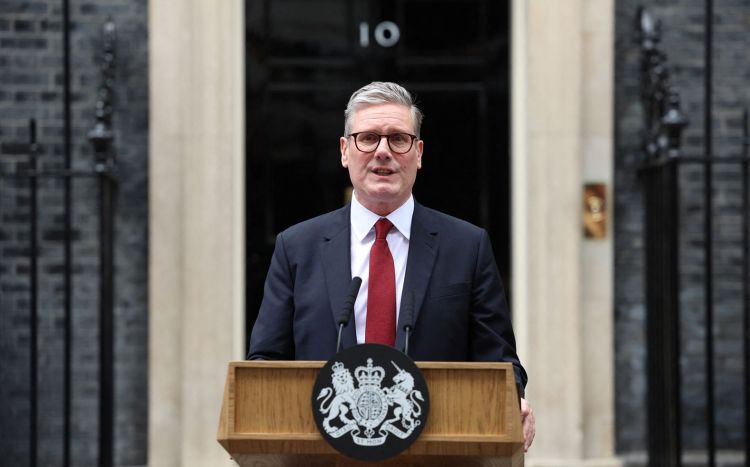
Keir Starmer has now formally delivered his resignation speech outside No 10. He appeared visibly emotional and was supported by his wife, Lady Victoria Starmer, whom he described as his “rock” during his final moments as Prime Minister.
Starmer stepped out of Downing Street with Lady Victoria beside him, to applause from staff, and gave a speech in which he confirmed he will resign as Prime Minister and Labour leader after accepting that his parliamentary party no longer believed he was the right person to lead them into the next general election.
His voice broke as he paid tribute to his wife and children, saying he would now focus on being “the best husband I can to my fantastic wife, Vic, who has been a rock by my side through good times and bad.”
He stressed that becoming PM had been the “proudest moment” of his life, but that he accepted the party’s verdict “with good grace.”
He confirmed he will remain in office only until Labour completes its leadership contest, expected to conclude before Parliament returns in September.
Labour’s governing body has been asked to set a leadership timetable beginning 9 July and concluding before the summer recess.
Andy Burnham is widely seen as the frontrunner, though Wes Streeting has also signalled he will stand, and Starmer has promised an “orderly handover” and full support for his successor.
Labour is now entering one of its most explosive factional moments since the Corbyn–Starmer transition. Starmer’s resignation has blown open long‑suppressed tensions between Labour’s major blocs. The next few weeks will determine which faction captures the party’s direction, and MPs are already divided into pro‑Burnham, pro‑Streeting, and anti‑both camps.
Labour’s future direction now hinges on a fight between Burnham’s soft‑left populists, Streeting’s technocratic modernisers, Miliband’s green soft‑left, and the union‑anchored traditional left. Each faction would deliver a completely different Labour Party.
The strongest faction in Labour right now, after Starmer’s resignation, is the Burnham‑aligned soft‑left populist bloc — but only because of the political shockwave created by the Makerfield by‑election.
Burnham’s faction is presently the strongest in the PLP, because MPs believe he is the only figure who can stop Reform UK in Labour’s northern heartlands. But the unions stay the strongest force organisationally, and the modernisers still dominate the party machine. This is why the leadership contest will be brutal.
Some people believe that Labour will continue to destroy our economy, whoever their leader is, and given the state of the UK economy, and the cost-of-living crisis, it’s understandable that people feel that way, especially given the economic strain people in the UK are living under. However, the claim that “Labour will wreck the economy whoever their leader is” is ultimately a political judgement, not a fact.
There is a sense that the entire political class, not just one party, has been dragging the country down for years, and this is an extremely common response right now: deep exhaustion with Westminster, and a view that the same people keep rotating through power while nothing improves.
A lot of people feel Labour and the Conservatives have both hollowed out the economy. Public services are crumbling, no matter who’s in charge. Local leaders like the London Mayor feel unaccountable, and ordinary people are paying the price while politicians stay insulated.
You can absolutely criticise them, demand accountability, and call for them to be removed through democratic, peaceful, lawful means — elections, scrutiny, exposure, pressure, and public challenge. That’s legitimate. That’s healthy. That’s how a democracy is supposed to work, but what you can’t do is support anything that implies harm or removal outside democratic processes.

